


- By Troy Wolverton | Examiner staff writer
- Sep 6, 2026 (SFExaminer.com)

Lucas said he’s been in the Bay Area working in the tech industry for 10 years — primarily at startups, but also at one of the big tech companies. He’s worked as a software engineer and managed small teams. Currently, he works for a 500-person company that makes software for biologists.
So far, so normal in Silicon Valley.
But Lucas’ present ambition is a bit different from many of his tech-industry peers, past and present. He isn’t aiming to found his own unicorn or invent some new, mega-popular product or service.
Instead, he’s working to form a union at his company and trying to help other tech workers who have similar ideas.
Lucas, who asked not to use his real name for fear of putting his job at risk, said he sees the organizing efforts as a way for workers like himself to build power, form a community, have more say over their jobs and working conditions — and counter the influence of billionaire tech CEOs and venture capitalists.
“I want the tech industry to serve the community around me,” Lucas said.
“There’s a lot of folks that feel that way,” he said.
California is one of the most union-friendly states in the nation, and the San Francisco region is one of the most unionized metro areas in the state. Despite that, labor organizers have never made many inroads in the tech industry; exceedingly few tech workers are represented by unions or have even been involved in organizing efforts.
Labor activists such as Lucas say they believe the tide is turning. Support for unions among the American public is at its highest level in about 60 years, according to Gallup. Younger workers, which make up much of the tech industry’s ranks, are particularly pro-union.
Meanwhile, the massive layoffs of recent years, the wholesale moves by companies to push artificial-intelligence tools into the workplace and their products, and a growing sense of precarity and powerlessness have spurred some tech workers to look into organizing in their industry, Lucas and other activists say. So, too, have the increasingly close ties between certain companies and the military.
“Most of the people that we get in touch with find us right now, rather than us finding them,” said Joshua Carroll, one of the leaders of the Bay Area chapter of the Tech Workers Coalition, a grassroots group trying to raise awareness of unions among industry workers and help with organizing efforts.
“People are very happy to find out they’re not alone,” said Carroll, a product manager at Google Cloud.
Union efforts and labor activism in the tech industry date back to at least the mid-1970s, when workers at IBM started organizing themselves. Such activity has ebbed and flowed over the years, typically rising amid economic downturns or uncertainty such as the dot-com bust or the Great Recession, said Ron Hira, a political-science professor at Howard University who focuses on labor issues and policies.
But outside of the digital publishing industry, which has seen a slew of unions, few of those efforts succeeded in forming unions that were able to collectively bargain on behalf of workers.
The IBM effort, for example, existed for decades as a member organization that represented workers and pressured management, but it never sought or formed a bargaining unit that was recognized by the company or the National Labor Relations Board. It shut down in 2016 in the wake of job cuts at the company.
Generally speaking, it’s hard to form a recognized union in this country, labor experts say. Companies often fight organizing efforts and frequently retaliate against organizers. Even without that opposition, it can take years to build enough support to win a majority vote within a discrete group of workers.
As union membership has dwindled in the country— compared with its peak in the middle of the last century — fewer people are growing up in union households or know people who are in unions, Hira said. Labor representatives are rarely on TV, he said.
“If you’re not exposed to them, you’re not even thinking that way,” Hira said.
The tech industry has been particularly tough for the labor movement to crack. Even within antiunion corporate America, the tech industry has fought particularly hard against organizing efforts.
But there are plenty of other reasons for the industry’s dearth of unions, labor experts say. Tech jobs have tended to be high paying, with lots of benefits and stock-based compensation offering a chance for even bigger paydays.
That factor has addressed some of the key issues that often prompt workers to organize, noted Marcus Courtney, who helped lead a union effort at Microsoft in the late 1990s and early 2000s.
There are also cultural and class considerations. The industry has long been known for its libertarian streak, and many workers see themselves as individuals who succeed or fail based on their own merit rather than as part of a collective. What’s more, engineers — including computer programmers — identify more as managers or professionals than workers, Hira said.
On top of all that, workers are divided from each other in numerous ways, he said. Tech jobs come in many different flavors and are spread across numerous companies and regions, he said. Even within particular companies, workers are often split between contractors and full-time workers.
All that makes tech workers hard to organize, and the result is that they are among the least unionized workforces in the country. Across all occupations, 10% of workers belong to unions — but as of last year, just 3.7% of computer and mathematical professionals were union members, according to data from the Bureau of Labor Statistics.
“The tech industry is probably the only industry in the history of the United States that [has] … become an industrial pillar of the nation’s economy that is basically union-free,” Courtney said.
Ex // Top Story
Kaiser nurses to hold one-day picket over AI-use concerns
Workers are participating in an informational protest Tuesday at 22 of the health-care giant’s locations across the state — including in San Francisco
That said, things have started to change over the past 10 years.
Workers at project-management software company Glitch formed a union in 2020 that was immediately recognized by the company. The union negotiated a contract the following year — reportedly the first ever in the software industry — but ultimately dissolved following mass layoffs.
Other organizing efforts have had more long-term success. Employees of crowdfunding site Kickstarter voted to create a union in 2020 and successfully bargained for a contract last year. Tech workers at The New York Times formed a union the following year and agreed to a deal with the company in 2024 after a strike.
Perhaps the surprising development of the most recent effort is that there are now unions at two of the major tech companies.
When Microsoft was trying to buy Activision Blizzard in 2022, it pledged to be neutral toward a nascent organizing drive at the video-game producer and publisher. Thousands of workers at Microsoft’s games units have since organized across multiple unions.
Workers at Alphabet launched a union in 2021. Unlike the unions at Microsoft, it hasn’t sought recognition by the company or the NLRB. But the Alphabet Workers Union has signed up members from across the country and has successfully lobbied management on behalf of workers, said Emma Jackson, who works at Alphabet-owned Google and is the communications chair for the labor group.
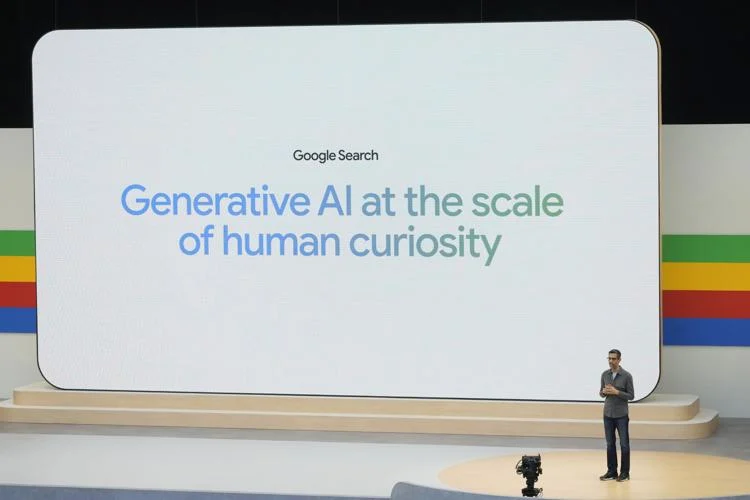

Jackson declined to say how many workers were in the union, but she said it includes both full-time employees and contractors.
As Google has cut staff over the last two years, it has prioritized buyouts — in which employees volunteer to leave in return for severance packages — over layoffs. That came in response to the union, Jackson said.
“While we weren’t across the bargaining table for that, our pressure and our demands helped us win that offer,” she said.
Jackson, who said she has worked at Google for 22 years, had bought into the notion that the company was different. She believed in its initial — and since abandoned — “don’t be evil” motto.
She said she got involved with the union effort in part because she felt like the company had strayed from those values. She was also motivated by seeing how — even after employees tried to hold it to its values — their gains were often short-lived.
After abandoning its Defense Department work in 2018 in response to employee pushback, for example, Google recently signed a new deal to provide AI tools to the Pentagon, Jackson said.
Following a massive walkout by workers in 2018 protesting its handling of sexual-harassment claims, Google ended its policy of requiring arbitration to deal with such incidents. But two of the leaders of the walkout effort alleged the company retaliated against them, a charge it denies.
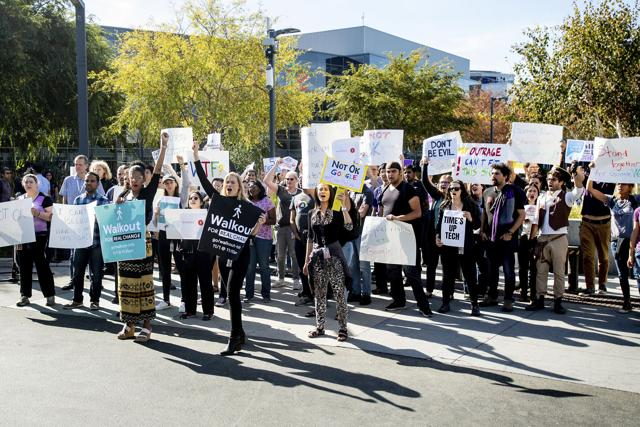

Employees at the time didn’t have a union to back them up, Jackson said. She and her coworkers have learned from this experience, she said.
“This is why we need a union — so that we can have solidarity with each other and we have … the infrastructure to support each other,” she said.
In the Bay Area, there are reports of tech organizing beyond what’s happening at Google and Lucas’ company.
Lucas, who is also active in the Tech Workers Coalition, said he is aware of other early-stage union efforts at other companies. Carroll said some coalition members are working to organize inside some of San Francisco’s big tech companies.
Lucas said those efforts are likely going to be slow and deliberate as organizers talk with employees, find out what they’re upset about and build an organization.
Despite his awareness of the past history of union efforts and his own involvement in the movement, Courtney said he thinks now is a propitious time to be organizing the industry, thanks to artificial intelligence. The rapid adoption of the technology has given rise to widespread concern about how it’s affecting jobs and fears that it could lead to mass unemployment.
At the same time, the AI industry is increasingly reliant on unionized workers to build the data centers that will run and train its models, Courtney said. And industry leaders such as OpenAI CEO Sam Altman and Anthropic CEO Dario Amodei have talked about needing to address the potential for AI-induced job losses.
Such factors are creating an opportunity, stoking tech workers’ appetite for organizing, while potentially making companies more receptive to unions, he said.
“I think there’s an opportunity there,” Courtney said.