


- By Troy Wolverton | Examiner staff writer
- Sep 9, 2026 (SFExaminer.com)
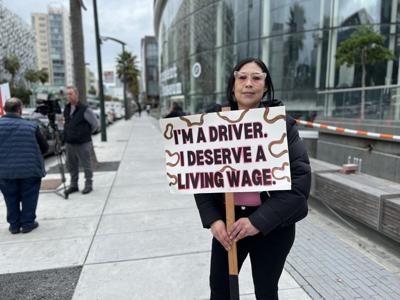
It’s official: Uber and Lyft drivers have formed a union.
Now comes what might be the harder part: negotiating a first contract with the San Francisco-based ride-hailing companies.
On Wednesday, the state Public Employment Relations Board certified the California Gig Workers Union — which is backed by the powerful Service Employees International Union — as drivers’ official bargaining organization.
As such, the union will be able to negotiate on their behalf on a sectoral basis, meaning it will be empowered to bargain with Uber and Lyft at the same time for a contract that will apply to drivers who work for either company or both.
Joseph Augusto, a San Francisco resident who drives for Uber and Lyft, said he’s been working with the SEIU to form a drivers union for six years. He said he was amazed at how quickly the process happened after a new law authorizing driver unionization — Assembly Bill 1340 — took effect at the beginning of the year.
The effort to form a union “took a lot of work, but there’s a lot of incentive by the drivers,” Augusto said.
“There’s a lot of motivation … they’re not too happy with Uber,” he said. “And so today is a big day.”
In a statement, Ramona Prieto, Uber’s head of public policy and communications for the western U.S., acknowledged PERB’s move as part of the process set up by the new law.
“PERB’s certification is the next step in delivering on AB 1340, a historic compromise that gives drivers a pathway to representation while preserving the independence and flexibility they’ve consistently said they value most,” Prieto said.
In a separate statement, Lyft spokesman CJ Macklin said the company would negotiate in good faith with the union.
“Lyft does well when drivers do well, and we’ll stay focused on helping drivers succeed while keeping rideshare affordable and dependable for everyone who counts on it,” he said.
PERB’s certification of CGWU was expected. The agency determined last month that the union had shown that it had the support of 30% of active drivers — defined as those who, among all ride-hail drivers in the state, had given at least the median number of rides during the most recent six-month period.
Following that determination, CGWU was set to become the certified bargaining unit unless a group representing at least 30% of active drivers who opposed unionization came forward and demanded a vote within 30 days.
No such group stepped forward during that window, PERB said in its certification document.
CGWU will represent not only the state’s 100,307 active drivers, but everyone who drives for Uber and Lyft, which account for 99.2% of all ride-hail rides in California, according to PERB data. It’s unclear exactly how many drivers that is.
In the first six months of the year, a combined total of 200,533 drivers for Uber and Lyft gave at least 20 rides, according to Joseph Eckhart, PERB’s acting general counsel. The companies weren’t required to disclose to the agency how many drivers gave fewer rides than that during the period.
Including those drivers, SEIU estimates CGWU will represent about 300,000 to 350,000 drivers total, said Cecille Isidro, the union’s spokeswoman. Those numbers would likely make the organization one of the largest unions in the state.
Under AB 1340, the union can now request to begin negotiations. CGWU expects negotiations to start by the end of the year, Augusto said.
But first, he said, the union plans to survey and hold meetings with drivers to understand their chief grievances and what the organization should prioritize in negotiations. CGWU also plans to train negotiators, he said.
While the union still has to do that research, Augusto said, he has a sense about what drivers are going to demand from talking with them.
Top of the list is likely to be increased pay and an end to algorithmic pricing, through which the companies determine the fares customers pay and the remuneration drivers receive based on what Uber and Lyft know about each.
Drivers have complained that since the companies adopted algorithmic pricing several years ago, their pay has plunged.
A study from the UC Berkeley Labor Center two years ago found that, when taking into account mileage expenses, waiting time and the cost of benefits they’d get if they were actual employees from the companies, drivers made about $7.63 per hour. At the time of the report, San Francisco’s minimum wage was $16.32 per hour.
For his part, Augusto said, he’d like to see a return to a rate-card system, in which all drivers are paid the same amount per mile and per minute of driving, to account for their investments in their cars and their time.
In addition to pay, another likely demand in negotiations will be that the companies provide a better system for drivers to challenge deactivations, he said.
Drivers have charged that when Uber and Lyft deactivate them — making it so they can no longer use their apps to drive for pay — they often are given little to no explanation and have no way to appeal the decision to a human being. Instead, their challenges are typically handled by automated systems.
Earlier this year, the advocacy group Rideshare Drivers United sued Uber, alleging that the company’s deactivation appeals process didn’t meet the requirements of Proposition 22, a law passed by voters in 2020.
That law designates drivers as independent contractors, rather than employees of Uber and Lyft, if the companies meet certain obligations — including having appeals processes for terminations.
In its lawsuit, RDU argues that because Uber doesn’t offer a “bona fide” appeals process, the company shouldn’t be able to treat drivers as independent contractors.
Pay and deactivations “are the two priorities we’re going to fix,” Augusto said.
Even though the legislation requires both sides to bargain in good faith, those negotiations — once they begin — could take well over a year or more to reach a final agreement under the timeline laid out within it.
The law gives the two sides 210 days to reach an agreement before one or the other can ask PERB to refer them to a mediator. It then allows them up to 22 days to agree on a mediator. After that, the legislation provides them up to 75 days to reach an agreement through mediation.
If they can’t strike a deal, either side can next request that PERB refer them to an arbitrator. The arbitrator has up to 105 days after that to meet with the parties and issue a recommended settlement.
Twenty days later, if the companies haven’t accepted the arbitrator’s recommended deal and the two sides haven’t reached an agreement on their own, the union can ask PERB to approve the deal unilaterally.
PERB’s general counsel has 60 days from then to review the settlement and make his own recommendation to the agency’s board. The board has up to 21 days after getting the recommendation to approve or disapprove the settlement.
If you have a tip about tech, startups or the venture industry, contact Troy Wolverton at twolverton@sfexaminer.com or via text or Signal at (415) 515-5594.