A general view of the University of California Berkeley campus including Sather Tower, also known as The Campanile. (Photo by David Madison/Getty Images)
UC Berkeley is at risk of losing funding unless they provide information related to any potential “foreign collaborations” to the Trump administration’s Department of War by the end of August. Cal is one of 30 universities currently subject to this threat.
The demand from the Department of War was issued earlier this week and specifies the need for universities to complete a “comprehensive audit” by the end of the month or risk losing their access to federal funds, per the Chronicle.
The institutions subject to this threat also include UCLA and UC San Diego. This probe marks the latest in a long series of investigations initiated by the Trump administration against some of the nation’s most elite universities.
Citing concern that these colleges are in cahoots with foreign powers and not doing enough to combat anti-semitism, among other allegations, the quantity of investigations levied at these institutions has reached a point where they’ve now begun to repeat themselves.
The Chronicle notes that only last year, the US Department of Education launched a probe concerning alleged incidents of “improper handling of foreign funding” aimed at both Harvard and UC Berkeley.
Dan Mogulof, a spokesperson for UC Berkeley, has confirmed the campus has received notice of the audit and noted that “so far” no findings of foreign ties related to last year’s Department of Education investigation have been uncovered.
As the Guardian reports, other universities subject to this latest probe include the University of Southern California, Harvard, MIT, Duke, and New York University.
In a statement issued earlier this week, the Pentagon’s Chief Technology Officer, Emil Michael, noted simply that “the Department of War has zero tolerance for academic partnerships that compromise our national security.”
This order follows a release last month in which the Pentagon identified 130 foreign universities and research institutions alleged to be engaging in conduct that could put funds for domestic research and development at risk of misappropriation.
The seven demonstrators who were found guilty last month of multiple misdemeanors over their 2024 pro-Palestine protest on the Golden Gate Bridge have been sentenced to 30 days in jail. The sentence includes credit for time served and six months of probation. [Chronicle]
Court papers reveal that the Department of Homeland Security’s covert surveillance of anti-ICE groups is much darker than it first appeared. Welcome to Donald Trump’s America.
It’s time to familiarize yourselves with the names “Operation Puppet Master” and “Operation Keyhole.” If those nefarious phrases evoke to you the U.S. government’s domestic spying on leftist groups in the 1960s and 1970s, it’s for good reason. The terms are coinages of today’s Department of Homeland Security, and they’re associated with a massive covert surveillance effort that DHS unleashed earlier this year to track anti-Immigration and Customs Enforcement protests in Minneapolis, where Donald Trump’s violent paramilitary invasion triggered months of intense civil conflict.
We just learned about the broad outlines of this domestic surveillance from newly released court papers related to the ongoing prosecution of a handful of protesters. As The New York Timesreported, the papers show that DHS began surveilling left-leaning groups—including a union, a climate change group, and others—after ICE killed Alex Pretti in January. This has entailed seeking financial records and infiltrating protest meetings that are protected by the First Amendment.
But you can get a far more vivid picture of these undercover surveillance operations—and how brazenly they were conducted against American citizens—if you read deep into the court papers. The documents—which are attached as exhibits to a motion filed by lawyers for one of the protesters facing prosecution and are available on Pacer—include investigative reports that were transmitted by the undercover agents themselves about meetings they infiltrated.
It’s jarring, revealing stuff. The reports show that covert agents surreptitiously attended well over a dozen protest meetings organized by groups like the Sunrise Movement and various small socialist organizations. In some cases the agents secretly recorded the gatherings.
What’s more, in at least one case, an undercover agent may have tried to influence the conduct of meeting organizers. One report from an agent describes a meeting in late January of the Sunrise Movement at a Minneapolis public library. While spying on the proceedings, the agent seems to have learned that the organization’s intention was nonviolent: As the agent notes in his own investigative report, “it was made clear” at the meeting that the organization is “focused on peaceful protests.”
Yet after this discovery, the agent then approached a meeting organizer and made a surprising proposition. The agent told the organizer “he works in construction” and is willing to build things to assist “with more direct action protests,” the report reads, adding that the agent stressed “that going to jail did not bother him.”
That sounds like the agent may have signaled a willingness to engage in something illegal, to bait the group into moving in that direction, argues Kevin Riach, the lawyer for one of the protesters who is being prosecuted, Isaac Sant.
“This is an effort to entice someone who’s shown no inclination to commit a crime into committing one,” Riach told me. “What this tells us is that there wasn’t actual criminal activity to be investigated. They had to invent it. That’s not how this is supposed to work—not in this country, anyway.”
In other cases, undercover agents infiltrated these meetings only to find that the protesters turned out to be awfully innocuous. One agent covertly attended a meeting in February and found that it “was more of a panel discussion,” where there was “no discussion, or call for, violence toward law enforcement.”
Similarly, another agent’s report described infiltrating a meeting in Ann Arbor, Michigan, of organizers who said they sympathized with the Minneapolis anti-ICE resistance. (The papers show that DHS’s surveillance reached into other states beyond Minnesota.) This agent reported initiating a conversation with a married churchgoing couple, and the woman told the agent she’d traveled to Uganda to assist “in the construction of a hospital.”
In short, we’re not exactly talking about the Weather Underground bombers here.
Indeed, as Substacker Brian Kaylor notes, a number of these undercover operations were even conducted in churches where protesters had organized. Several of the pastors were kept entirely in the dark about law enforcement’s infiltration of their houses of worship.
The absurdity of all this is overwhelming. In some cases, the Keystone Kops vibe is strong: One agent attended a May meeting in Minneapolis, only to report that his “concealed body-worn audio recorder erroneously fell to the floor of the gymnasium.” The agent left without the device and had to return later to retrieve it.
Interestingly, the investigative reports also offer a glimpse of culture clashes between protesters and the agents who spied on them. One agent attended a Minneapolis meeting in February and reported, perhaps with distaste, on a female protester “with they/them pronouns” and “bright green short hair” and a “nose ring.”
As writer John Ganz hasnoted, Trump’s secret police force is made up of the MAGA “demimonde” and the “Trumpenproletarian mob.” And indeed, Trump’s political project has long been all about turning loose “his” people—law enforcement, biker gangs, coal miners, Ultimate Fighting enthusiasts—against the leftist enemy that inhabits blue America. The centrality of violence to all this is not disguised in the least. ICE recruitment targets MAGA-adjacent UFC fanbases and people who show an interest in paramilitary tactical equipment or military recruitment. ICE messaging openly glorifies military-style operations in urban areas—that is, in blue America’s diverse, cosmopolitan strongholds. Trump talks about Minneapolis as akin to an enemy country populated with undesirables who must be purged by MAGA patriots.
Now we’re learning that this war on blue America also includes extensive undercover surveillance. Many of these agents appear to have been drawn largely from Homeland Security Investigations, the arm of ICE that’s supposed to be focused on serious, complex, transnational crimes. They’ve now been reduced to standing around in parking lots writing down protesters’ license plate numbers and using sleazy deception tactics to spy on fellow Americans whose only crime is sympathy with immigrants.
Violence is precisely what spawned this undercover spying operation, but the real culprit was the violence of the government, not of the protesters. As Lisa Needham writes at Public Notice, we shouldn’t lose sight of how quickly ICE’s invasion of Minneapolis devolved into lethal state violence against Americans. It was just after ICE’s arrival in the city that an agent gunned down Renee Good in her car, with Pretti’s killing by federal agents following around two weeks later.
The outpouring of public protest in the face of this invasion apparently helped prompt DHS to launch its massive undercover surveillance operation directed at Americans, on the theory that the protests were being organized by larger, more sinister forces. The government dubbed this “Operation Puppet Master.”
But it’s unclear what all this surreptitious spying is even turning up. The Timesnotes that none of the groups targeted by it have been charged. And while the surveillance supposedly helped produce that aforementioned indictment of a handful of protesters, in reality the spying has swept far, far beyond those targets. The main result has been a discovery process that has now exposed the depth and breadth of the government’s massive spying operation for all to see.
There’s one other big unknown here. The document declaring the opening of Operation Puppet Master contains another vague reference: It says this effort has also been sanctioned under something called “Operation Keyhole.” Yet it’s unclear what this even is. As Kevin Riach, the lawyer, told me: “This suggests there’s some broader surveillance operation underway that we have yet to learn about.”
When I asked DHS what the phrase “Operation Keyhole” describes, the agency declined to comment.
Trump’s mass deportations have become akin to a Forever War. The expansion of ICE has poured tens of billions of dollars into the growth of Trump’s very own paramilitary army. This has included the stockpiling of enormous amounts of heavy military-style tactical equipment and weaponry, furnished by private contractors who resemble war profiteers.
And so, just as we saw under George W. Bush’s Forever Wars, we’re witnessing the growth of a massive public-private bureaucracy that’s metastasizing in unnerving new directions. It now appears to entail extensive domestic surveillance operations as well. We’ve only just begun to scratch the surface of it all. As always seems to happen with Forever Wars, we may never even learn all that much about many of the darkest atrocities perpetrated in its name.
Greg Sargent is a staff writer at The New Republic and the host of the podcast The Daily Blast. A seasoned political commentator with over two decades of experience, he was a prominent columnist and blogger at The Washington Post from 2010 to 2023 and has worked at Talking Points Memo, New York magazine, and the New York Observer. Greg is also the author of the critically acclaimedbook An Uncivil War: Taking Back Our Democracy in an Age of Disinformation and Thunderdome Politics.
Elected officials across the country are fighting the federal government’s mass deportation campaign with new laws and funding. But some states are welcoming the shock troops.
Graphic by The American Prospect. Sources: Neil Constantine/NurPhoto via AP Photo; Erin Hooley/AP Photo.
This article was featured in the Daily Prospect newsletter. Sign up for it here.
MANHATTAN – Standing with Attorney General Letitia James, New York City Mayor Zohran Mamdani, and a phalanx of local elected and community leaders last week, New York Gov. Kathy Hochul put the Trump administration and their collaborators on notice that the state would not stand for Immigration and Customs Enforcement agents snatching residents and abusing children.
Hochul announced $7.25 million in new legal aid funding for the 1,400 unaccompanied immigrant children across New York, 251 of whom are in detention. That money comes on top of the $16.9 million New York City’s latest budget allocated for the same purpose, and its $30 million increase to overall immigration legal services, which now total $150 million.
She reminded law enforcement officials that they had until August 25 to end their 287(g) collaboration deals with ICE, said failing to do so would result in legal action, and name-checked Nassau County Executive Bruce Blakeman, whose agreement with the agency is among the most extreme in the country. Hochul banned 287(g) agreements—deals that deputize local law enforcement agencies to conduct federal immigration enforcement—earlier this year under the Local Cops, Local Crimes Act. Five law enforcement agencies have refused to respond to James’s demand that agencies obey Hochul and send her their plan to exit the arrangements. On the contrary, more local police departments are signing the deals, while at the same time stockpiling more small arms, as the Prospectreported last month.
“My message is I expect [Blakeman] and everybody else in this state to follow the laws of New York and there are consequences if you do not,” she said and told the room of reporters she expected the media to call out his mischaracterization that her ban on 287(g) agreements means permission for crimes. “Someone like that will intentionally misrepresent, which is a nice way of saying ‘lie’ about what we’re actually talking about.”
“There’s only so much we can control of the federal government. But we can control how businesses in our state operate.”California state assemblymember Matt Haney
Apart from the police departments planning to operate illegal agreements, New York’s new laws and funding put it on one side of a new American divide. There are states that are actively fighting President Trump’s ethnic cleansing campaign. And there are ones that welcome it.
Multiple states are in the first category: Since Trump retook the White House, lawmakers in that group have increased not only their anti-ICE laws but “their ambition in exercising local power,” as the National Immigration Law Center put it last month. According to its tally, California, Connecticut, Delaware, Hawaii, Illinois, Maine, Maryland, Massachusetts, New Mexico, New Jersey, New York, Oregon, Rhode Island, Virginia, and Washington have all enacted new legislation to fight ICE during Trump’s second term, including limiting collaboration between local cops and immigration enforcement, banning immigration officers from hiding their identities or going to sensitive locations, and protecting residents’ data.
States on the other side believe it is both moral and financially responsible to use local resources to help federal agents terrorize immigrants. Florida is on that side. The state holds more 287(g) agreements than any other; all 67 counties have 287(g) agreements as of last year and the “vast majority” of immigration enforcement is conducted by the local and state cops those agreements have deputized, according to the ACLU. That includes the Florida Highway Patrol, whose officers are detaining immigrants on highways and city streets during routine traffic stops. Earlier this summer, the state’s Board of Immigration Enforcement gave the Walton County Sheriff’s Office $9 million in grants for serving as an ICE holding facility.
Florida also requires by law that local police departments comply with ICE detainer requests. Under such a request, also called ICE holds or immigration detainers, the agency asks local law enforcement to keep in custody someone they would otherwise release so that agents can more easily deport them. There’s no nationwide law requiring cops to cooperate, but like Florida, officials in Arkansas, Georgia, Louisiana, North Carolina, Tennessee, and Texas have all passed laws forcing law enforcement to do so, according to the Brennan Center for Justice’s State Court Report.
The Prospect in your inbox
Analysis that goes beyond the noise with in-depth, progressive reporting.Sign up
No paywall, no programmatic ads — just the reporting. Unsubscribe anytime. Submitting your email signs you up for The Daily Prospect, Today on TAP, Aftermath, and Weekend Reads.
Alabama is another state doing the federal officials’ work for them. Alabama’s Department of Corrections and six local police departments are among the agencies in that state to ink new 287(g) agreements as of the end of last month.
IN NEW YORK, HOCHUL ARGUED against allowing a federal agency that’s already better funded than most militaries in the world to soak up even more money by engrossing the funding of local law enforcement. Alongside her, Mamdani repeated information about immigration support services, including the Immigration Legal Support Hotline, whose number he read out: 1-800-354-0365.
States on New York’s side are likewise putting more money into legal aid for unaccompanied immigrant children after Trump refused to renew a contract for a coalition of aid organizations nationwide, then assigned the job to disgraced anti-sex-trafficking organization Our Rescue for $244 million, though it has no experience doing that work, as the Prospectreported.
Next door in New Jersey, Gov. Mikie Sherrill announced earlier this summer a $12 million increase in funding for the Detention Deportation Defense Initiative, raising the total to more than $20 million, and established the Rapid Legal Response Initiative to increase the state’s ability to file habeas corpus petitions to protect people from ICE moving them out of the state.
New Jersey is home to the ICE detention camp Delaney Hall, run by GEO Group, where at least three people have died since December. Rep. Analilia Mejia (D-NJ) and other members of the state delegation are also working to track the true number of deaths inside, after ICE changed its policy in June to only report the deaths of people in detention custody. Doing so allows them to transfer custody of immigrants shortly before they die from catastrophic medical emergencies. They did so recently to 29-year-old Prisciliano Trejo Ricano, who died from leukemia shortly after ICE released him from Stewart Detention Center in Georgia, and Jose Chajon-Raxon, who died shortly after ICE released him from Delaney Hall. Mejia told the Prospect that she and other state electeds are working with families and local aid and faith organizations to keep track of who else is injured and at risk inside the camp.
Some states are coming at the problem in new ways, trying strategies that haven’t yet been attempted. Across the country in California, for example, a pair of proposed state laws would impose stiff new taxes on CoreCivic, GEO Group, and any other corporate detention profiteers. Under Assembly Bill 1633, such corporations would be subject to a new Private Detention Facility Tax of 50 percent of gross receipts and send the money into a new Due Process for All Fund to pay for legal aid and other immigration services. And under Assembly Bill 2465, the companies would be disqualified from receiving state benefits, such as grants and tax credits.
“There’s only so much we can control of the federal government. But we can control how businesses in our state operate,” Democratic California state assemblymember Matt Haney said Friday at a press conference outside Adelanto ICE Processing Center, where four people have died since Trump retook the White House.
“If private detention companies insist on making incarceration their business, California should make accountability, transparency part of the cost of doing business,” he said, adding, “If they look at this tax and say it’s too much for us to operate in California, well then bye.”
Speaking to the Prospect ahead of the press conference, California assemblymember Liz Ortega said that the laws aren’t going to shut down the detention camps, but they are going to put a price on collaborating with Trump’s terror campaign. Corporate profit-seeking is what’s driving the torturous conditions in Adelanto, where people inside are reporting squalid conditions, including “worm-like creatures” in the drinking water, and medical neglect, such as journalist Carlitos Ricardo Parias’s untreated gunshot wound, which after 300 days inside has caused his arm to turn purple.
“We’ve been told over and over by the federal government that this is their domain and therefore states can’t do anything legally, so this is a different approach,” Ortega said, who added that her ask of other state lawmakers is to find ways to fight back, too.
“We can’t just work on this issue when we see this news,” she said. “This is something we have to continue to work on until this administration recognizes that what they’re doing is terrible, it’s unprecedented and it’s wrong.”
Why the Prospect Deserves To Exist
We do things differently at the Prospect. We haven’t put up a paywall—we’re free for all readers regardless of their ability to pay—and we don’t run programmatic advertising.
Why? We believe that quality journalism should be available to everyone, even if they cannot afford a monthly subscription.
Everything we’re doing now and in the future at the Prospect centers around you, our readers. From the stories we write to the business model we use, we place you at the center of all our decision making.
To stay true to our values, we need you to support us. If you believe in our journalism and our independence, make a donation today.
Whitney Curry Wimbish is a staff writer at The American Prospect. She previously worked in the Financial Times newsletters division, The Cambodia Daily in Phnom Penh, and the Herald News in New Jersey. Her work has been published in multiple outlets, including The New York Times, The Baffler, Los Angeles Review of Books, Music & Literature, North American Review, Sentient, Semafor, and elsewhere. She is a coauthor of The Majority Report’s daily newsletter and publishes short fiction in a range of literary magazines. She can be reached on Signal at wwimbish.07. More by Whitney Curry Wimbish
Robert Reich and Inequality Media Premiered Aug 13, 2026 In early 2026, a team of filmmakers, including former Sec. of Labor Robert Reich, wondered what it would be like to invite 30- and 80-year-olds to gather in conversation about America. The idea was to visit six states in six months, convening a wide variety of mostly strangers to play a simple game:
Pull up a chair
Ask each other questions
Take the time to listen
THE WORK IN PROGRESS captures candid discussions about America’s ever-evolving democracy, identity, definitions of community, and where we go from here — alongside portraits of Americans at work. Watch the trailer for THE WORK IN PROGRESS, in theaters September 4. And make sure to sign up for updates about the film, including where it’s playing, future live watchalongs, and how to order the deck of conversation cards used in the movie: https://www.theworkinprogressfilm.com/
Demonstrators march during the nationwide “Stop ICE Terror” rally through downtown Minneapolis, Minnesota, on January 20, 2026 in protest against US President Donald Trump’s policies. Photo by ROBERTO SCHMIDT / AFP via Getty Images
This story originally appeared in Workday Magazine on Aug. 21, 2026. It is shared here with permission.
On Tuesday morning, a coalition of leaders and members from labor, community, and faith organizations in Minnesota denounced Operation Puppet Master, an alleged campaign by the Department of Homeland Security (DHS) to spy on Minnesotans during Operation Metro Surge earlier this year. In a press conference held outside of Target’s headquarters in downtown Minneapolis, the coalition urged Minnesotans to continue standing in solidarity with one another, and demanded companies headquartered in the state sign the business for democracy pledge.
The call comes after the New York Times published a report on August 13 about the campaign by DHS. Details were made public in a motion for discovery filed by Kevin Riach, an attorney for healthcare worker Isaac Sant. According to the motion, federal agents “surreptitiously recorded dozens of conversations with ordinary people who were simply exercising their First Amendment right to protest ICE’s lawless rampage in our state. The agents gathered information about Minnesotans from law enforcement databases and internet searches, and created dossiers that are apparently now available agency-wide.”
The documents describe surveillance and infiltration of union and community meetings during and before Operation Metro Surge. Eighteen organizations, including labor unions, were listed in a chart connecting them to Direct Action Minnesota (DAMN), a group of individuals who resisted what coalition members call a “terror campaign” by Immigration and Customs Enforcement (ICE) during Operation Metro Surge. Sant is one of 15 individuals who were indicted and charged by the federal government for conspiracy in what organizers have called an act of political repression and retaliation. More than half of the 15 are rank-and-file union members, and now the federal government is claiming labor organizations to be part of the alleged conspiracy. The motion continues: “With no evidence, the government alleged to the grand jury that this conspiracy in this case extends far beyond the defendants to include the AFL-CIO, the Minneapolis Federation of Educators, the Minnesota Association of Professional Employees, Monarca, Veterans for Peace, and the Grease Pit bicycle repair shop, among others.”
In addition to the AFL-CIO, Minneapolis Federation of Educators (MFE) Local 59, and Minnesota Association of Professional Employees (MAPE), SEIU Local 26 is also named by DHS along with the Workers Solidarity Circle and Black Cat Workers Collective. The motion also states that Homeland Security Investigations subpoenaed financial records for several labor unions, including SEIU locals in Minnesota and the Communication Workers of America (CWA).
Alec Stewart is a MAPE union member and one of the Minnesota 15. “The revelation of Operation Puppet Master exposes that while the government was targeting immigrant communities, tearing families apart, abducting children and murdering folks in the street, they were also attempting to disrupt and dismantle one of the facets of Minnesota that makes us so unique, and that is our strong and unified labor movement,” he said at the press conference.
Treasure Thoreson is a teacher, executive board member at MFE Local 59, and one of the Minnesota 15. Thoreson spoke at the press conference about the food drives, fundraisers, grocery deliveries, and support that educators gave to their community all while continuing to show up to schools to educate students. “The government feels so threatened by our ability to come together and use our protected First Amendment rights, our legal rights as unionists that they feel they must surveil and disrupt. However, that to me is a signal that what we are doing is effective, impactful, and powerful,” she said. According to Thoreson, a GoFundMe that she donated to was flagged by DHS as evidence that she is part of a conspiracy.
GET FEARLESS, AD-FREE, UNCOMPROMISING REAL NEWS IN YOUR INBOXSign up
Gabriel Van de Water is a community organizer and artist who is one of the Minnesota 15. Van de Water referred to a report by Human Rights Watch detailing the human rights abuses that happened under Operation Metro Surge. “Human Rights Watch referred to the occupation as a manufactured crisis. This administration has chosen to follow up that crisis with a manufactured conspiracy,” said Van de Water. “The Minnesota 15 case and others like it must be understood as an attempt to criminalize dissent, to make an example out of some of us so that all of us hesitate to exercise our rights to protect one another. We will not allow this to happen.”
Kieran Knutson is president of CWA Local 7250, which was also named in the document. “We are more determined than ever to stand up to our repressive government. We are more determined than ever to stand in solidarity with working class people,” he said. “The Minnesota 15 are some of the finest people I know. These are our people, we have their backs. We know that this prosecution against them is a bogus attack on the entire movement.”
Emilia Gonzalez Avalos, the executive director of Unidos MN, a grassroots social justice organization, spoke about the surveillance and infiltration enacted by the federal government on community members and noted the silence of corporations like Target. “They sat in our libraries, in training rooms, and wrote down what we thought about the Constitution. They took down license plates outside a church in Roseville, and built files of the families inside, their addresses, children, and where they work. Federal agents walked into a Target store in Richfield and detained two citizens who were at work,” said Gonzalez Avalos. “To this day, Target has said nothing about it. We came here today because that silence still has answers available.”
Target has been the center of national boycott campaigns for rolling back its diversity, equity, and inclusion commitments, and now this Minnesota coalition is demanding that the corporation meet with coalition members before early voting begins on September 15. Best Buy, 3M, and Cargill were also named by the coalition as corporations that are being urged to sign the pledge.
There is also a labor-endorsed call to boycott Target during the back-to-school season. President of MFE Local 59 Marcia Howard highlighted this call by the American Federation of Teachers that was supported by the national AFL-CIO, which passed a resolution supporting the boycott at its constitutional convention held in Minneapolis in June.
“Educators spend eight billion dollars on back to school supplies,” said Howard. “Between AFT calling for a boycott and AFL-CIO extending that boycott, the only thing that this corporation needs to do is make good. Make good for Alex Pretti, for Renee Good. For all of us who have been in the streets, for our students, for each other.”
Target made $5.1 billion in profits in 2025, and its chair and former CEO Brian Cornell pulled in over $21 million.
Minnesota AFL-CIO president Bernie Burnham speaks in front of Target’s headquarters in downtown Minneapolis. The AFL-CIO was one of the organizations listed by DHS. Photo by Amie Stager.
Bernie Burnham, the president of the Minnesota AFL-CIO, which represents 1000 local unions and hundreds of thousands of workers in the state, said at the press conference that “attacks on labor are not new. Those with power always push back when they face the kind of solidarity we saw in Minnesota last winter.” Burnham continued, “Instead of holding federal agents accountable for shooting and killing Renee Good and our [American Federation of Government Employees] union brother Alex Pretti, or addressing the dangerous and deadly conditions within immigration and detention facilities, the Trump administration continues to weaponize our federal government to intimidate our unions, our communities, and anyone who peacefully opposes their radically authoritarian agenda.”
Coalition members say they remain unintimidated. “Countless Minnesotans rose to the occasion and stood strong in the face of what the Trump administration tried to do to our communities and the whole nation owes those Minnesotans a debt of gratitude,” said Phillip Cryan, the executive vice president of SEIU Healthcare Minnesota & Iowa. “We keep us safe. If they come after any of us, 15 of us, or 1500 of us, the hundreds of thousands of us who did what we needed to do this winter to protect our communities, will be there to support them.”
Amie has always been a student of media and culture. Her interest in art and literature growing up turned into a curiosity for storytelling that opens up readers’ inner and outer worlds. During a Washington D.C. trip in high school, she visited the Newseum and found a way to use her passion and skills to serve, love, and protect her community in an empowering and liberating way. After a gap year and six years working as a barista, she’s now pursuing work in journalism and writing. She graduated spring 2021 from the University of Minnesota Hubbard School for Journalism and Mass Communication with a major in journalism and minors in art and anthropology. When she’s not writing for Workday Magazine or Up with the Workers she’s exploring landscapes, museums, and coffee shops. Follow her on Twitter @amiestager.More by Amie Stager
Liam Tadeo is seen in a family photo that his aunt posted on a GoFundMe fundraiser after he and his father were detained by US Immigration and Customs Enforcement on August 16, 2026, and taken to South Texas Family Residential Center in Dilley, Texas.
(Photo: Patricia Resendiz/GoFundMe)
“Liam should be starting kindergarten this week,” said Rep. Greg Casar. “Instead, he’s sitting in a trailer prison right now in Dilley, Texas.”
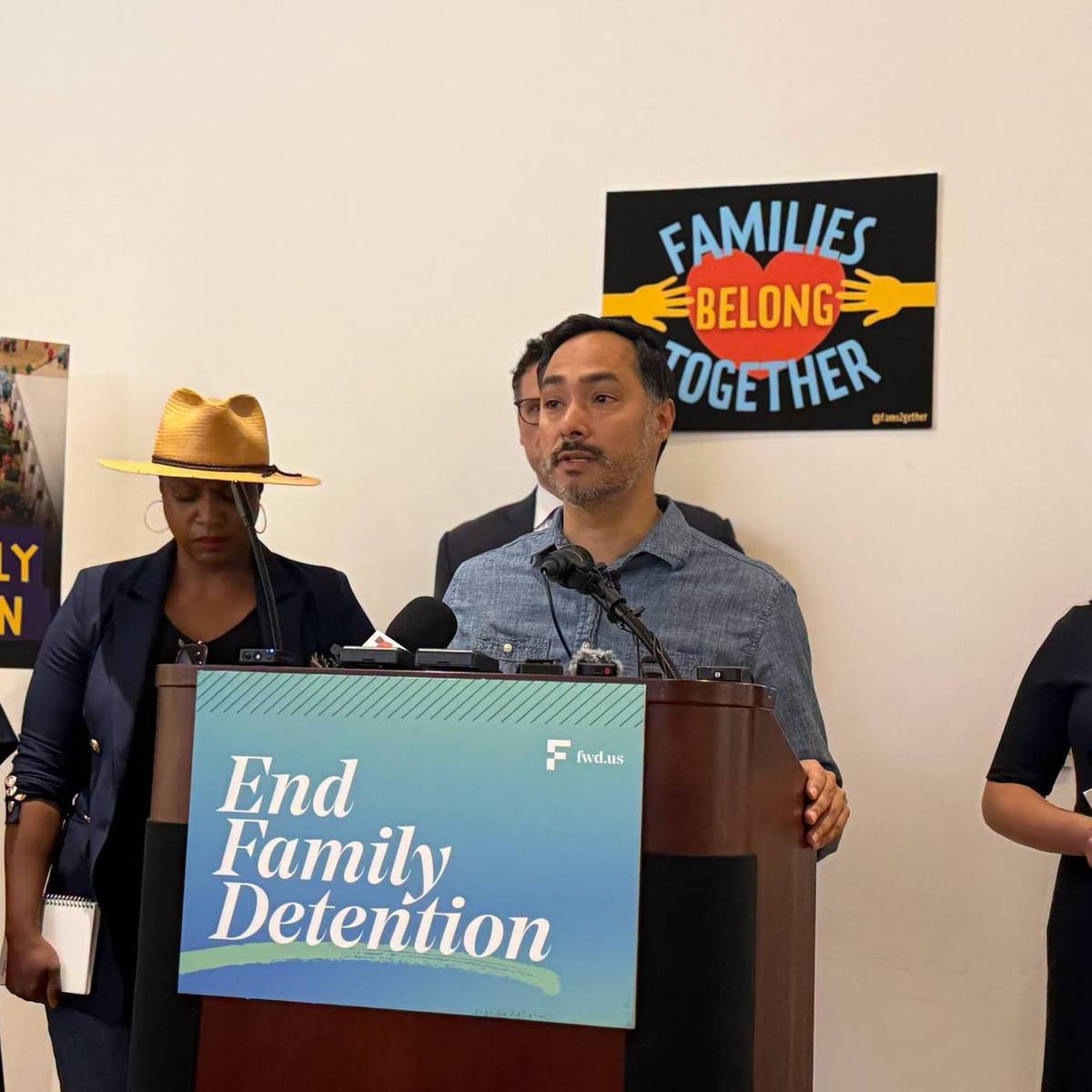
US Congressman Greg Casar on Thursday repeated his call for the Trump administration to close the immigration detention center in southern Texas where it’s held thousands of children over the past 18 months—children, the progressive Democrat said, who “should be playing soccer, going to school, living their lives, not being arrested on the streets,” as one of the center’s newest detainees, 5-year-old Liam Tadeo, was earlier this week.
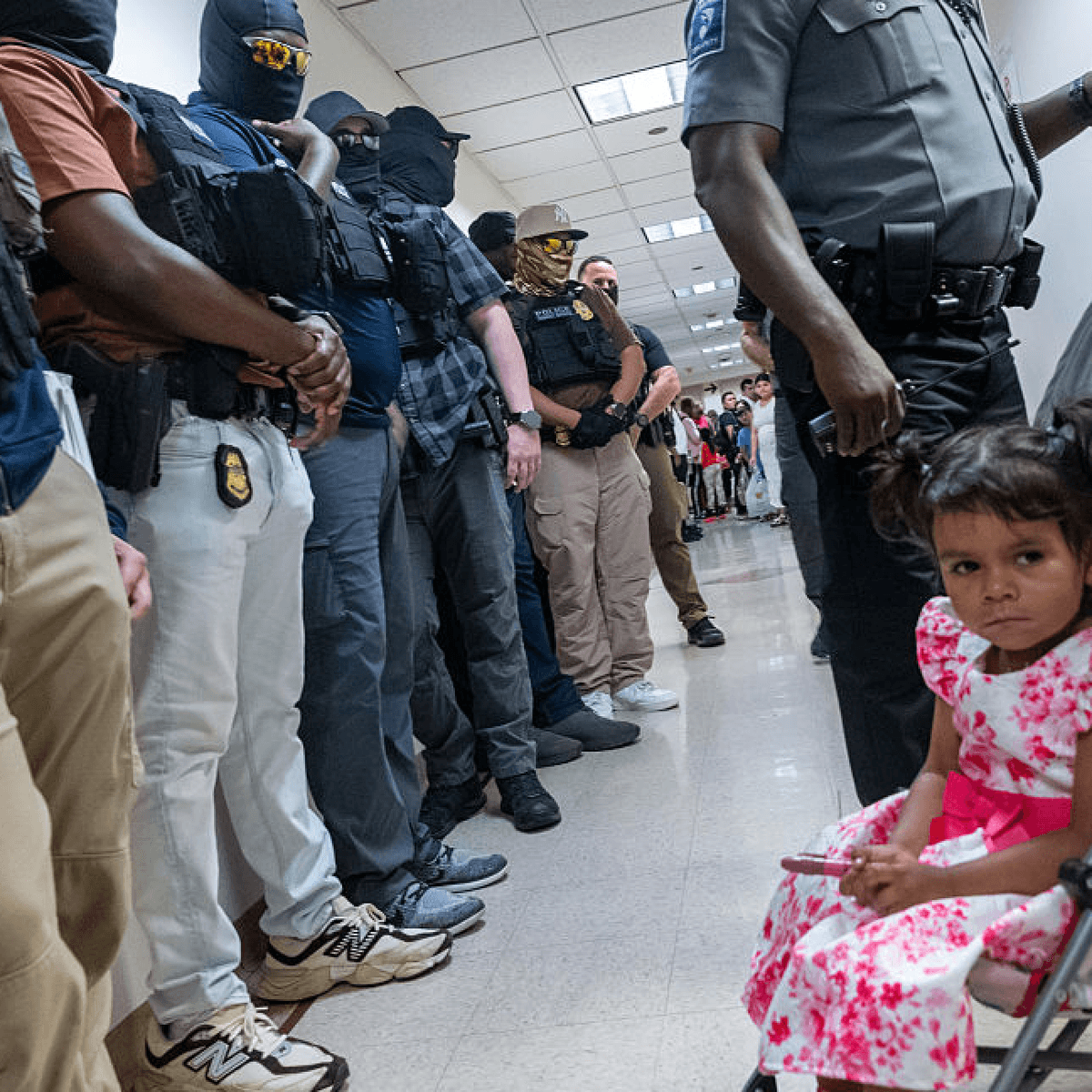
Casar demanded the release of at least 112 children who are being held at South Texas Family Residential Center in Dilley, Texas, outside San Antonio, days after Tadeo was abducted along with his father by US Immigration and Customs Enforcement (ICE) agents during a traffic stop in Austin.
Tadeo and his father were on their way to the child’s soccer game, days before he was set to start kindergarten, when they were arrested and taken to the detention center, said Casar. The facility, which is commonly known simply as Dilley, is a for-profit center run by CoreCivic that has come under scrutiny over reports of medical neglect and poor conditions for the dozens of families detained there.
“Liam should be starting kindergarten this week,” said Casar, chair of the Congressional Progressive Caucus. “Instead, he’s sitting in a trailer prison right now in Dilley, Texas.”
ICE just arrested a 5-year-old on his way to a soccer game in Austin.
His name is Liam, just like the little boy from Minnesota.
He should be in kindergarten this week. Instead he's in a trailer prison in the desert.
Lidia Terrazas of Univision posted a video on social media showing Tadeo crying during the arrest.
“Liam has been living in the United States for most of his life,” said Terrazas. “I just want you to see him. I want you to look at his face. I can’t even imagine what he was feeling in this moment… He’s crying, he looks at his dad while surrounded by immigration officers.”
ICE has abducted another five-year-old. His name is Liam. This week he missed his first week of Kindergarden because he is detained at the infamous Dilley Detention Center in Texas. Reporting by the great @LidiaTerrazas. pic.twitter.com/Smj0PMSZYT
Terrazas and Casar both noted that Tadeo has the same name as another 5-year-old boy, Liam Conejo Ramos, who was abducted by ICE on January 20 in Minnesota, as he was returning home from preschool with his father. Images of the boy wearing a blue bunny hat and a Spider-Man backpack were circulated widely online as the public expressed outrage over his detention, which happened around the same time that two US citizens were fatally shot on the streets of Minneapolis by federal immigration agents.
A federal judge ordered the release of Conejo Ramos and his father in February, but they are now fighting a ruling to deport them.
Patricia Resendiz, Tadeo’s aunt, posted a fundraiser on GoFundMe, asking the community “for help to secure the release of my nephew.”
“The detention of Liam and my brother-in-law was cruel; they are not criminals—they were simply on their way to a soccer match,” wrote Resendiz. “Liam is a beautiful, intelligent, and big-hearted little boy. My sister is devastated, and so are we. Liam was detained right in front of my son, his cousin. My son told me that the ICE agents said to Liam, ‘You can’t escape.’ We appreciate any help you can provide.”
The Department of Homeland Security (DHS) and ICE have not responded to questions from the press, including Newsweek and Univision, about Tadeo’s detention.
But DHS recently told FOX 7 Austin that it would continue ramping up deportation operations in the Texas capital, with the agency asserting that “being in detention is a choice” and imploring undocumented immigrants to “self-deport.”
“The United States is offering illegal aliens $2,600 and a free flight to self-deport now. We encourage every person here illegally to take advantage of this offer and reserve the chance to come back to the US the right legal way to live the American dream. If not, you will be arrested and deported without a chance to return,” said DHS. “Under President [Donald] Trump and Secretary [Markwayne] Mullin, ICE is targeting the worst of the worst.”
Despite the administration’s persistent claims that undocumented immigrants should “self-deport,” AL.com reported on Thursday on a Venezuelan family who attempted to return to their home country, went to an ICE check-in appointment as part of the process, and were detained and taken to Dilley, where they’ve been held for more than a month.
The family’s 7-year-old daughter has appealed to Sen. Katie Britt (R-Ala.), the chair of a Senate subcommittee on homeland security appropriations who spoke out against Conejo Ramos’ detention earlier the year, asking her to help secure the family’s release.
Tadeo was detained a day before Judge Dolly M. Gee of the US District Court in Los Angeles ordered a new oversight effort at Dilley and other detention facilities in Texas and California where children are being held. The judge found that children at Dilley have likely been forced to live in unsafe temperatures with inadequate sleeping quarters and without basic hygiene products like soap.
The court also found that the government may be keeping inaccurate records regarding the length of children’s detention. Under the Flores settlement, children cannot be held in immigration detention for longer than 20 days. Over the past year, said attorneys for minors who have been detained at Dilley, about 1,560 children have been held at the facility for more than 20 days.
Our work is licensed under Creative Commons (CC BY-NC-ND 3.0). Feel free to republish and share widely.
State Senator Aisha Wahab has officially been declared the winner of Tuesday’s special runoff election to fill the remainder of former Congressman Eric Swalwell’s term that ends in January, representing much of Alameda County.
Wahab was the clear favorite to win, however she won by a far slimmer margin in this runoff than she did in the special election that preceded it in mid-June, or in the early June primary for the seat’s subsequent term.
With 95% of the votes tallied, Wahab won with 53% of the vote on Tuesday, six points off ahead of Hernandez, who had 46.9%. That’s compared to the 26 points that Wahab led by in the June 16 special election that preceded this runoff.
As SFist reported earlier this week, Wahab’s opponent, BART Board President Melissa Hernandez, has been the beneficiary of a large sum of attack-ad spending from AIPAC (the American Israel Public Affairs Committee), funding that seems motivated largely by Wahab’s Muslim identity, and her having called Israel’s actions in Gaza a genocide. The ads focused on attacking Wahab’s voting record in the California legislature, and misrepresenting it as being soft on crime and sex trafficking.
Political watchers say that AIPAC may also simply be flexing its financial muscle as a warning to other progressive Democrats, however it’s especially curious given that neither Hernandez nor Wahab have made Gaza any sort of talking point in their campaigns. (Hernandez has said she believes Israel went too far in their retaliation against Hamas in Gaza, but stopped short of calling it a genocide.)
As Wahab told Politico of the AIPAC money, “On every single credential, I am the most qualified. So what’s the elephant in the room? At the end of the day, all I can say is that it’s based on prejudice and racism.”
Wahab and Hernandez will now face off one more time in November, in the race for the two-year term in Congress representing California’s 14th District. That race is likely to see further spending on attack ads to damage Wahab, though it’s not likely that the result will much different than Tuesday’s.
Democratic political consultant Jim Ross told the Chronicle this week that Tuesday’s runoff was a test of what that AIPAC’s ad spending could do — and he suggested that if it brought Hernandez within five points of Wahab, that meant she could still be a viable candidate in November. How about six points?
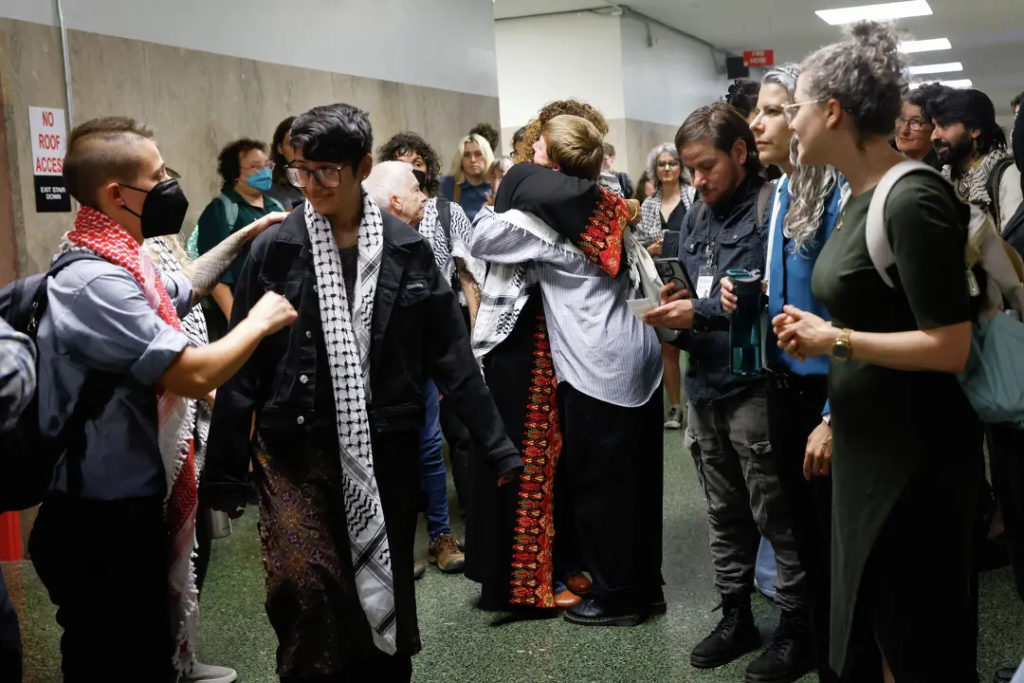
Golden Gate Bridge protester Em Tillotson, center right, gets a hug of support from Nida L, center left, one of the Golden Gate 26, as Golden Gate Bridge protester Bhavika Anandpura, second from left, gets support from Raye Kahn, left, press cooordinator and a Golden Gate 26 misdemeanor co-defendant at the Hall of Justice on Friday. Lea Suzuki/S.F. Chronicle
A San Francisco Superior Court judge on Friday sentenced seven people who shut down the Golden Gate Bridge in 2024 to protest the war in Gaza to 30 days in jail, with credit for time they’ve already served, and six months of probation.
Given the time they’ve already spent in jail, the protesters will likely serve another 11 to 13 days behind bars and will not be retried on charges on which the jury deadlocked.
After a two-month trial, a jury found the demonstrators guilty last month of false imprisonment, obstruction of a thoroughfare and unlawful assembly — all misdemeanors. They were also each fined $1,000 and can opt to spend an additional 13 to 15 days serving on a work program. Their probation begins on Friday, but none will be required to serve their sentence until there is a verdict in their appeals, which their attorneys said they intend to file.
Bhavika Anandpura, Sarah Ferrell, River Allen, Rocky Chau, Conrad de Jesus and Em Tillotson faced up to five years in county jail. Sara Cantor was convicted of an additional misdemeanor count for refusing to disperse, and faced 5 ½ years.
The protesters avoided a maximum sentence of 15 years when the jury deadlocked 10-2 on a felony conspiracy charge, with 10 voting guilty. The jury was also hung 11-1 on a misdemeanor trespassing charge, with the majority voting not guilty. On Friday afternoon, Assistant District Attorney Angela Roze said prosecutors would dismiss the charges “in the interests of justice,” meaning the protesters will not face retrial.
Just before 8 a.m. on April 15, 2024, several cars stopped together on the Golden Gate Bridge. Protesters demanding an end to Israel’s war in Gaza emerged. They stopped traffic for four hours. Some locked themselves together with metal bars, a tactic law enforcement calls the “sleeping dragon.”
District Attorney Brooke Jenkins charged 26 people on the bridge with a host of criminal offenses, saying the demonstration threatened the health and welfare of people traveling across the bridge, including a person with a brain tumor who missed a medical appointment, a mother who had to help her young sons defecate in a bag, nurses who could not get to work, and a woman who now suffers from a fear of heights.
A judge later found insufficient evidence to charge most of the defendants with more serious crimes.
Civil rights activists and defense attorneys called Jenkins’ charges an unreasonably harsh response to protesters fulfilling what they saw as a moral duty to speak out against U.S. military support for Israel.
In a statement, District Attorney Brooke Jenkins said she believed the court’s sentence finally held the defendants accountable for their actions.
“I continue to encourage civil discourse and exercising our rights under the First Amendment, but this serves as a reminder that when such acts become unlawful and compromise public safety that there will have to be consequences,” said Jenkins
Jenkins said her department’s initial hope was that the defendants would be sentenced to a one-year term of probation and 16 actual days in jail, representing one day in jail for each hour that each victim named in the convictions was “trapped on the bridge against their will.”
“We hope that imposing a custodial sentence will hopefully act as a deterrent to future criminal conduct by others considering blockading a bridge,” she said.
Every seat in the courtroom on Friday was filled by family members and supporters of the seven defendants, who were separated from the gallery by plexiglass. Judge Teresa Caffese began the proceedings by reading a letter written by a juror in the trial, who said that while they believed convicting the defendants of the misdemeanor counts was the right decision, they hoped she would weigh her sentencing with fairness and compassion.
“Nothing in the trial suggested they acted out of malice or personal gain,” the juror wrote, saying they believed the defendants were empathetic, well-intentioned people who “cared deeply about the causes they support.”
After reading the letter, Caffese said she believed the defendants’ unequivocal goal was to cause as much disruption as they could on the bridge, regardless of how their conduct would be classified under the law. The defendants, she said, testified that they believed what they were doing was legal, as a matter of conscience.
“Both claims cannot be true. Either laws were violated or they were not,” said Caffese. “History contains countless examples of protests (done) without violating laws.”
Caffese said the defendants, who initially resisted arrest, only agreed to surrender after they learned their vehicles, which were parked on the bridge, would be sawed in half. She claimed they had “made their point” in less than an hour, when they received media coverage, and could have ceased their demonstration at that point. In her preamble, she also described the way Dr. Martin Luther King “willingly accepted” arrest, demonstrating a commitment to his cause and a principle that “civil disobedience carries responsibility.”
After summarizing statements written in support of the defendants, Caffese denied their requests for diversion and emphasized that they were not being sentenced for their beliefs. She denied an attorney’s request for Chau, who cares for his older mother, to serve his custodial time on home detention, but later allowed for him to serve it “non-consecutively.”
She also made an exception for Cantor, the defendant who had faced a lengthier sentence. Cantor, who uses a cane to walk, had allegedly been sent to solitary confinement during her initial days in jail because jail staff saw her cane as a weapon, her attorney said. Caffese allowed Cantor to serve her custodial time in home detention.
Several demonstrators’ attorneys pressed the judge after the sentencing to ask why she was imposing county jail for a non-violent protest involving defendants with clean records, rather than considering less restrictive alternatives, such as electronic monitoring or home detention. At one point, one of them grew increasingly agitated and began to raise her voice at the judge.
“In this courthouse, any misdemeanor that goes down gets the option of (the alternative work program),” said Deputy Public Defender Nuha Abusamra, noting that even offenders with criminal records were often released on home monitoring. “So I’m wondering, what is it other than their political beliefs?”
The judge refused to answer her question directly, saying she had already stated her reason.
During a short recess, Jordan Harger, one of the original “Golden Gate 26,” whose case had been diverted, said they believed the punishment was “abhorrent.”
Any jail time, especially in the county’s jails, was unjust, Harger said. Harger and others rejected the judge’s invocation of Martin Luther King Jr. and believed there was no reason to put someone in jail for “fighting a genocide.”
“My comrades are deeply principled people. And they are very brave people,” Harger said, appearing to cry and shake slightly. “And I know that when they’re in that jail they’ll be sharing their commissary. They will be educating others. They will be caring for other incarcerated people.”
As the hearing came to a close, the defendants and a swarm of their supporters filed out of the courtroom and into the hallway, where they began to rejoice and holler, clapping and dancing in a circle.
Annie is a reporter for the Chronicle covering breaking news, crime and human-interest stories. She previously wrote for the Chronicle’s Arts & Entertainment section, Datebook. Before joining the Chronicle, she studied journalism at Cal Poly, San Luis Obispo, where she launched a culture column for the campus newspaper, produced radio stories for NPR affiliate KCBX, and worked as a DJ and writer for KCPR, the university’s radio station. Her work has appeared in VICE and Flood Magazine and has been recognized by the California Journalism Awards and the San Francisco Press Club.
Abigail Vân Neely covers crime, criminal justice and breaking news in San Francisco and the East Bay. She previously worked at Mission Local, where she reported on policing, the courts, homelessness, addiction and city government. She has bachelor’s and master’s degrees from Stanford University and lives in San Francisco.






 by
by