The six fatal flaws in Mayor Lurie’s so-called ‘Family Zoning Plan’

It won’t bring down housing prices. It will create displacement—and it’s terribly divisive

By CALVIN WELCH

SEPTEMBER 7, 2025 (48hills.org)

“Ideals without common sense can ruin this town … What does that get us? A discontented, lazy rabble …all because a few starry-eyed dreamers …stir them up and fill their heads with a lot of impossible ideas!”

—Mr. Potter (Lionel Barrymore) in Frank Capra’s “It’s A Wonderful Life,” 1946

In Frank Capra’s “It A Wonderful Life,” for the super-rich banker, Mr. Potter, the town of Bedford Falls was poised on ruin because of the non-sensible lending policies of the town’s saving and loan, which continually made home loans to working people that built a community that sustained the town. A misplaced deposit leads the saving and loan to insolvency, causing its beleaguered manager, Jimmy Stewart, to wish he were dead. An angel is empowered to make the wish seem to come true, to show Stewart how his loss would affect others.

To illustrate what life would have been in Bedford Falls without him, the angel sends him to the Bedford Falls that never had him, now named “Potterville.” Potterville’s main shopping street was lined with bars and night-time entertainment venues of various types, not the retail shops selling goods to locals that was Bedford Falls main street. Stewart comes to his senses and the angel switches the town back to Bedford Falls, where the community pours donations to the saving and loan, which saves it from ruin.

Mayor Lurie’s re-zoning plan, now set for Planning Commission approval September 11, has all the sensibility of a “Potterville” transformation of San Francisco: a rabid disdain for the “starry-eyed dreamers” of San Francisco who currently live in the city’s neighborhoods (“othered” as Nimbys), and a deep kiss on the lips of the “common sense” real estate investors eager to displace the current “discontented rabble” with a whole new set of up-market highrise towers full, not only of upscale housing but also various new “commercial uses”—all planned from the top down, with local voices silenced, all benefiting folks not yet in San Francisco but sure to come (until they don’t).

A packed meeting at the Irish Cultural Center on the West Side focused opposition to the Lurie zoning plan. Photo by Michael Redmond

The proposal, devised by the Breed administration and adopted and expanded under Lurie, is centered on western San Francisco, a portion of the city that has a high proportion of the Chinese population both as residents and merchants, and which currently provides the majority of both family and senior housing (and the overwhelming majority of “multi-generational” housing) in San Francisco, and which is currently underserved by public transit.

While billing itself as a “family housing program” that will expand density along major transit corridors it, in fact, does little to either preserve existing family housing or require the affordability necessary for actual families to live to in the new housing it proposes. It provides no impact fee on developers of the new dense housing to pay for public transit operations—at a time when public transit faces financial collapse.

There are six fatal flaws in the Lurie proposal that need to be understood and corrected if the plan is going to avoid displacing more families and neighborhood-serving small businesses.

Sponsored link

Help us save local journalism!

Every tax-deductible donation helps us grow to cover the issues that mean the most to our community. Become a 48 Hills Hero and support the only daily progressive news source in the Bay Area.

Learn more

1. Lurie’s rezoning proposal fails to meet the affordable housing San Francisco needs, as defined by his own administration.

The most salient failure of the Lurie proposal is it inability to lay out a plan that will meet the affordable housing needs defined by his own Planning Department. Moreover, the proposal includes a new policy that will convey publicly owned land of the SFMTA to market-rate developers with minimum affordable requirements, instead of limiting all surplus public land for 100 percent affordable housing development.

The handout supplied by the Planning Department on the Lurie proposal contains the following graphic:
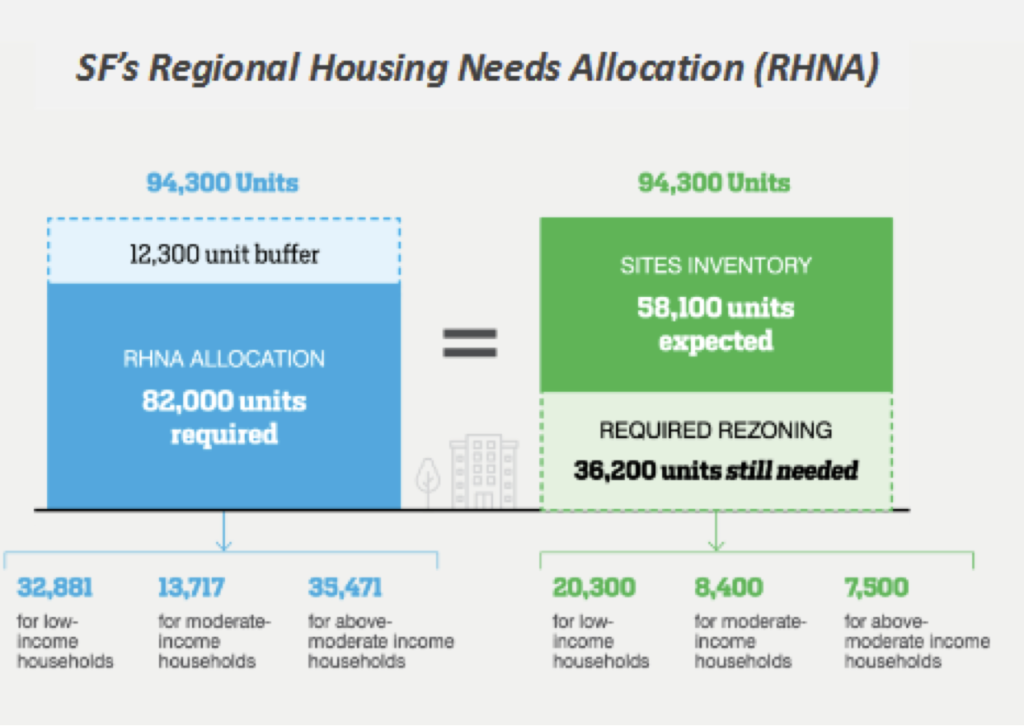
Under state law, The Association of Bay Area Governments estimates the housing need for the next seven years for San Francisco, by income categories. It should be noted that Mayor Breed appointed, as San Francisco’s representative to the ABAG committee doing the calculations a Yimby founder who lives in the East Bay. With such help, it isn’t surprising that the 2023-2030 estimate reached the astounding number of 94,300 new units, an eye watering 326 percent increase over the previous 2015-2022 RHNA estimate of 28,869 units for San Francisco.

What had changed? Why the huge increase in a locality that has not seen a 300 percent increase in population (indeed, San Francisco’s population continues to decline) and had, at the time, some 70,000 housing units approved but not built in its “pipeline?”

State law had changed and given real estate speculators a vested interest in huge, un-achievable RHNA requirements. State Senator Wiener, the Yimby poster boy, had passed a state law saying that if a county failed to meet its RHNA goals then new housing proposed for that county would be approved “as a matter of right—that is, automatically, without public hearing or review by local planners.

Wiener’s legislation did not require that these projects be built, but did create a new financial instrument—an approved building permit that could be sold and re-sold in one of the hottest real estate markets in the world. And as the saying goes, “that ain’t nothing” if you’re a real estate speculator.  

But speculating in approved projects does not produce housing, especially critically needed affordable housing.

As of Sept. 1, the current pipeline of approved but un-built housing units numbers 71,772, with some 17,378 being classified as affordable, or 24 percent, according to the Planning Department’s data.

This fact undermines a key Yimby/Lurie rationale for the rezoning plan: That existing density and approval processes stop the city from approving critically needed housing. If 71,000 units have been approved but are un-built by developers, something else is happening—not dependent on either zoning or approvals. What that might be and proposals to correct it are not a part of the Lurie plan.

Returning to the above graphic, the Lurie rezoning program does take into account the huge pipeline of approved but un-built housing by reducing the RHNA requirement by some 58,100 “units expected”—without a specific mention of the pipeline or why only 58,000 and not the full 71,000 units are “expected.” What happened to the remaining 13,000 units has never been explained.   

But what is significant is that the graphic lists 28,700 of the remaining 36,200 “units still needed” by “required rezoning” earmarked for low- and moderate-income households. That’s a whopping 79 percent of the total units needed. But as the pipeline figure show only 29 percent of the expected units, some approved a decade or more ago, are affordable— showing the real capacity of the city to produce affordable housing.

With such a high affordability bar set by the Planning Department, the Lurie re-zoning proposals must contain a historically aggressive policies to achieve that goal. They don’t, not even close.

There are two programs aimed at affordable housing in the Lurie proposal: The Housing Choice Housing Sustainability District (Sec.344) and the newly proposed Non Contiguous SFMTA Site Special Use District (Sec.249.11). The first sets the affordability goal at 10 percent “affordable to very-low or low-income households” and the second sets the goal at between 22 percent and 24 percent, depending if they are rental or ownership units.

The SFMTA proposal is especially odious because it gives to the SFMTA Commission (appointed totally by the major) the ability to recommend waving both the Transportation Sustainability Fee and the Jobs-Housing Linkage Fee to the Board of Supervisors. Project built on SFMTA sites could be as high as 400 feet. These publicly owned sites would then be overwhelmingly market-rate housing and commercial buildings, not quite the comfy “family housing” hawked by Lurie.

The one certain affordable housing program that could be adopted at the local level is the dedication of surplus public land for the exclusive use of affordable housing. Site acquisition is 50 percent of the cost of affordable housing development, a cost totally able to be met by restricting the use of public land for affordable housing.

Instead, Lurie is proposing to allow massive market rate development on some of the largest parcels in public ownership—Muni’s Presidio and Kirkland yards alone could accommodate several hundred units of affordable family housing, serving thousands of San Franciscans for 50 years or more.

But the bottom line is that the Lurie re-zoning would not come close to meeting the RHNA goals of affordability. It seems that somehow the state has indicated to Lurie that it would be just fine to miss the affordability requirement—as long as the market-rate and commercial projects go forward.

2. Lurie’s rezoning may destroy more existing affordable family housing than it will create, especially housing that includes multi-generations in single households as much of the Sunset and Richmond does.

The Richmond and Sunset contain a huge amount of the city’s family housing, especially housing for both children and seniors.

Three maps from the Department of City Planning GIS page (https://sfplanninggis.org/intro/) show the story graphically:
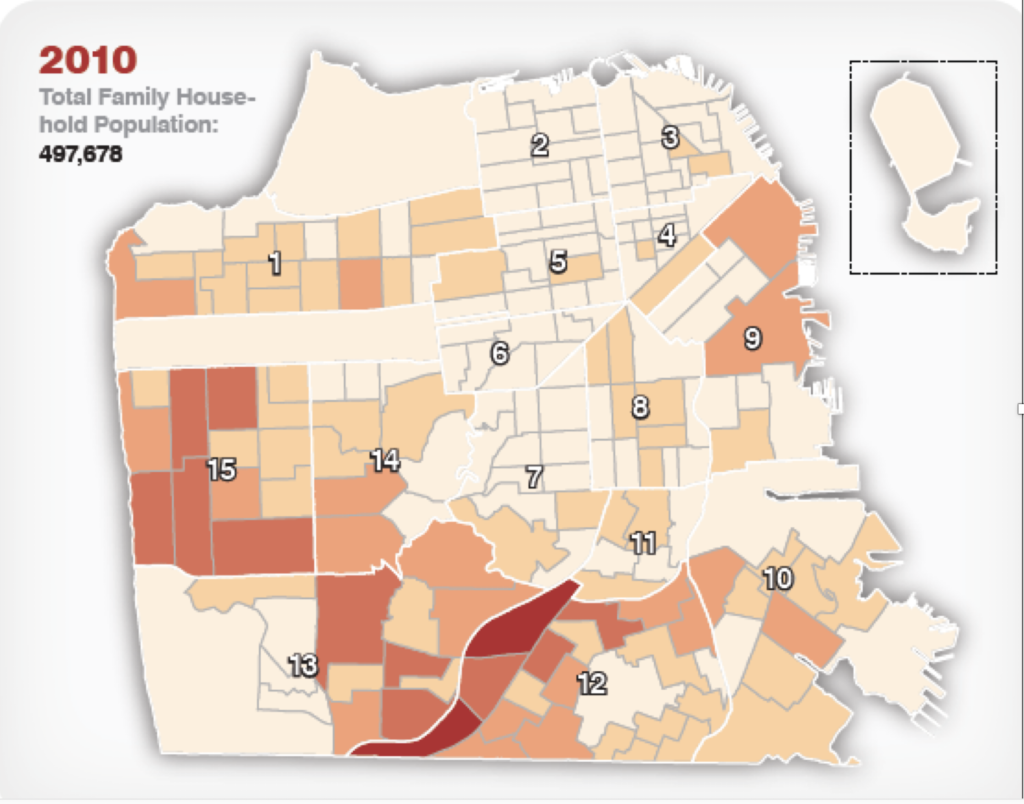
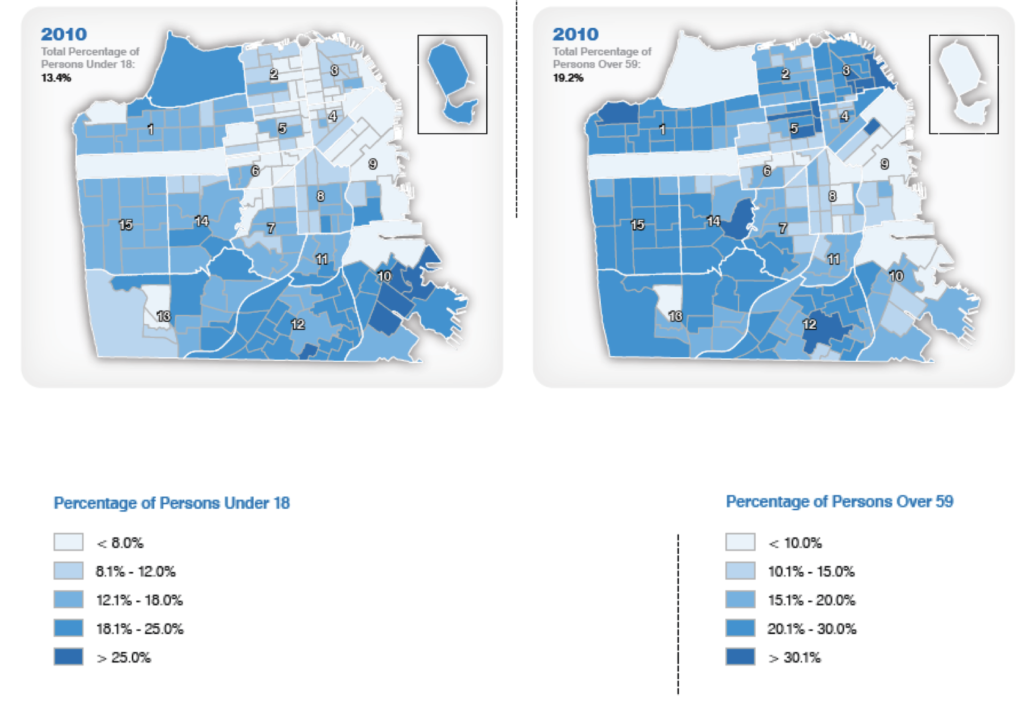
The Richmond and Sunset have large populations of children AND seniors—which is not true in most areas of the city, which either have a high proportion of children and few seniors (Presidio, Bayview) or large senior population and fewer children (North Beach, Nob Hill).

This “multi-generational” character of the Richmond and Sunset reflects the fact that the area has a high concentration of Asian households, which often include grandparents, parents and children all living in the same household. This is reflected in the fact that of the 12 census tracts with the largest number of family households, 50 percent of them are in the area covered by the Lurie rezoning (as shown in the map above).

For Lurie and his Planning Department, it seems that only nuclear families count. Lurie’s plan allows the demolition of existing housing (even rent controlled homes) if the new housing equals or exceeds two-bedroom units of the existing buildings.

But where the Lurie rezoning goes totally off the rails as a “family housing rezoning” effort is allowing the conversion of a housing use to a commercial use in all 37 neighborhood shopping districts covered by the proposal.

In more than half of these districts, the conversion of a housing use above the first floor (or sometimes the second floor) is simply prohibited. Under Lurie’s plan, any existing housing use above the first floor can be converted to a commercial use by the vote of the four Planning Commission members the mayor appoints.

The language of the proposal allows the conversion of not only existing housing uses but also the new housing built under the plan. It’s impossible to determine the net effect of these dramatic changes will have on the total housing produced under Lurie’s plan. The plan maximizes profit for real estate speculators, and does not guarantee new housing for families at prices they can afford.

3. It will displace small, locally owned neighborhood-serving businesses and provide no meaningful means of retaining them.

The Lurie rezoning is centered on 37 shopping districts, which currently house some 4,300 registered businesses, according to the Planning Department. The plan itself states: “Increased residential development could result in displacement of existing businesses.” But it offers no concrete policies to keep such displacement from happening.

In a presentation made before the Small Business Commission in late July, the Planning Department claimed that 915 businesses were located on parcels where Lurie’s proposal would remove “development constraints” and another 207 businesses were “located on suitable parcels” for new development, meaning 1,122 of the 4,300 (26 percent) businesses in the rezoning area are facing displacement.

The overwhelming majority of these businesses are neighborhood serving retail businesses and hundreds are owned by women and people of color, with most employing San Francisco residents. The Planning Department offered no specific strategy to keep these businesses in place, and no specific policies within the zoning proposal itself to avoid the displacement. The Lurie rezoning has no polices that preserve existing neighborhood-serving or legacy businesses in place; the only policies are aimed at relocation.

After planning staff read off a list of existing city services aimed at assisting small businesses, most of which are already oversubscribed, Miriam Zouzounis, vice president of the Small Business Commission, dismissed them as having no real impact on the new threat contained in the Lurie proposal. “I don’t trust the city,” she said.

4. It provides no new revenue for public transit and no means to support current service levels.

The Lurie proposal removes most parking requirements in new development, but it contains no new transit impact fees on the new development, assuming the existing Muni system can absorb the new ridership. As shown above it even potentially waves the existing Transportation Sustainability Fee on large projects allowed in the proposed SFMTA SUD—a particularity ironic policy given the financial cliff facing Muni. The greatest density in the mayor’s proposal is along “transit corridors.”

All of this is being proposed in the context of a $322 million Muni deficit. Add to that a recognition that both regional and local transit funding ballot measures, even if passed, will not fill that hole. While proposing a steep increase in population along transit corridors, the rezoning plan simply ignores the funding crisis facing the transit system.

Instead, Lurie seems to prefer Waymo, Lyft, and Uber as his recent approval of them returning to Market Street shows. Waymo has dramatically increased its fleet while Muni continues to reduce the number and frequency of its buses. Even in San Francisco sometime one and one equal two: If there is little or no new revenue for Muni, service will continue to decline and the basis for a “transit oriented” dense housing proposal will simply disappear.

Calling a Waymo to get the kids to and from school sounds like a hell of a plan for all the families Lurie seeks to build housing for along transit corridors that no longer have public transit.

In June, the mayor cut service to two lines that serve western San Francisco—yet his rezoning plan continues to claim it is “transit oriented” and calls for more density in the western neighborhood in a style that is simply Trumpian in its denial of reality.

5. The Lurie proposal allows endless speculation with approved projects and no hard requirement to actually build the housing.

How can it be that San Francisco has 71,000 approved units that have not been built in an endlessly declared “housing crisis?” The answer is simple: the willingness to accept speculation in approved housings projects.

Treasure Island (6,500 approved units) and Parkmerced (5,314 approved units) have been stalled for two decades as one ownership group sells its equity in the project to another speculator. The same is true with the development at Bayview Hunters Point Shipyard (9,637 approved units) and the Potrero Power Plant (2,228 approved units) Money can be made by not building approved projects.

Lurie, with this rezoning plan, seems not to care. The Yimbys seem not to care. Senator Wiener seems not to care. The State of California seems not to care. They all seem to care only about streamlining approvals of massive new projects—and they don’t care if those projects ever actually get built. Only the folks who need the housing care—but they have little or no voice in the matter.

Developers are under no city obligation to build the housing they get approved in a timely manner, if at all.

Only one of the several alternative proposals in Lurie’s rezoning plan has a mandatory “use it or lose it” requirement: The Housing Choice Housing Sustainability District. The proposal states that the approval of a project “shall expire” if the developer “has not procured a building permit within 30 months” of its planning approval. While 30 months may be overgenerous given our hair-on-fire housing crisis, at least it recognizes the problem.

Why this is not a requirement of all projects created in Lurie’s re-zoning plan?

Again, the answer is simple: speculation. After all, billionaires talk to other billionaires, and business is business. Which, of course, is why we have an affordable housing crisis not just in San Francisco, not just in California, not just in the USA, but world-wide.

6. It pits current San Franciscans against future San Franciscans.

The Lurie rezoning plan was devised by London Breed, perhaps the most divisive mayor since the “father of redevelopment,” Joe Alioto. Breed delighted in the practice of the politics of pitting one set of San Franciscans against another. In the end, it cost her the election, as voters grew weary of her constant scapegoating and blaming others for the failure of her policies.

Lurie won with a feel-good campaign centered on bringing us all together by following a middle road, through a set of moderate policies aimed at including us all in a better city. He added the astute pursuit of the Chinese vote, which had completely soured on Breed, making him, in effect, the second mayor of San Francisco elected largely with Chinese support (Willie Brown was the first).

It was odd that he would then accept a massive rezoning proposal that was itself based upon the most divisive of all possible policies: displacing existing residents, many of whom were Chinese residents of the Sunset and Richmond who had voted for him. At the very heart of the Breed rezoning proposal was a massive assault on current residents and businesses of western San Francisco, with policies and proposals that required the demolition and displacement of homes and businesses of current residents.

In polite San Francisco politics, one does not talk about race, as the civic assumption is that in liberal San Francisco racial politics is simply not practiced. Officially the city supports diversity, equity, and inclusion. Yet in land-use policies, the city has a rich and continuing history of rank racism, from the policies of “Black removal” of the Redevelopment Agency to the attempt to relocate the Chinese out of downtown to the deep and invisible reaches of the South for Market after the 1906 earthquake and fire.

Using another map from the Planning Department GIS page this fact becomes clear.
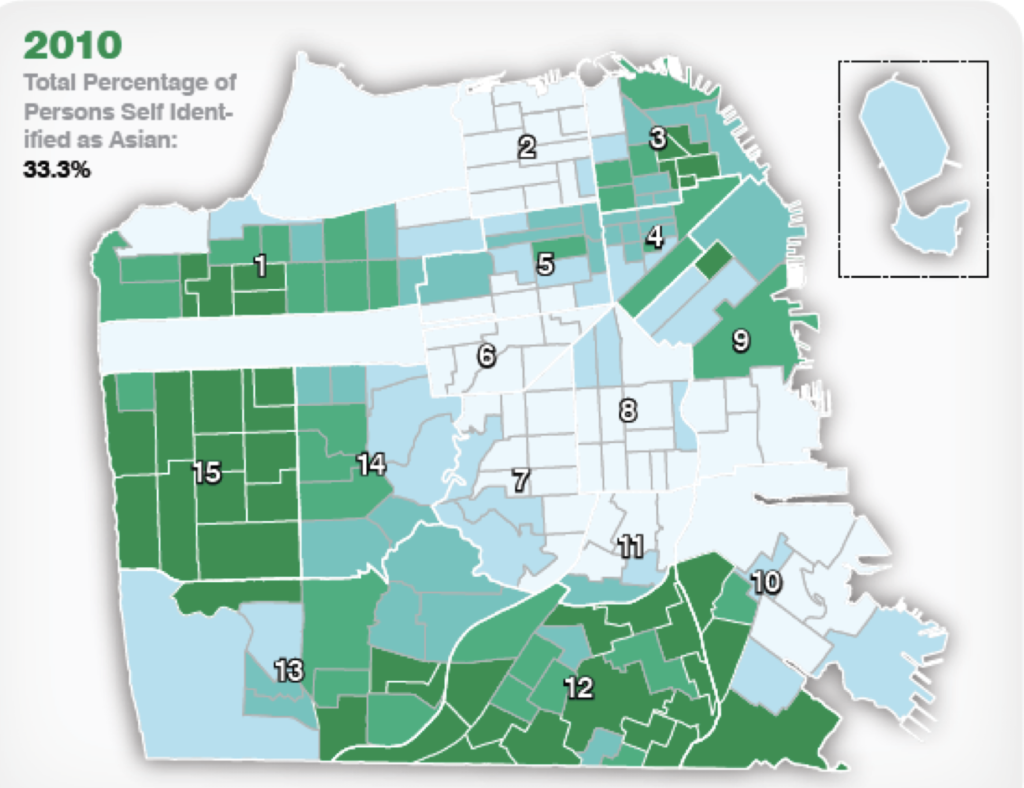
At the very heart of Lurie’s proposal is the heavily Chinese Sunset and Richmond. How Lurie and his advisers failed to see the disproportionate impact a zoning proposal that allows unlimited demolition and conversion of existing housing would have on that specific population is baffling—unless, of course, they didn’t care.

San Francisco’s Chinese voters have become increasing important in citywide elections, as the number of Asians increased from 29 percent of the population in the 1990 Census to 37 percent in 2020. with approximately 60 percent of the Asian population Chinese. The Chinese vote is simply determinative in the Sunset and the Richmond.

There can be little doubt that Chinese residents of the Richmond and Sunset see the rezoning as a displacement threat to their community. Even the Chronicle has recognized that concern around the rezoning is a factor in the almost certain re-call of the District 4 supervisor (here and also here). Engardio is a strong supporter of the Yimby agenda (which included the closing of the Great Highway) and of Lurie’s rezoning, proving, as we will see if he is recalled, that the Yimbys in San Francisco can get you into more trouble than they can get you out of.

It not good policy and certainly not good politics to propose land-use policies which seek to replace current residents with more wealthy future ones—as Breed might well have told Lurie if they are still talking.

Lurie’s rezoning proposal will not result in more family housing and quite possibly reduce it through demolitions and conversions, and instead boost large-scale commercial uses deep into existing residential neighborhoods. It has little if any affordability, which is the main need of families, while handing over to market rate developers critically needed public land which could be used for 100 percent affordable housing development.

It will displace hundreds of small businesses, many of which employ local residents, with no plans to prohibit such displacement and no new initiatives to fund the relocation of those businesses. It will certainly worsen the city transit crisis by increasing density along “transit corridors” while providing no new funds for the additional riders and no operational support for the existing service.

It either purposely or ignorantly targets the largest multi-generational set of family households in the city for displacement in a manner that falls hardest on the Chinese community, which will harden attitudes and make the pursuit of common goals all the more difficult. And, astoundingly, it doesn’t require that any of the housing be built but instead allows the uncontrolled speculation of buying and selling, merging lots, and demolishing small buildings and displacing businesses and residents—while the great land use game is played for the benefit of the few and the misery of the many.

There is little prospect that either the Planning Commission or the new “moderate” Board of Supervisors will meaningfully amend the measure, so it will pass basically as written before the end of the year. Then the choice of our future is in our hands. There are two elections next year. A ballot measure amending Lurie’s give-away should be on one of them.

‘It’s Terror’: Global Sumud Flotilla Bound for Gaza Bombed

TUNISIA-ISRAEL-PALESTINIAN-CONFLICT-AID-FLOTILLA

Tunisian protesters wave Palestinian flags at the Port of Sidi Bou Said near Tunis on September 9, 2025, after the organizers of a Gaza-bound flotilla carrying humanitarian aid and pro-Palestinian activists said late on September 8 that one of their boats was hit by a suspected drone. 

(Photo by Yassine Mahjoub/AFP via Getty Images)

“Our peaceful mission to break the siege on Gaza and stand in solidarity with its people continues with determination and resolve,” said members of the flotilla’s steering committee.

JULIA CONLEY

Sep 09, 2025 (CommonDreams.org)

Pro-Palestinian protesters gathered at the Port of Sidi Bou Said in Tunis, Tunisia early Tuesday morning after the international group organizing a humanitarian aid mission to Gaza said one of its boats had been struck by what was believed to be a drone.

The Global Sumud Flotilla said one of the main vessels of its fleet of 50 boats was struck while it was anchored in the harbor. The boat was carrying the group’s steering committee, which includes climate leader Greta Thunberg, human rights activist Yasemin Acar, and Brazilian organizer Thiago Ávila.

Footage taken from a boat docked near the “Family Boat” showed the moment an object appeared to drop onto the vessel, triggering an explosion.

The Global Sumud Flotilla said no one was injured in the apparent attack and said that “acts of aggression aimed at intimidating and derailing our mission will not deter us.”

“Our peaceful mission to break the siege on Gaza and stand in solidarity with its people continues with determination and resolve,” said the group in a statement.

Political commentator Brian Allen posted another video taken aboard the Family Boat.

The flotilla is the latest fleet of boats headed for Gaza to deliver humanitarian aid and break the siege Israel has imposed since October 2023 as it has relentlessly attacked the exclave, killing more than 64,000 Palestinians so far, and said it is planning a complete takeover of Gaza.

Nearly 400 people, including at least 140 children, have died of starvation caused by Israel’s near-total blockade on humanitarian aid. More than 1,000 people have been killed while trying to access food, including at hubs set up by the privatized, US- and Israel-backed Gaza Humanitarian Foundation. The Integrated Food Security Phase Classification said in late July that parts of Gaza are facing famine, with one in three people going days without consuming any food.

Israel has stopped several aid boats from reaching Gaza in recent months, including the Madleenand the Handala, and detained organizers. The Conscience, another boat operated by the Gaza Freedom Flotilla, was reportedly bombed by Israel in May off the coast of Malta, forcing organizers to turn back.

Israeli National Security Minister Itamar Ben-Gvir has threatened to designate humanitarian aid organizers trying to reach Gaza by boat as “terrorists” and to detain them.

On Tuesday, Francesca Albanese, the United Nations special rapporteur on the occupied Palestinian territories, said the reports of a drone attack have to be verified but noted Israel’s “history” of attacking aid vessels bound for Gaza.

https://www.instagram.com/reel/DOXDcfsiNpM/?utm_source=ig_web_copy_link

Tunisian officials have said the vessel was not attacked by a drone and blamed the fire that broke out on a cigarette butt or lighter.

“There is no other state protecting this boat other than Tunisia creating a safe port,” said Albanese. “The question is, if it’s confirmed that this is a drone attack, it will be an assault, an aggression against Tunisia and against Tunisian sovereignty.”

“We cannot keep on tolerating this,” she added, “and normalizing the illegal.”

Our work is licensed under Creative Commons (CC BY-NC-ND 3.0). Feel free to republish and share widely.

JULIA CONLEY

Julia Conley is a staff writer for Common Dreams.

Full Bio >

DHS Claims Videotaping ICE Raids Is ‘Violence’

The expanded definition has justified assaults on journalists who have documented detentions of immigrants.

BY MATTHEW CUNNINGHAM-COOK 

SEPTEMBER 9, 2025 (Prospect.org)

Cunningham-Cook-Videotaping ICE 090925.jpg

WINTERS ROCK ENTERTAINMENT

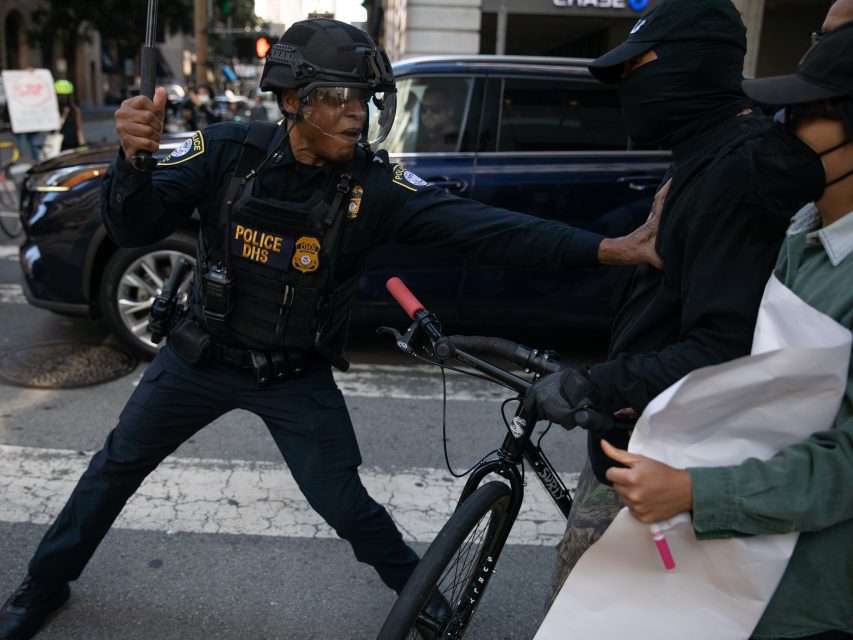
DHS officers confront a man filming with his phone outside the federal detention center in downtown Los Angeles, August 8, 2025.

This article is published in partnership with the Center for Media and Democracy.

President Trump’s Department of Homeland Security (DHS) claims that making and posting videos of ICE agents as they disappear tens of thousands of immigrants from America’s streets, workplaces, and courtrooms without due process is an act of “violence” to be dealt with accordingly.

DHS Assistant Secretary for Public Affairs Tricia McLaughlin told the Center for Media and Democracy (CMD) that “videotaping ICE law enforcement and posting photos and videos of them online is doxing our agents,” and added: “We will prosecute those who illegally harass ICE agents to the fullest extent of the law.”

In one incident, ICE targeted a Georgia-based journalist, Mario Guevara, for videotaping enforcement operations. Guevara has legal work authorization in the U.S., according to his attorneys, and has been held in ICE detention for more than two months.

More from Matthew Cunningham-Cook

McLaughlin’s statement comes on the heels of a little-noticed press briefing in July where DHS Secretary Kristi Noem stated that “violence” is “anything that threatens [DHS agents] and their safety. It is doxing them. It is videotaping them where they’re at.”

That expansive definition is likely driving the department’s claims of escalating “violence” against ICE agents, which purportedly rose from an alleged 700 percent increase on July 11, to 830 percent four days later, and to 1,000 percent by August 7. When asked by CMD to provide concrete examples of violent assaults on personnel, the DHS spokesperson pointed to an incident of trash dumped on an ICE agent’s lawn and a sign with a profanity directed at an agent by name.

Peter Eliasberg, an American Civil Liberties Union (ACLU) of Southern California attorney representing journalists and observers who were attacked and injured by DHS officers in Los Angeles, told CMD that this definition bears “no relationship to what violence actually is. I don’t think there’s any evidence that … there is truth [in] those numbers.”

Meanwhile, DHS agents have repeatedly resorted to violence, assaulting and injuring journalists and legal observers doing their jobs. The lawsuit filed by the Los Angeles Press Club, the NewsGuild–Communications Workers of America, and individual plaintiffs alleges that DHS agents used targeted, unchecked, and officially sanctioned violence against them, including “smashing the hands of people recording events with their phones” and shooting reporters with “less lethal” munitions.

Expand

Cunningham-Cook-Videotaping ICE 090925 2.jpg

WINTERS ROCK ENTERTAINMENT

DHS officers outside the federal detention center in downtown Los Angeles

Statements like Noem’s and McLaughlin’s raise serious concerns about the Trump administration’s lack of respect for First Amendment rights, experts argue.

DHS appears to “fundamentally misunderstand the First Amendment,” said David Cole, a First Amendment scholar and law professor at Georgetown. “The First Amendment is designed above all to give citizens the right to criticize and report on government abuse. There’s not only no law against recording law enforcement officers doing their job, but it is a First Amendment–protected right to do so in public in ways that don’t interfere with them carrying out their tasks. It reflects a failure [on the part of] the administration to understand the central role that watchdogs play in our democracy, [and any] attempt to restrict [that] goes against the First Amendment.”

While the Supreme Court has rarely ruled on the matter, Cole said, a number of lower courts have concluded that as long as you are not interfering with the ability of law enforcement officers to do their jobs, “the government cannot stop you from recording, either in memory, or [on a] legal pad, or … video recorder.”

There is limited capacity for DHS to police itself. In March, the department shut down its Office for Civil Rights and Civil Liberties, abruptly closing 500 investigations into public complaints of violations in the process. In August, a report issued by the office of Sen. Jon Ossoff (D-GA) disclosed more than 500 incidents of rights violations in immigration detention facilities in the first seven months of Trump’s second term. In July, Rep. Dave Min (D-CA) led a group of congressional Democrats in asking the DHS inspector general to investigate various assaults by ICE agents on civilians and members of Congress.

In response to a request for comment from CMD, ACLU senior staff attorney Scarlet Kim dismissed assertions by DHS that video recording is an act of violence. “The right to photograph, film, and publish publicly visible law enforcement activity is a core First Amendment right,” she maintained. “It creates an independent record of what officers are doing, and it is no accident that some of the most high-profile cases of misconduct have involved video recordings. The burning question is why ICE officers feel the need to hide who they are and what they do from the public—masking their faces, lacking visible ID, driving unmarked vehicles, and now attacking those who document their activities.”

While no state legislature has passed laws equating the video recording of police officers with “violence,” some states have made the practice more difficult by mandating buffer zones to keep observers a certain distance away from officers and first responders when they arrive on a scene.

DHS, the third-largest cabinet department after the Departments of Defense and Veterans Affairs, is a sprawling 260,000-employee operation that includes Immigration and Customs Enforcement (ICE), Customs and Border Patrol (CBP), the Coast Guard, the Federal Protective Service, the Secret Service, the Federal Emergency Management Agency (FEMA), and the Transportation Security Administration.

With the recent passage of the One Big Beautiful Bill, DHS is set to receive another $44 billion on top of the $115 billion it had requested as part of the routine budgeting process. Within that, the budget for ICE has now skyrocketed to triple what it was in fiscal year 2024, making it larger than the military budgets of all but 15 other countries around the world.

MATTHEW CUNNINGHAM-COOK

Matthew Cunningham-Cook is a writer and researcher with expertise in health care, retirement policy, and capital markets. He has written for The Intercept, The Lever, The New York Times, The Nation, Al Jazeera, and In These Times.

What the polls are screaming to ‘mainstream’ Democrats

Meyerson on TAP
September 9, 2025 (Prospect.org)
The Democratic rank and file is much more aligned with Bernie, AOC, and Zohran than it is with Chuck and Hakeem.
Lately, the gap between what rank-and-file Democrats believe and what many leading Democratic officials say and do has widened to Grand Canyon dimensions. I’ve noted previously that while just a bare 8 percent of Democrats supported Israel’s war on Gaza in a July Gallup poll, a substantial minority of Democratic senators voted against a Bernie Sanders resolution in August to halt our nation’s provision of offensive arms to Israel.
Now, two new polls reveal the core ideological beliefs of Democrats and those of their top leaders are similarly dissimilar. A New York Times/Siena poll released today shows that democratic socialist and Democratic mayoral nominee Zohran Mamdani leads Andrew Cuomo in New York’s mayoral race by a 46 percent to 24 percent margin, with Republican Curtis Sliwa and incumbent Eric Adams bringing up the rear.
On a more fundamental, what-do-you-believe, who-are-you level, a Gallup poll yesterday shows that nationally, the percentage of Democrats who view socialism positively—66 percent—exceeds the percentage who view capitalism positively—42 percent—by (using my powers of subtraction) a 24 percentage point margin. At a less theoretical level where the rubber meets the road, the Times/Siena poll of New Yorkers showed that 37 percent of them (not just the Democrats) said having a democratic socialist for their mayor would be good for the city, against 32 percent who said it would be bad and 26 percent who said it would be neither good nor bad. As well, the specifics of Mamdani’s “affordability” agenda’s social democratic policies polled considerably higher than his opponents’ stances.
Let’s back up a bit. From the presidency of Franklin Roosevelt through that of Lyndon Johnson, the prevailing ideology of the Democratic Party was a weak-tea version of social democracy. The Carter and Clinton presidencies marked a clear switch to neoliberalism, from which the Obama presidency never really shook itself free.
Today, in a period when wage income lags hugely behind investment income and when income inequality, consequently, continues to soar, it shouldn’t be all that surprising that a substantial majority of Democrats react more positively to democratic socialism than they do to actually existing capitalism. Yesterday’s Gallup poll also showed just 37 percent of the public, and 17 percent of Democrats, had a favorable view of big business, in sharp contrast to a Gallup poll released just 12 days ago that showed that 68 percent of the public, and 90 percent of Democrats, had a favorable view of unions.
So—by what standards, by whose standards, are Bernie Sanders, Alexandria Ocasio-Cortez, and Zohran Mamdani outliers from the Democratic mainstream? In thus far refusing to endorse Mamdani, it’s New York Gov. Kathy Hochul who’s the outlier among her fellow Democrats. I understand Mamdani’s politics would likely pose an obstacle to a Democratic candidate running in a swing district, though Dan Osborn’s showing in Nebraska’s Senate election last year shows that a progressive populist program may fare a lot better than is commonly thought, even in nominally conservative climes.
Meanwhile, however, the politics of urban Democrats are clearly the politics of, at minimum, anti-corporate, anti-bank social democracy. Yet the Democratic leaders refusing to support Mamdani seem to believe that urban Democrats should support establishment candidates who don’t share those urban Democrats’ beliefs—beliefs rooted, I should add, in the life experiences of those urban Democrats. Those leaders’ position resembles what Bertolt Brecht famously characterized as that of the East German Communist politburo when it faced a mass popular uprising: that the politburo should “dissolve the people and elect another.”
You might think that some leaders and pundits who pine for the days of the centrist Democratic Leadership Council’s repudiation of both minority rights and social democratic policies might realize that Mamdani is running on the latter, and will make social democracy the hallmark of his administration should he win. If that affronts the strategic sense and ideological faiths to which these leaders and pundits cling, they should at least ponder the question of how many political parties stay in business when they reject the politics of their base.
~ HAROLD MEYERSON

‘We Won’t Be Silent’: 1,000+ Students Protest Trump’s DC Takeover

Students at George Washington University walked out

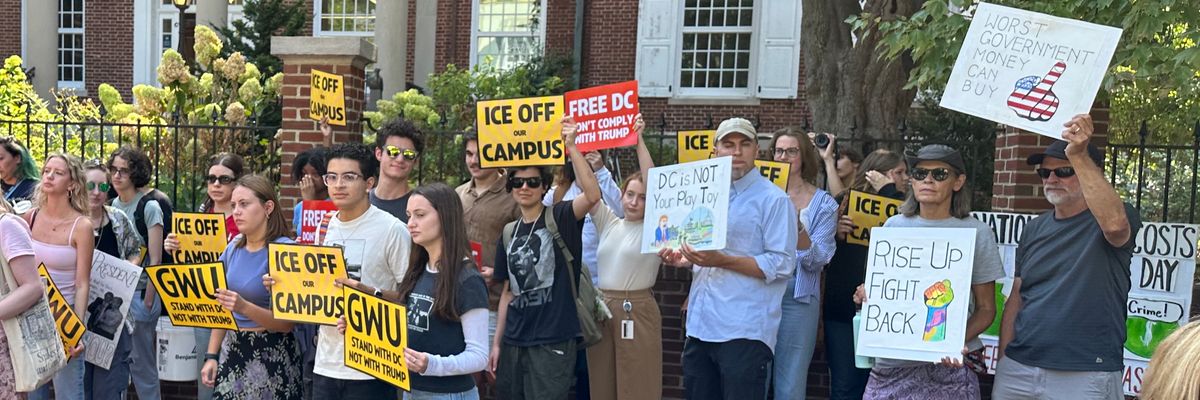
Students at George Washington University and three other schools in Washington, DC walked out on September 9, 2025 to protest the federal takeover of the district and the deployment of National Guard troops.

 (Photo by the Sunrise Movement)

“The students leading today’s walkouts are showing the entire nation what it means to resist authoritarianism with strength and solidarity,” said Rep. Pramila Jayapal.

JESSICA CORBETT

Sep 09, 2025 (CommonDreams.org)

As US President Donald Trump expands his authoritarian takeovers of Democrat-led cities, more than 1,000 students from four universities in Washington, DC walked out to protest the Republican’s recent actions in the nation’s capital.

Students from American University, Georgetown University, George Washington University, and Howard University are protesting Trump’s deployment of National Guard troops and federalization of the Metropolitan Police Department (MPD), which have also provoked a lawsuit from DC Attorney General Brian Schwalb and a congressional resolution that aims to stop his takeover.

“Students are showing the country that we won’t be silent while Trump tries to strip DC residents of our rights,” American University student organizer Asher Heisten said in a statement circulated Tuesday by the youth-led Sunrise Movement.

“When Trump sends federal forces into DC, he is trying to intimidate and silence us,” Heisten continued. “But students are proving that we will fight back to reject Trump’s dangerous authoritarianism.”

https://twitter.com/i/status/1965492160054341719

The students were joined by a pair of progressive lawmakers, US Sen. Ed Markey (D-Mass.) and Rep. Pramila Jayapal (D-Wash.).

“Trump’s federal takeover is a direct attack on democracy and the people of Washington, DC,” Jayapal said in a statement. “The students leading today’s walkouts are showing the entire nation what it means to resist authoritarianism with strength and solidarity.”

The congresswoman told a crowd at Georgetown, her alma mater, that “this is an unprecedented moment in our country, where we have an authoritarian leader who is deploying federal troops to Washington, DC—to cities across the country, militarizing our streets, kidnapping people on the streets.”

“The only bulwark that we have is the people, and so what you are doing here today is so important, because, at the end of the day, the checks and balances that were supposed to be built into our Constitution so that we could protect our constitutional rights are not working right now,” she stressed, calling out Republicans in Congress and US Supreme Court justices for refusing to hold Trump accountable.

Acknowledging the thousands of protesters who marched to the White House on Saturday, Jayapal declared that “we are not powerless,” a line that drew loud cheers from the crowd.

Markey, in his remarks at Georgetown, noted that when the president’s supporters stormed the US Capitol on January 6, 2021 in hopes of stopping the certification of his 2020 electoral loss, “Trump refused to send in troops.”

“He allowed for that assault,” Markey said of the attempted insurrection. “But now, here in DC, the president is attempting to create an impression that the crime rate is going up rather than down, that there is in fact a crisis here in the District of Columbia.”

“And what he is doing, not just here in DC, but in Chicago, in LA, in Boston, is to try to characterize communities that are majority minority, that are majority Black and brown, as being unsafe to live,” Markey noted. “And it’s not a coincidence… It is to scare America. You cannot make America great again by making America hate again.”

Markey argued that “this is not about policing, this is about political theater,” and denounced Trump’s DC takeover as a “charade.”

https://washingtonpost.com/video/c/embed/6c398cc7-08e8-4fb5-9eb8-616cf70ef3aa

Like the lawmakers, Georgetown student Scout Cardillo suggested that the DC takeover isn’t just about the district. Cardillo told The Washington Post that “the effects of the occupation of DC and federalization of MPD is going to be felt throughout the country imminently, and it is on us to take a stand and fight back.”

Our work is licensed under Creative Commons (CC BY-NC-ND 3.0). Feel free to republish and share widely.

JESSICA CORBETT

Jessica Corbett is a senior editor and staff writer for Common Dreams.

Full Bio >

Mamdani Holds Huge Lead in NYC Mayor’s Race, But Top Dems Still Won’t Back Him

Sen. Bernie Sanders Holds New York Town Hall With Mayoral Candidate Zohran Mamdani

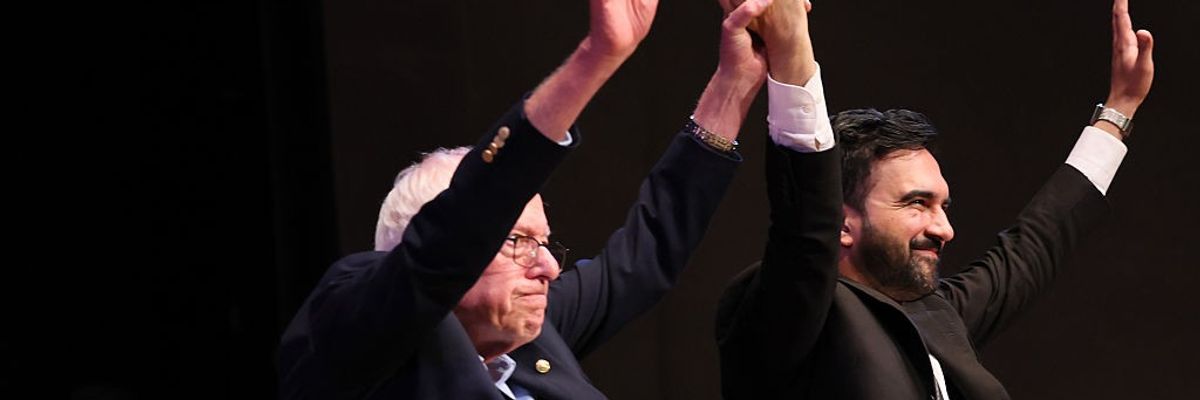
Sen. Bernie Sanders (I-Vt.) and New York mayoral candidate Zohran Mamdani prepare to leave the stage at the conclusion of the Fighting Oligarchy town hall at the Leonard & Claire Tow Center for the Performing Arts on September 6, 2025, in New York City.

 (Photo by Michael M. Santiago/Getty Images)

Voters trust Mamdani more on issues from affordability to crime to Israel-Palestine, but one strategist says party leadership is likely still refusing to back him due to “donor pressure.”

STEPHEN PRAGER

Sep 09, 2025 (CommonDreams.org)

Progressive state lawmaker Zohran Mamdani holds a “commanding” lead in New York’s upcoming mayoral election, according to the latest polling. But his continued momentum is still not enough for some top Democrats to get behind him, even as President Donald Trump openly colludes with his rivals.

New York Times/Siena poll published Monday has Mamdani, a democratic socialist state assemblyman, 22 points north of his nearest challenger, disgraced former New York Gov. Andrew Cuomo, whom he soundly defeated in the Democratic primary earlier this year.

Last week, several outletsreported that the Trump administration has been working behind the scenes to clear the field for Cuomo by offering administration posts to other mayoral candidates, including Democratic Mayor Eric Adams, and Republican contender Curtis Sliwa in exchange for them dropping out of the race.

Cuomo’s identity as Trump’s horse has ratcheted up the pressure for top Democratic leaders—namely the Empire state duo of House Minority Leader Hakeem Jeffries and Senate Minority Leader Chuck Schumer—to throw their weight behind Mamdani. But with the election now less than two months away, they have still refused to budge, to the increasing frustration of the party’s base and its progressive leaders.

Last week, Rep. Alexandria Ocasio-Cortez (D-N.Y.) called out these leaders directly, asking on the steps of the Capitol: “Are we a party who rallies behind our nominee or not?”

“I am very concerned about the example that is being set by anybody in our party,” she continued. “If an individual doesn’t want to support the party’s nominee now, it complicates their ability to ask voters to support any nominee later.”

During a stop on his “Fighting Oligarchy” tour, Sen. Bernie Sanders (I-Vt.), a Brooklyn native, said New York Democrats should be “jumping up and down” to support a candidate who has galvanized young voters like Mamdani.

Speaking of party leadership, Sanders said: “It’s no great secret that they’re way out of touch with grassroots America, with the working families of this country, not only in New York City, but all over this country.”

That sentiment was shared by the liberal tastemakers on the popular podcast Pod Save America. Former Obama speechwriter Jon Favreau called out leadership by name, saying their hesitancy to endorse Mamdani was “pathetic.”

“Donald Trump’s going to try to get Eric Adams out of the race so he can help Andrew Cuomo,” Favreau said. “Meanwhile, Hakeem Jeffries and Chuck Schumer have not yet endorsed the candidate who won the Democratic primary in New York City, the choice of the Democratic voters. Because why, because they don’t want to get involved in a primary in a city, in the state they represent?”

Favreau questioned what happened to the “rule that when a Democrat wins the primary, we’ve all got to unite behind the nominee… because we are facing an authoritarian threat.”

Cuomo, he said, “is basically participating” in that threat by being “on Donald Trump’s side.”

According to CNN, this reluctance is widespread across New York Democrats:

Reps. Yvette Clarke, Dan Goldman and Ritchie Torres have not said they plan to support Mamdani. Rep. Gregory Meeks, who endorsed Cuomo in the primary, has also remained silent along with Rep. Grace Meng, who represents parts of Queens.

New York Gov. Kathy Hochul and Mamdani have had “a number of conversations,” Hochul said recently, and the two have met in person. Speaking separately to a Politico reporter, Hochul dismissed the talks between Adams and Trump aides with a profanity. Still, she has not made an endorsement.

Sources told CNN that the reticence stems in some part from the “public threat by Mamdani’s democratic socialist allies to primary Jeffries and other congressmen” as well as Mamdani’s “ties to democratic socialists and his criticism of Israel.”

Sanders countered that Mamdani’s were “not radical ideas.”

“We’re the richest country in the history of the world,” he said. “There’s no excuse for people not having affordable housing, good quality, affordable, decent transportation, free transportation.”

Not only did the Times/Siena poll find Mamdani leading in the coming election, but voters also said they trusted him most on issues across the board, including ones that party grandees fear will be liabilities.

He holds leads over all comers, not only on his bread and butter issues of affordability and housing, but also on crime, taxation, and the Israeli-Palestinian conflict.

https://x.com/MichaelLangeNYC/status/1965369411608732125?ref_src=twsrc%5Etfw%7Ctwcamp%5Etweetembed%7Ctwterm%5E1965369411608732125%7Ctwgr%5E%7Ctwcon%5Es1_c10&ref_url=https%3A%2F%2Fwww.commondreams.org%2Fnews%2Fdems-still-wont-back-mamdani

In an interview on CNN, former Obama campaign manager David Axelrod suggested that the refusal to back Mamdani was probably the result of “donor pressure.”

Though Mamdani has surged in recent months with small-dollar donors, big money in the city has been behind Cuomo and other centrist candidates.

The biggest of these is the billionaire-funded Fix the City PAC, which received an $8.3 million donation from former New York Mayor Michael Bloomberg, and as of late August had dropped more than $15 million to keep Cuomo afloat.

Another fund, called New Yorkers for a Better Future Mayor ’25 has yet to declare a favorite, but has both barrels locked on Mamdani. Under a similar name, this PAC marshalled support for more than a dozen corporate-friendly city council candidates early this year, with support from the pro-Israel hedge fund manager Bill Ackman and several major players in New York’s real estate industry. It has announced a goal of raising $25 million to defeat Mamdani in November.

Axelrod said that the party leadership’s fealty to these donors over the groundswell of support for Mamdani was “a mistake.”

“He ran on the issue of affordability and on a kind of positive politics that got—as Bernie said—many, many young people in that city to involve themselves in the process,” he said.

Axelrod also added that, despite Jeffries’ claim that Mamdani has yet to win over voters in the House leader’s district, the insurgent candidate, in fact, “carried Hakeem Jeffries’ district” by a 12-point margin.

Former Sanders foreign policy adviser Matt Duss said that Axelrod’s diagnosis of “donor pressure” was “correct.”

“But,” he said, “we should also be completely clear that ‘donor pressure’ is just a polite way of saying ‘political corruption.'”

Our work is licensed under Creative Commons (CC BY-NC-ND 3.0). Feel free to republish and share widely.

STEPHEN PRAGER

Stephen Prager is a staff writer for Common Dreams.

Full Bio >

Make Calls to Elect Zohran Mamdani

Trump’s cronies, the political establishment, and billionaire class are lining up to try to take down Zohran Mamdani in his run for NYC Mayor.

That’s why we’re launching a nationwide phonebank campaign — making calls every Tuesday and Thursday through Election Day to reach thousands of voters and make sure Zohran wins in November.

Every call we make is another voter reminded that they have a choice – to stand with Mamdani, a fighter for tenants, workers, and justice against the oligarchs and the political machine.

– Will you join our national phonebank to elect Zohran Mamdani?
Sign Up to Phonebank

This is exactly why Our Revolution exists: to mobilize people across the country to defend progressives under attack. If we all step up, we can send a message loud and clear: we won’t let billionaires and the establishment decide our future.

Together, we will elect Zohran Mamdani – and build the movement to take on oligarchy everywhere.

When we organize, we win,

The Our Revolution Team

Today’s Calls to Action

Click here to send a message to your Member of Congress: Fight Back Against Trump’s Domestic Military Deployments by Rejecting the NDAA!

Call your Member of Congress at (202) 224-3121 and use this phone script:

  • Hello, my name is [Your Name], and I’m a constituent from [Your City]. I’m demanding that you reject the National Defense Authorization Act that funds any acts of aggression against US cities or states. Donald Trump has openly threatened to use the so-called “Department of War” against cities in the U.S. That is an abuse of power, a violation of the Posse Comitatus Act, and a betrayal of our democracy. Our military should defend us from foreign enemies, not be weaponized against our own communities. I urge you to stand with the people, not authoritarian power, and vote NO on the NDAA unless it strips Trump of these dangerous tools.

Thank you for taking action!

Q&A: For veteran S.F. Chronicle homelessness reporter Kevin Fagan, work was always personal

Fagan appears at Mission’s Roxie Theater on Sunday

A woman with wavy brown hair, wearing a sleeveless white top, gold hoop earrings, and a necklace, smiles at the camera indoors. by SAGE RÍOS MACE September 9, 2025 (MissionLocal.org)

A man wearing glasses and a green checkered shirt plays an acoustic guitar while seated in front of a whiteboard.
Kevin Fagan plays an original piece for the Marin Academy students in San Rafael on Sept. 5, 2025. Photo by Sage Rios Mace.
Law enforcement officers detain a person on the ground during an operation on a city street.

Help Mission Local cover ICE

We’ve been covering immigration enforcement intensely under Trump. Now, we’re seeking $300,000 — $100,000 a year for the rest of Trump’s term — to hire a full-time immigration reporter.

Donate

Kevin Fagan walked into Mary Collies’ 12th-grade classroom at Marin Academy in San Rafael on a recent Friday to lead a class discussion on his new book, “The Lost & the Found: A True Story of Homelessness, Found Family and Second Chances.”

He held a guitar, its case covered in stickers like “DEMOCRACY depends on JOURNALISM,” a blending of his careers as a journalist and musician.

Fagan exchanged introductions with Collie and then launched into tales of his youth: falling in love with a Wellington, New Zealand girl, scraping by as a low-paid United Press International stringer, and busking on the side to earn $300 on good nights.

Mission Local logo, with blue and orange lines on the shape of the Mission District

Want the latest on the Mission and San Francisco? Sign up for our free daily newsletter below.Sign up

Kicked out of the house at 16, Fagan’s book draws on his personal experience of homelessness and decades of experience reporting on it for the San Francisco Chronicle.

In it, Fagan unearths his personal history and intertwines extensive research on housing and inequality with the stories of Rita and Tyson, two homeless San Franciscans he met on the streets.

Following his class discussion, Fagan joined Mission Local for a Q&A on his career and the shaping of his book. His next event is scheduled for Sunday, Sept. 14, at the Roxie Theater for The Healing WELL fundraiser, “Hope Lives Here: The Tenderloin Speaks.”

Kevin Fagan sits on a desk at the front of a classroom, speaking to a group of students who are seated and facing him.
Kevin Fagan speaks about his career and new book to students at Marin Academy in San Rafael. Photo by Sage Rios Mace.

Mission Local: How did “Lost & Found” come about, and what was your writing process?

Kevin Fagan: The book grew out of journalism. In 2003, I was put out on the street by the San Francisco Chronicle managing editor, with Brant Ward, a photographer, to try to figure out why there were so many homeless people in San Francisco.

After six months of being in the street with Brant, we did a five-day series that tried to illustrate the depth of the problem, and then it moved to proposing solutions based on best practices. 

The first day of the series was focusing on a colony of about a dozen addicted homeless folks on a traffic island at Van Ness in the Mission, a colony called Homeless Island. They were addicted to heroin, crack, booze; some were turning tricks to get money. All of them were panhandling in one way or another.

One of the folks in that story was Rita Grant. She was not turning tricks. But, she was addicted to heroin and did crack and had HIV. After the story ran on Rita, Rita’s sister, Pam, who was in Florida, read the story online and used that story to come out and find Rita and rescue her.

She wrote me a letter saying“I’m coming out to get her, thanks for writing the story.”

I waited a year and went back to see how things were going with Rita and they were wonderful. She had rehabbed beautifully into the person she was meant to be. She had been an Olympics-bound gymnast, a surfer girl. They called her “homecoming queen.”

She was beautiful, smart, charming, well-liked and had just tumbled into homelessness through a series of events. You don’t just become homeless in a day, you rattle down a ladder of going through your friends, your family, crises, of course, bad choices, bad luck. 

After covering a lot of homeless stories, I’ve become a homeless specialist in my career, along with other things, too, but homelessness is the closest to my heart. 

I ran into Tyson Filzer when I was doing a story about a proposed shelter on the waterfront in San Francisco. Tyson was sitting on a piece of cardboard on the Embarcadero, and he gave me a really thoughtful Interview, so I put him in the paper and we ran a photo.

His brother in Ohio read this story online and called me up and said, “I haven’t seen him in seven years. I know he’s homeless. I know it’s bad. I’m raising money on a GoFundMe to get him into rehab — help me find him.”

I’ve helped a lot of people try to find their homeless loved ones, sometimes successfully, sometimes not. Tyson’s brother flew out here and we found Tyson in a day. I knew where to look, and it wasn’t very hard. 

He was well-liked in the community, because he was one of those guys you could trust to watch your back. Smart, a good dude. Baron, his brother, took him back to Ohio after he detoxed and did some rehab and it was a wonderful success story.

But then, hard things happened. I don’t want to give away the ending of the book, but it doesn’t end well for Tyson. Shortly after that, I thought, “I can write a book about this.” I had pitched a book in 2016 to an agent about Homeless Island, but it got rejected because there were too many characters.

Well, this time it was just two. So, Tyson and Rita represented a couple of really important aspects of homelessness to me. Their backgrounds, how they wound up where they were, and what happened to them afterwards.

ML: How did you get your start in journalism and reporting on homelessness?

KF: I wanted to be a journalist since I was 14. My mom had been a Navy journalist and she told me it was the best job in the world. She was right. And so that was a passion of mine.

But the core driving motivators for me are that I love writing, I like having adventures, I like talking to people, and I want to do good in the world. I think journalism accomplishes all four of those, especially when you’re writing about homelessness.

ML: How did your childhood experience shape your ability to report on homelessness and connect with interviewees?

KF: In terms of empathy, I can relate to someone who’s poor. I know what it’s like to have people look at you like you’re weird. I was the kid with the broken glasses, the shitty clothes from the thrift store, pants that didn’t go all the way down to your shoes.

You get judged as a kid. Children can be pretty cruel, and so I never forgot how my background made me want to explore poverty, which then, of course, inevitably led to homelessness.

I wanted to figure out why the hell I was poor. My parents were educated and we actually had a few years where we were middle class. But then, most of the time, my father was in college and we had three kids in the family and my mom could only do part-time jobs, at the best, while watching after the kids.

It made me mad that some people have to be poor in this country. I hated not having enough food in the house, I hated having shitty clothes and I hated having to leave high school early. I never took the SATs.

Fortunately, we had really good public education in California. San Jose State was a great school, but I always wondered, could I have cut it at Harvard or Stanford? Years later, when I won the John Knight Fellowship at Stanford, I got to spend a year there and I realized, yeah, I could have done this. It helped take a little monkey off my back, but it still leaves scars on you. 

Kevin Fagan sits on a stool holding a book, facing a seated student in a classroom with a whiteboard and posters on the wall.
Kevin Fagan answers student questions about his book at Marin Academy in San Rafael. Photo by Sage Rios Mace.

ML: What was it like to build a connection with Rita and Tyson across the span of many years and then bring life to their stories?

KF: It was like doing a project story, a long project story for the Chronicle, which was where I was the longest. Only it just kept going. It was a luxury. I got to have virtually all the questions I have answered.

With Rita, I figured, all right, if I want to really show who Rita is, I need to go back to the beginning. What was it like being raised with a ton of siblings? She had a lot of brothers and sisters.

I wanted to figure out, okay, where did things turn for her, good and bad? How do you trace the arc of someone’s life when it has turned out badly or turned out well, what are the junctures?

And to do that, I had to do just the same kind of research you do as a reporter. I looked up records, looked up her yearbook and the criminal records of her as well as her various family members. 

What I liked most is talking to people. I find some real happiness in interviewing people. I did probably hundreds of interviews over years between her and Tyson and all the other research I did. It was really fun to take a person’s life and jigsaw puzzle it, which is what that was like. I did that with Tyson, too. 

ML: What have you learned about the best approaches needed to solve homelessness across your career? 

KF: I think the root of homelessness is greed, if you had to give it one word on the most macro level. Something that I value in my perspective is having lived in New Zealand, Australia and England and traveled a lot.

One example I give is that England has a population of 60 million people and about the same homeless population as San Francisco, which is a city of about 850,000 people. They freak out about their “rough sleepers,” as they call their chronically homeless people. 

The difference is that they have national health, so you don’t go bankrupt because you can’t afford a doctor. And they have living-wage laws so you can work as a janitor, punching a cash register, doing, you know, low-level paper-shuffling jobs. You can work at one of those jobs in England and be able to afford rent.

Here, you can’t work a minimum-wage job in San Francisco and afford a single-room apartment for yourself. We have the worst homeless problem of any Westernized country but we’re also the richest country on earth, which is offensive.

It shouldn’t be that way. It’s because we don’t want to share societal responsibility. Just look at the income disparity: We’re in the Gilded Age, with huge splits between rich and poor. 

ML: If readers are left with one message from your book, what message should that be?

KF: Be kind, and see homeless people as human beings worthy of saving, because they need to be saved. Chronically homeless people like Rita and Tyson are not disposable human beings. They need help and they deserve help.

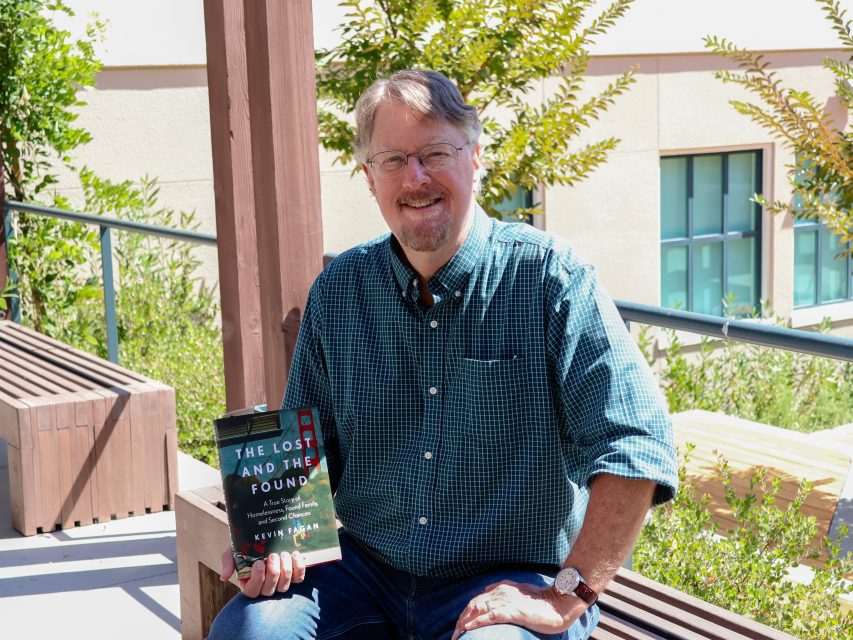
A man with glasses and a beard sits on a wooden bench outdoors, holding a book titled "The Lost and the Found" by Kevin Hays.
Kevin Fagan poses with a copy of his book at Marin Academy in San Rafael. Photo by Sage Rios Mace.

Kevin Fagan will appear at the Roxie Theater at 3117 16th St. on Sunday, Sept. 14 at 1 p.m. Doors open at 12:30 p.m. Tickets are $100. Funds raised benefit The Healing WELL. Tickets available here

Help us cover ICE in San Francisco

A police officer wearing protective gear confronts a masked individual holding a bicycle during a street incident. Another person stands nearby holding a sign or poster.

Mission Local has been covering immigration enforcement in San Francisco day in and day out — on the streets and in the courts.

As the Trump administration invests $170 billion in ICE, we want to make an investment of our own: $300,000 — $100,000 a year for Trump’s remaining three years — to hire a full-time immigration reporter.

Donate

LATEST NEWS

Former Stuff spot gets new tenant: Trading Post, selling local arts and crafts

Former Stuff spot gets new tenant: Trading Post, selling local arts and crafts

Amid immigration crackdown, Chinatown artists say it’s time to flex, not hide

Amid immigration crackdown, Chinatown artists say it’s time to flex, not hide

Nine years after S.F. cyclist’s death, hit-and-run driver gets 15 years

Nine years after S.F. cyclist’s death, hit-and-run driver gets 15 years

SAGE RÍOS MACE

sage@missionlocal.com

I’m covering immigration for Mission Local and got my start in journalism with El Tecolote. Most recently, I completed a long-term investigation for El Centro de Periodismo Investigativo in San Juan, PR and I am excited to see where journalism takes me next. Off the clock, I can be found rollerblading through Golden Gate Park or reading under the trees with my cat, Mano.More by Sage Ríos Mace

BOOK: “TAKE HOLD OF OUR HISTORY: MAKE AMERICA RADICAL AGAIN”

Take Hold of Our History: Make America Radical Again

Harvey J. Kaye

The eighteen essays and speeches in Take Hold of Our History render a manifesto – a call to remember, redeem, and embrace the American radical story and tradition in favor of cultivating American historical memory and imagination and making America radical once again. For too long we have allowed the right to hijack the past and suppress, efface, lie about, and/or appropriate the essentially radical story of America from the struggles of the Revolution to those of the Age of Roosevelt and the 1960s. And no less tragically, we on the left, apparently haunted by the worst of our national experience, have turned our back on our own story and deferred to the tales of conservatives and reactionaries. Fleeing from the past, we merely compound the tragedies and ironies of American history, for we turn our backs on both the nation’s democratic creed and radical imperative, but also the struggles from the bottom up, the struggles in which working people and others have laid hold of America’s revolutionary promise and succeeded in making the United States freer, more equal and more democratic, at times, radically so. As Bill Moyers put it in 2008: “Here in the first decade of the twenty-first century the story that becomes America’s dominant narrative will shape our collective imagination and our politics for a long time.” The time has come for us to advance that narrative.

(Goodreads.com)