Sotomayor’s dissent in Trump v. CASA

Trump v. CASA

From Wikipedia, the free encyclopedia

(Redirected from Trump v. CASA, Inc.)

Trump v. CASA, Inc.
Supreme Court of the United States
Argued May 15, 2025
Decided June 27, 2025
Full case nameDonald J. Trump, President of the United States, et al., Applicants v. CASA, Inc., et al.
Docket no.24A884
Citations606 U.S. ___ (more)
ArgumentOral argument
DecisionOpinion
Questions presented
Can a district court issue a nationwide (universal) injunction that blocks enforcement of a federal executive order beyond the specific parties involved in the lawsuit?
Holding
Universal injunctions likely exceed the equitable authority that Congress has given to federal courts.
Court membership
Chief JusticeJohn RobertsAssociate JusticesClarence Thomas · Samuel Alito
Sonia Sotomayor · Elena Kagan
Neil Gorsuch · Brett Kavanaugh
Amy Coney Barrett · Ketanji Brown Jackson
Case opinions
MajorityBarrett, joined by Roberts, Thomas, Alito, Gorsuch, Kavanaugh
ConcurrenceThomas, joined by Gorsuch
ConcurrenceAlito, joined by Thomas
ConcurrenceKavanaugh
DissentSotomayor, joined by Jackson, Kagan
DissentJackson
Laws applied
Judiciary Act of 1789

Trump v. CASA, Inc.606 U.S. ___ (2025), was a United States Supreme Court case addressing whether lower-court judges have the authority to issue “universal injunctions” to block the enforcement of policies nationwide. On June 27, 2025, the Court ruled in a 6–3 decision that universal injunctions were in excess of the judiciary power unless necessary to provide the formal plaintiff with “complete relief”. Writing for the majority, Justice Amy Coney Barrett emphasized that “complete relief” for a plaintiff was distinct from “universal relief” impacting all similar situations nationwide.

While the case did not directly address birthright citizenship in the United States, it centered on several universal injunctions blocking Executive Order 14160, issued by President Donald Trump to redefine the government‘s understanding of the Citizenship Clause. Three district court judges issued universal preliminary injunctions to block the order nationwide while the cases proceeded through the legal system.

The government appealed to the Supreme Court arguing that district judges should only be allowed to block enforcement with respect to the specific challengers filing a given lawsuit. The Supreme Court consolidated the appeals into Trump v. CASA. In its ruling, the court issued partial stays on existing injunctions except for those that were parties to the cases.

The opinion did not address the constitutionality of the birthright citizenship executive order and left open the ability for plaintiffs to pursue class-wide relief through class action lawsuits.

Background

As a presidential candidate, Donald Trump stated that he would end birthright citizenship in the United States.[1] After his second inauguration, he signed Executive Order 14160, “Protecting the Meaning and Value of American Citizenship”, which ordered all departments of the executive branch to refuse to recognize children born to illegal immigrants or visa holders as citizens.[2] An estimated 150,000 such children were born in the United States each year.[3]

The order was quickly blocked by multiple universal preliminary injunctions issued by district court judges.[4] In addition to the three cases consolidated into Trump v. CASA, the executive order was also blocked by Judge Joseph Normand Laplante in New Hampshire Indonesian Community Support v. Trump.[5] Including these orders, as of May 14, 2025 there had been 39 injunctions issued against the second Trump administration blocking actions such as mass federal employee layoffs, federal funding freezes, and deportations.[6]

The administration viewed each injunction as judicial overreach and argued lower-court judges should only be allowed to block a contested policy from affecting the actual plaintiffs involved in the case.[3][6] Neither side of the dispute briefed the Supreme Court justices on the constitutionality of Executive Order 14160.[3]

Lower court history

Eighteen states and two cities (San Francisco and Washington, D.C.) filed a lawsuit in the District Court for the District of Massachusetts as New Jersey v. Trump. Four other states filed a second lawsuit, Washington v. Trump, in the District Court for the Western District of Washington.[7][8] A third lawsuit, by immigrant and asylum-seeker rights groups CASA de Maryland and the Asylum Seeker Advocacy Project, was filed in the District Court for the District of Maryland on behalf of five pregnant women.[9]

Federal judges in each of the district courts issued preliminary injunctions to block the order from taking effect anywhere in the country.[4] Judge John C. Coughenour, presiding over Washington v. Trump, called the order “blatantly unconstitutional”.[2] Government appeals challenging the injunctions were rejected by the Court of Appeals for the Ninth Circuit, the Court of Appeals for the Fourth Circuit, and the Court of Appeals for the First Circuit.[4]

U.S. Supreme Court

On April 17, the Supreme Court agreed to hear Trump v. CASA, consolidating it with Trump v. New Jersey and Trump v. Washington and setting oral arguments for May 15.[10]

Oral arguments were heard on May 15, with the solicitor general of the United States, D. John Sauer, representing the administration; Kelsi B. Corkran, for the immigrant groups, including CASA;[11] and Jeremy Feigenbaum, the solicitor general of New Jersey, for the various states.[12]

Decision

On June 27, the Supreme Court ruled 6–3 that, “Universal injunctions likely exceed the equitable authority that Congress has given to federal courts.”[13]

Justice Amy Coney Barrett wrote the majority opinion. Barrett’s opinion did not declare universal injunctions unconstitutional, but concluded that they were an overreach based on the Judiciary Act of 1789 and inconsistent with “historical equitable practice”.[14] Barrett wrote that “the equitable relief available in the federal courts” should be akin to what was “‘traditionally accorded by courts of equity'” at the time of the founding of the United States,[14] quoting the Supreme Court’s holding in Grupo Mexicano de Desarrollo, S.A. v. Alliance Bond Fund, Inc. (1999).

The Court granted the government a partial stay of the injunctions blocking Executive Order 14160, but “only to the extent that the injunctions are broader than necessary to provide complete relief to each plaintiff with standing to sue.”[13] They specified that the executive order could not take effect until 30 days after the ruling.[15]

Barrett acknowledged the importance of providing “complete relief” to plaintiffs seeking an injunction, but said “complete relief” was a narrower concept than “universal relief”. Barrett wrote that a pregnant mother would receive complete relief as long as her own child was not denied citizenship. “Extending the injunction to cover all other similarly situated individuals would not render her relief any more complete,” Barrett continued.[16]

However, the Court left it to the “lower courts [to] determine whether a narrower injunction is appropriate” with respect to the states suing the administration.[16] The states had argued that only a universal injunction would provide them with complete relief, because tracking the immigration statuses and residences of parents moving between states before providing a newborn with mandated benefits would be administratively complex.[16]

The court’s ruling left open the ability for plaintiffs to seek widespread relief by filing class action lawsuits.[17]

Concurrences

Justices Clarence ThomasSamuel Alito, and Brett Kavanaugh filed concurrences. Justice Neil Gorsuch joined Thomas’s concurrence and Thomas joined Alito’s concurrence.[18][19]

Thomas’s concurrence explicitly stated that the Court’s decision ended the practice of district courts issuing universal injunctions and emphasized the need to create remedies specifically tailored to the parties in a case.[20]

Kavanaugh wrote that plaintiffs may still request the “functional equivalent of a universal injunction” by filing “statewide, regionwide, or even nationwide” class action lawsuits.[19]

Alito opined that the Court’s decision may potentially have a loophole if states can assert third-party standing to obtain broad injunctions on behalf of their residents, or if district courts award injunctions to broadly defined classes in class action lawsuits. He urged lower courts to be vigilant against potential abuses of these methods.[21][20]

Dissents

Justice Sonia Sotomayor filed a dissent which was joined by Justices Elena Kagan and Ketanji Brown Jackson. Sotomayor argued the government had not pursued a complete stay of the injunctions because such relief would require them to prove that Executive Order 14160 was likely constitutional. She wrote:[22]

The gamesmanship in this request is apparent, and the Government makes no attempt to hide it. Yet, shamefully, this Court plays along.

Jackson also filed a separate dissent, in which she wrote:[23][24]

When the Government says ‘do not allow the lower courts to enjoin executive action universally as a remedy for unconstitutional conduct,’ what it is actually saying is that the Executive wants to continue doing something that a court has determined violates the Constitution—please allow this.

Barrett criticized Jackson’s dissent, writing that “Justice Jackson decries an imperial Executive while embracing an imperial Judiciary.”[24]

Within hours of the Supreme Court ruling, CASA de Maryland filed a motion in their existing district court case in Maryland, asking Judge Deborah Boardman to certify a class of children born to immigrant parents who would be ineligible for birthright citizenship under Executive Order 14160.[25] The American Civil Liberties Union filed another class action suit in New Hampshire the same day.[26]

More at: https://en.wikipedia.org/wiki/Trump_v._CASA

SF Pride focuses on the joy in resisting 

  • by John Ferrannini, Assistant Editor 
  • Tuesday, June 24, 2025 (ebar.com)

People celebrate LGBTQ Pride at the 2023 San Francisco parade.

Photo: Gooch

San Francisco Pride has been buffeted by declining sponsorships amid corporate retreats from diversity, equity, and inclusion policies. But the organization is leaning into its theme, “Queer Joy is Resistance,” as it prepares for the annual parade and celebration. The Pride parade kicks off at 10:30 a.m. Sunday, June 29, from Market and Beale streets, commemorating the 56th anniversary of the Stonewall riots that began the modern movement for LGBTQ civil rights in the United States.

The parade’s theme comes on the heels of nationwide protests against President Donald Trump and the backsliding of democracy that’s already leading to attacks on the civil rights of queer people, particularly the trans community. The parade – one of the largest in the world and San Francisco’s biggest annual march – also caps over a week of activities put on by the San Francisco Lesbian, Gay, Bisexual, Transgender Pride Celebration Committee.

“This year’s theme, ‘Queer Joy Is Resistance,’ is more than a slogan. It’s a call to action.” Suzanne Ford, a trans woman who is SF Pride’s executive director, told the Bay Area Reporter.

“At a time when our community is under attack from powerful political forces, simply showing up to Pride is an act of defiance,” Ford stated. “It’s about joy in the face of fear, unity in the face of division, and love in the face of hate. I’ve never seen this community more determined to stand together – and that’s exactly what we’re doing this year. We’re not backing down.”

Joshua Smith, SF Pride’s board president, mentioned the backlash against LGBTQ rights and DEI efforts. These have led to some major corporate sponsors of Pride in prior years opting not to participate this go-around, as the Bay Area Reporter previously reported.  

“Pride has always been about visibility, but this year it’s also about perseverance,” Smith stated. “As we celebrate SF Pride’s 55th anniversary, we’re honoring the power of community to come together, even in the face of political and social backlash. Our message is clear: we are still here, still proud, and we are not going anywhere.”

Every year there are a number of grand marshals. Community grand marshal Kenan Arun, a board choice, is the co-executive director of the Center for Immigrant Protection. He also is a volunteer with the San Francisco Gay Men’s Chorus and a board member at The Turkish American Gezi Platform.

“San Francisco means home, not just in geography but in spirit – a place where I could fully embrace every part of who I am,” Arun stated. “It was never just about moving to the United States; it was about choosing San Francisco. As both an immigrant and a queer person, this city represents the possibility of safety, expression, and community. … After more than 15 years of LGBTQ+ advocacy from Turkey to the U.S., I know the work is far from over. Representing Pride is how we ensure no one gets left behind – especially our trans siblings – whether in our birthlands or our chosen homes.”

Community grand marshal Jessy Ruiz, another board choice, is from Michoacan, Mexico, and immigrated to the United States in 1996. Ruiz plans to open a new nonprofit organization, Voces Trans Latinx, (Voices Trans Latinx) and currently works at the Mission Neighborhood Resource Center.

“When people see someone like me, a Latina transgender woman, in a leadership position, we give them a reference, proof that it is possible to live authentically, with dignity and without fear,” Ruiz stated. “Representation is a tool for empowerment because it helps us break down barriers, challenge prejudice and create a world in which we can all live freely.”

Community grand marshal Jahnel Butler is a public choice. Known as Jahnell Chanel in the Ballroom scene, she is associate director of trans services at the San Francisco Community Health Center.

“Representation at Pride matters because it tells our community, ‘You belong. You’re not alone. Love is transformative,” Butler stated. “It’s important to show up – because when we’re visible, we’re powerful. And that power creates positive change.”

“San Francisco Community Health Center is committed to providing comprehensive, culturally responsive, and gender affirming health care,” according to a statement from the nonprofit, which is this year’s organizational grand marshal. “In the time of rising attacks on our communities, SFCHC continues to be committed to centering those most impacted, particularly the transgender and gender non-conforming community whose bold existence forces us to rethink and reimagine what’s possible for us all. SFCHC works tirelessly to lift up the voices of our communities and shows the world that we are powerful.”

Tyler TerMeer, Ph.D., a member choice for grand marshal, is CEO of the San Francisco AIDS Foundation. TerMeer is queer, Black, and HIV-positive, and discussed these identities in his statement.

“It’s humbling to be named grand marshal at a time when our very existence is being legislated. I carry this honor not just for myself, but for every Black, queer, and HIV-positive person who’s ever been told they don’t belong,” TerMeer stated. “This honor isn’t just about me – it’s about the movement, the memory, and the mandate to keep showing up, louder and more unapologetically than ever.”

The lifetime achievement award went to longtime social activist Tita Aida, aka Nicky Calma, who also works at the San Francisco Community Health Center.

“To receive the lifetime achievement grand marshal is a great honor I will cherish and will linger during my lifetime and beyond. Very proud to be part of our growing LGBTQIA history,” Aida stated. “SF Pride is like family to me. The work SF Pride gives me that octane of humility, unconditional kindness and to grow to do what I do, to serve my community.”

Read the rest of this story below

and never miss another!

Sign up today to receive trusted LGBTQ news in your inbox.Please select the newsletters you’d like to subscribe to:Bay Area Reporter newsletterNews is Out weekly newsletterBay Area Reporter health newsletterSubmit

A contingent carried flags in the 2024 San Francisco Pride parade.    Photo: Rick Gerharter

Other events
SF Pride’s celebration, or festival, takes place Saturday, June 28, and Sunday, June 29, in Civic Center Plaza from 11 a.m. to 6 p.m. The June 28 headliner is trans actress Michaela Jaé of “Pose” fame, and the June 29 headliner is gay rapper Saucy Santana.

For those interested in something a little different, there’ll also be a Pride Rollerdisco at SVN West, 10 South Van Ness Avenue, from 2 p.m. to 9 p.m. June 29. It’s billed as “the ultimate rooftop roller skating party under the San Francisco sky,” according to SF Pride’s webpage, which has tickets available to this and the subsequently mentioned events at sfpride.org/events .

“This all-inclusive, disco-drenched celebration is taking over SVN West Rooftop for an afternoon of glitz, glam, and groove – all in honor of San Francisco Pride and Folsom Street,” the website states.

Also concurrently is the Pride party inside San Francisco City Hall from 1 to 5 p.m. featuring an art show and a hosted bar.

Thursday, June 26, will see a Pride block party at 5 p.m. outside 10 Annie Street in the Yerba Buena neighborhood, south of Market Street. Admission is free.

Earlier that day will be SF Pride’s third annual Human Rights Summit. The summit will be from 9:30 a.m. to 7 p.m. at the Commonwealth Club at 110 The Embarcadero, and will be hosted by Michelle Meow. Marsha Levine, the former longtime San Francisco Pride parade manager and the founder of InterPride, will moderate. Speakers include San Francisco City Attorney David Chiu, a straight ally, and Evan Low, a gay former state Assemblymember who’s now president and CEO of the LGBTQ+ Victory Fund.

As the B.A.R. previously reported, after SF Pride opted not to make Andry Jose Hernández Romero, the Venezuelan asylum seeker who was sent by the Trump administration to an El Salvador megaprison without due process, an honorary grand marshal, Ford had stated, “We will also dedicate a significant portion of the Human Rights Summit on Thursday of Pride Week to highlight this important issue and center the voices of impacted communities.”  

There is a portion on the summit’s schedule, at 3 p.m., titled “At the Intersection of Immigrants, Trans, and People with Disabilities. Disability Rights Education and Defense Fund (DREDF), MIJENTE, SF PRIDE, Advocates for Trans Equality (A4TE),” but this is the only portion mentioning immigration-related matters.

Meow confirmed June 19 that the 3 p.m. item would address asylum and migration matters.

Meow stated to the B.A.R. that this is the “most important year” for the summit as “anti-LGBTQIA+ policies have continued to strip human decency away from our communities, including our most vulnerable and precious populations.”

“Queer joy is what we deserve,” Meow stated. “Resistance is our power to fight for our existence and humanity collectively.”

Finally, San Francisco Opera will hold a Pride concert Friday, June 27, at 7:30 p.m. at the San Francisco War Memorial Opera House, 301 Van Ness Avenue.

San Francisco Opera has been a proud participant in San Francisco Pride since the 1980s, SF Pride’s website stated. It will celebrate the LGBTQIA+ community with a very special evening of music, immersive projections, and post-show dance party. Sapphira Crystál is a superstar drag queen and trained opera singer who will host this celebratory evening. Tickets start at $30.

GOP Budget Bill Falling Apart as Senate Parliamentarian Strikes Dozens of Provisions

Republican Lawmakers Work To Pass Trump's "Big, Beautiful Bill" On Capitol Hill

U.S. Senate Majority Leader John Thune (R-S.D.) speaks to reporters at the Capitol on June 25, 2025.

 (Photo: Joe Raedle/Getty Images)

“With more decisions to come, this guidance results in more than $250 billion in healthcare cuts removed from the Republicans’ big bad bill,” said Democratic Sen. Ron Wyden.

JAKE JOHNSON

Jun 26, 2025 (CommonDreams.org)

Key elements of the sprawling Republican budget package—including major components of its assault on Medicaid—are crumbling under scrutiny from Democratic staffers and the Senate parliamentarian, who has deemed dozens of provisions in violation of reconciliation rules.

On Thursday, Elizabeth MacDonough—who was appointed as parliamentarian in 2012 and has served under both Republican and Democratic leadership—advised against nine provisions of the GOP legislation that are under the Senate Finance Committee’s jurisdiction.

WITHOUT YOU, COMMON DREAMS SIMPLY WOULDN’T EXIST.

In a moment that demands fearless reporting, Common Dreams needs your support to keep our independent journalism alive.

about:blank

One of the provisions seen as running afoul of the so-called Byrd Rule was the Senate GOP’s proposal to sharply limit provider taxes that states use to fund their Medicaid programs—a change that experts said would result in catastrophic healthcare cuts.

Provisions targeted by the parliamentarian would be subject to a 60-vote threshold in the Senate if kept in the bill, meaning they would require Democratic support to pass. Republican leaders have indicated that they’re rewriting some of the targeted provisions in an attempt to bring them into line with budget reconciliation rules, which bar provisions that don’t have direct budgetary impacts.

“The parliamentarian has made clear that reconciliation can not be used to manipulate state provider tax policies, which would have resulted in massive Medicaid cuts that hurt kids, seniors, Americans with disabilities, and working families,” Sen. Ron Wyden (D-Ore.), the top Democrat on the Senate Finance Committee, said in a statement Thursday following news of the parliamentarian’s latest advisory rulings.

“With more decisions to come, this guidance results in more than $250 billion in healthcare cuts removed from the Republicans’ big bad bill,” said Wyden. “Democrats fought and won, striking healthcare cuts from this bill that would hurt Americans walking on an economic tightrope. This bill is rotten to its core, and I’ll keep fighting the cuts in this morally bankrupt bill until the end.”

Senate Budget Committee Democrats, led by Sen. Jeff Merkley (D-Ore.), provided a summary of the latest provisions deemed in violation of reconciliation rules:

“Democrats are continuing to make the case against every provision in this Big, Beautiful Betrayal of a bill that violates Senate rules and hurts families and workers,” Merkley said in a statement Thursday. “Democrats are fighting back against Republicans’ plans to gut Medicaid, dismantle the Affordable Care Act, and kick kids, veterans, seniors, and folks with disabilities off of their health insurance—all to fund tax breaks for billionaires.”

Under a behind-the-scenes process known as a “Byrd Bath,” Senate committee staffers and the parliamentarian confer over whether a bill’s provisions meet reconciliation guidelines.

In recent days, the parliamentarian has determined that dozens of provisions in the GOP legislation—including certain attacks on federal food aid, public lands, and the Consumer Financial Protection Bureau—don’t comply with the Byrd rule and must either be removed or face a 60-vote threshold in the upper chamber.

Bobby Kogan, senior director of federal budget policy at the Center for American Progress, praised minority staffers on the Senate Budget and Health, Education, Labor, and Pensions Committees on Wednesday after the parliamentarian ruled against six separate provisions of the GOP bill.

“Republicans just lost 10% of the affirmative savings they wanted to get in reconciliation. Truly in awe of the Bernie Sanders HELP staff and the Jeff Merkley Budget staff,” Kogan, a former Senate Budget Committee staffer, wrote on social media.

In a Thursday post responding to the parliamentarian’s latest decisions, Kogan wrote, “We won on trans care in Medicaid, provider taxes, [Federal Medical Assistance Percentage], immigrants in Medicaid, and other issues.”

“These victories are amazing for the people they help—and cost Rs more than $250 billion of their savings by rough calculations, largely not curable,” Kogan added.

Democrats on the Senate Budget Committee indicated Thursday that the parliamentarian is still reviewing a number of provisions, including a section of the Republican bill that would prohibit Medicaid funding for Planned Parenthood.

“Republicans are scrambling to rewrite parts of this bill to continue advancing their families lose and billionaires win agenda, but Democrats stand ready to fully scrutinize any changes and ensure the Byrd Rule is enforced,” Merkley said Thursday.

Our work is licensed under Creative Commons (CC BY-NC-ND 3.0). Feel free to republish and share widely.

JAKE JOHNSON

Jake Johnson is a senior editor and staff writer for Common Dreams.

Full Bio >

Listen Up, Democrats

Lessons to be learned from an NYC shocker

DAN RATHER AND TEAM STEADY JUN 26, 2025

Credit: Getty Images

You might not think a Democratic primary for New York City mayor would hold much national import. In most election cycles, you would be right. In 2025, you would be mistaken.

No doubt New Yorkers have a mind of their own when it comes to their politics and politicians, but when a democratic socialist wins the Democratic mayoral nomination in the world capital of capitalism, it’s a big deal.

It’s safe to say the shockwaves from this mayoral contest have resonated far west of the Hudson River. If it wasn’t paying attention before, the Democratic establishment must be now. Voters are anxious, almost desperate, for something and someone new and different.

Zohran Mamdani, the newly crowned Democratic mayoral nominee, was born in Uganda before moving with his Indian parents to the United States. He’s a charismatic, 33-year-old Muslim and state assemblyman who trounced Andrew Cuomo, a 67-year-old former governor of New York. Cuomo resigned in 2021 after 11 women accused him of sexual harassment. He denied the allegations but quit the office under pressure.

When put that way, it was not a surprising outcome. But when you add Mamdani’s platform, which includes a tax on millionaires to make city bus service free, city-owned grocery stores to control prices, and free universal child care, the results were astonishing — or something at least close to that.

Mamdani has a good chance of becoming New York’s next mayor in November’s general election. It is by no means assured, but even that he has a shot is a shock. His opponent (so far) is Eric Adams, the scandal-plagued and unpopular current mayor, who is running as an independent. How many others will enter the race is currently unknown, but it is likely to be a crowded field, including at least one Republican.

Because of Mamdani’s left-of-center policies, Wall Street and many in the Democratic Party are in a full-blown panic.

No one knows how much of his socialist platform Mamdani would be able to achieve if he becomes mayor, so some of the fears may be premature. For now, let’s push the policy stuff aside and focus on actionable takeaways.

Share

Democrats can and should learn a lot from this election. The electorate is exhausted and hungry for authenticity, for someone new who will fight to control costs. Mamdani’s campaign focused on the affordability crisis in New York. People are weary of establishment candidates and a Democratic Party that sits on its hands and doesn’t confront head on the likes of Donald Trump.

Mamdani exuded youth and vigor. He was a strong person-to-person campaigner. He focused on kitchen table issues and offered solutions. He flooded the media zone with appearances and videos that went viral and got people excited, which got them to the polls. He flipped the political script to take down the last remnants of a political dynasty.

Most importantly perhaps, he gave people hope — an emotion in extremely short supply these days, but one that has had a strong positive effect on the voting public. Hope equaled votes. It may be time to remind us all that both Bill Clinton and Barack Obama won riding hard on hope messaging.

“What’s happening in NYC is a blaringly loud message to those in the Dem establishment who still cling to old politics, recite focus-grouped talking points, and are too afraid to say what needs to be said,” Dan Pfeiffer, a former senior adviser to President Obama, posted on social media.

What needs to be said is that the Democratic Party is having an identity crisis, but not an existential one. I say this as a longtime observer of American politics who recognizes the urgent need to mount a plan to take back government control from a widespread movement led by an increasingly autocratic and egomaniacal president. And since there is no sign that Republicans will do it, it’s up to Democrats.

After Joe Biden’s early exit from the presidential race and Kamala Harris’s insurmountably short general election campaign, Democrats were left with a leadership vacuum. Add to that extended hand-wringing and recriminations for why Harris lost, and you have a party in serious need of repair.

By definition, Democrats are the “big tent” party. They are inclusive, taking all-comers. While this is a laudable trait in a political party, it can make coalition building and message-shaping extremely challenging.

Today, the Democrats do have strong, popular elected officials and candidates in all branches of the party: progressives and centrists, old guard, and young guns. But because they are all vying for control, infighting is inevitable. This hampers their ability to focus on the end game.

The way out of this Trump-centric, anti-democratic wilderness is a simultaneous attack on two fronts. The Democratic Party can’t be the lesser of two evils. To generate enthusiasm, the electorate must want to vote for them, not just against the other guy. Democrats have constantly been warned that they must vigorously criticize Trump, calling out his lies, corruption, and policies that hurt a majority of Americans, while owning the pocketbook issues that help those very same Americans. This is a page straight out of Mamdani’s playbook.

The polling couldn’t be clearer. According to a YouGov poll from mid-June, the top issues among all registered voters are civil rights (17.6%), inflation and prices (16.9%), and jobs and the economy (13.1%). You know what’s not there? Immigration. It has become Trump’s signature issue because he made it an issue. In Nate Silver’s polling average, Trump is underwater on almost every issue, including immigration (-4), the economy (-13), and inflation (-26.5).

The fact that civil rights is at the top of the list is an important change. During the 2024 presidential campaign, Harris, and Biden before her, tried to paint Trump as a threat to democracy. He was then and clearly still is today. But during the campaign it was an amorphous idea that many people simply didn’t believe, all while eggs cost $7 a dozen. But now, eggs aren’t much cheaper, and “democracy in danger” is no longer a hazy notion but a striking reality.

No doubt Mamdani will be a frequent target of Trump and his allies at Fox “News.” But maybe, for once, Democrats won’t take the bait.

Democrats are urged now to adopt an agenda that includes: controlling costs, implementing equitable tax policy, expanding health care, protecting due process, curtailing executive power. All of these things would be helping Americans, while simultaneously restoring our constitutional republic based on the principles of freedom and democracy.

It can and should be both. This would force Republicans to defend Trump’s indefensible and unconstitutional policies. Add in a major helping of hope and Democrats would have a shot at slowing if not outright stopping Trump’s agenda by taking Congress next year.

Does this reporter believe socialism is surging in New York? Or America as a whole? No. But antiestablishment candidates who focus on pocketbook issues and inspire voters will be a force wherever they spring.

Steady is free, but to support my team’s efforts to protect our democracy through the power of independent journalism, we’d appreciate it if you would consider joining as a paid subscriber. It keeps Steady sustainable and accessible for all. If you are not able to upgrade, we understand.

Upgrade to paid

No matter how you subscribe, I thank you for reading.

Stay Steady,
Dan

Anti-ICE protesters crash Palantir’s Bay Area office

By Stephen Council,Tech Reporter

June 26, 2025 (SFGate.com)

Protesters rallied against the tech company Palantir on June 26, 2025 in Palo Alto, Calif.Stephen Council/SFGATE

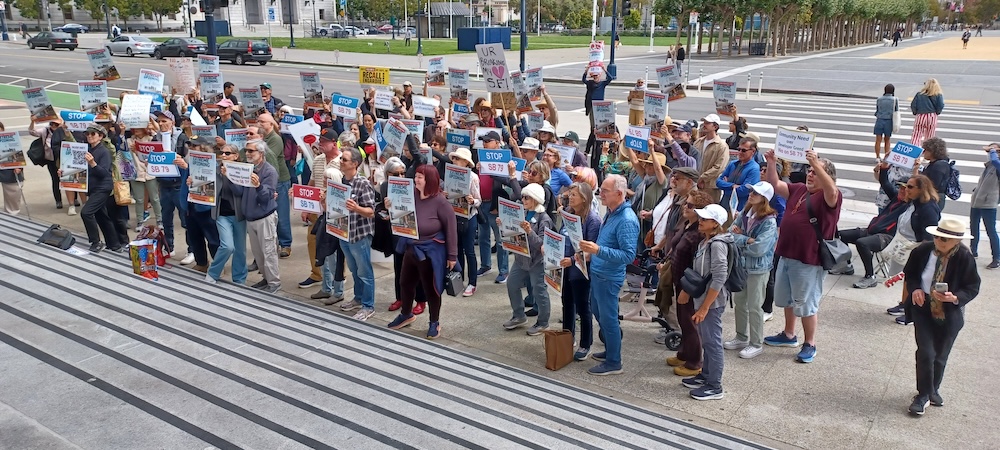
More than a hundred protesters gathered at Palantir’s Palo Alto offices on Thursday afternoon, with signs, speeches and chants that painted the data mining company as a force for evil. Attendees decried Palantir’s work with Immigration and Customs Enforcement and with the Israeli government, equating the $337 billion company to “Big Brother” and “the surveillance state.” 

The rally featured similar rhetoric to other anti-ICE and anti-oligarchy protests that have popped up around the Bay Area since the start of President Donald Trump’s second term, but was targeted at a narrower enemy. The Denver-headquartered company is working with ICE to speed its controversial deportation efforts, and, per the New York Times, creating a “master list of personal information on Americans” that critics argue could be used for mass surveillance. Speakers at the protest said that, after ICE’s raids in Los Angeles, Palantir could help the Trump administration target dissenting Americans next — boos rained in response.

“Palantir is the most dangerous company that you might never have heard of,” Katie Na, an organizer with Planet Over Profit, one of the protest’s planners, told SFGATE before the event. She pointed to Palantir’s co-founder, the Trump ally and conservative financier Peter Thiel, and called the company a “weapon” for his vision, she said, of “authoritarianism, mass surveillance, deportation and genocide.”

At first, attendees met outside the Palantir office on the corner of Alma Street and Hamilton Avenue. They hefted a banner reading, “Palantir Powers ICE” — which people from inside the office ran out to tear away — and blocked off Alma Street with lines of protesters. Signs included phrases like “Palantir Powers ICE & Automates Cruelty,” and “Predatory Tech.” During speeches, a pro-Palestine activist tied Palantir’s surveillance work to Israel’s destructive strikes in Gaza, a Google worker spoke about workers’ opposition to tech’s military use and an activist from the Alliance of Californians for Community Empowerment accused Palantir of “enabling the ICE raids that are separating our families.”

Then came a twist. After the speeches, Na directed the crowd to march, and led them around the corner to another building labeled with Palantir’s logo. Inside, she said, the company was running a recruiting event; she later said she saw people paper up the front door as the crowd approached.

“You’re doing the worst possible thing with your talents,” Na said into a megaphone, directing her message to potential recruits, as other protesters pounded on the windows and shouted for the event to be shut down. “Don’t stain your hands with blood while you fill your pockets with money, it’s not worth it.” 

SFGATE wasn’t able to immediately verify what was happening inside the building. Palantir did not respond to a request for comment as of publication. Six people were arrested at a protest against Palantir at the company’s New York office on Thursday, the Guardian reported, but there were no arrests in Palo Alto.

Na wrapped up the protest by declaring it a “f–king victory” and claiming that the event inside had been shut down due to the noise and attention. She, as well as fellow Planet Over Profit organizer Alice Hu, emphasized their hopes to SFGATE that damaging Palantir’s reputation might damage its stock price, in the mold of this spring’s “Tesla Takedown” protests. 

Attendees on Thursday had varying degrees of familiarity with Palantir, which has long remained under the radar thanks to its non-consumer-facing business model. The company, which is named for the magical “seeing stones” in “The Lord of the Rings,” sells software meant to help companies and governments deal with massive amounts of data. It has nearly doubled in value this year on investor excitement over its artificial intelligence tech and its government contracts — as of Thursday, it was worth more than either Coca-Cola or Samsung.

Alex Karp, the company’s CEO, has been unabashed about his views that Silicon Valley should take a larger role in Washington, and in particular, in making products for military use. Protests against his company’s work with ICE are nothing new — 2018 saw an action at this same office, and in 2019, tech activists blasted Palantir on its Github page. But the company’s recent work has brought new critics into the fold.

Linda Maki, who heard about the protest through a “Raging Grannies” email group, told SFGATE she’d attended a series of the anti-Tesla protests in the Bay Area this year, and lambasted the recent actions by ICE agents. She held a sign reading, “ICE = BOUNTY HUNTERS,” and blamed Palantir for helping the agency’s work.

“I’m for law and order,” Maki said, referencing instances in which the masked agents seem to be operating extrajudicially, including the beating of a California gardener who was father to three Marines. She called the agents “armed thugs” and “lawless vigilantes, but on our dime.”

A protester at the rally against Palantir on June 26, 2025 in Palo Alto, Calif., holds up a handmade sign.Stephen Council/SFGATE

Rocky Chau, another attendee, said he hadn’t known much about Palantir until about a month ago, but quickly recognized it as part of a “common enemy” of multibillion dollar corporations.

Along with Palestinians in Gaza, Chau said he was protesting on behalf of vulnerable, marginalized groups harmed domestically by the Trump administration. He added, “Who knows who will be targeted next?”

Work at a Bay Area tech company and want to talk? Contact tech reporter Stephen Council securely at stephen.council@sfgate.com or on Signal at 628-204-5452.

June 26, 2025

Stephen Council

TECH REPORTER

Stephen Council is the tech reporter at SFGATE. He has covered technology and business for The Information, The Wall Street Journal, CNBC and CalMatters, where his reporting won a San Francisco Press Club award.Signal: 628-204-5452
Email: stephen.council@sfgate.com

Democratic Party Accidentally Elects Someone Who Believes in Democracy

r/PoliticalHumor • 1 day ago NewYorkerNIck on Reddit.com

r/PoliticalHumor - Democratic Party Accidentally Elects Someone Who Believes in Democracy (Parody)

Democratic Party Accidentally Elects Someone Who Believes in Democracy

From – @GothamGoose on Instagram

NEW YORK (GOTHAM GOOSE) — In a shocking twist no one saw coming except literally everyone under 35, Queens Assemblymember Zohran Mamdani won the Democratic primary last night, leaving party insiders and political pundits scrambling to figure out how to spin “honesty” as a red flag.

According to anonymous DNC strategists, confusion set in shortly after the win was announced: “We kept refreshing NBC 4 New York waiting for someone to call him unelectable again,” said one senior comms staffer from an anonymous well known newspaper. “We even tried to use Chat GPT but it generated a donation link and asked how it could help Mamdani in the general election.”

In a group chat reportedly titled “Democratic Unified Messaging Board (aka D.U.M.B.”) centrist consultants floated the idea of labeling Mamdani as “too young,” then “too ideological,” before settling on “too sincere.” That didn’t stick either.

Meanwhile, a team of digital advisors tried reviving an old Vine meme to confuse younger voters, hoping it would trend before they realized TikTok isn’t a time machine. In a last-ditch attempt to manufacture scandal, a source confirmed that mayoral candidate Whitney Tilson was consulted to produce a new “AI Slop” attack ad—a remix of Mamdani’s old rap video meant to discredit him.

Unfortunately for the DNC, Mamdani’s base just made the remix go viral and turned it into a ringtone.

“It’s giving grassroots,” said one Gen Z voter. “And also bars.”

When reached for comment, one journalist at a major outlet said,

“We were ready to call him inexperienced. If that didn’t work, we were gonna go with unelectable. Now that he’s electable… we’re pivoting to: ‘Is democracy moving too fast? Is ranked voting actually democratic?’”

Party insiders are now reportedly researching ways to gerrymander TikTok and rebranding “meeting people’s material needs” as “economic instability.” Stay tuned for more panicked think pieces. And another AI video later in the week.

(Contributed by Gwyllm Llwydd)

Supes approve measure calling for local taxes on the very rich; news media doesn’t notice

By TIM REDMOND

JUNE 24, 2025 (48hills.org)

In what could be an historic move that nobody in the news media has noticed, the Board of Supes today unanimously approved a resolution calling for income and wealth taxes on the richest San Franciscans.

The measure, by Sup. Chyanne Chen, has no immediate impact; the state bars local government from taxing income or wealth. The resolution calls on the San Francisco delegation in Sacramento to seek legislation to change that.

But it’s the first time in decades that the Board of Supes has even considered the concept of a local income or wealth tax—and in the long term, if this gets any traction, it could transform local government finance in California.

The concept of taxing the rich has a lot of traction; why can’t we do it in San Francisco? Image from Twitter

The resolution passed with no discussion at the end of the meeting as part of a consent agenda for items introduced without committee reference.

State Sen. Scott Wiener has already told me he has no interest in pursuing that type of legislation. I have yet to hear from Assemblymember Matt Haney, who once identified as a progressive.

A modest income tax on the richest San Franciscans would resolve the city’s budget deficit with no cuts to public services. Everyone who would pay is already set to benefit from the Trump tax cuts.

The vote comes as we are starting to see increasing pushback against the billionaires paying little or no tax. Jeff Bezos just had to move the site of his $20 million Venice wedding because of protests. A prominent banner reads: “If you can rent Venice for your wedding you can pay more tax.”

New York mayoral contender Zohran Mamdani has made increasing local taxes on the rich the centerpiece of his campaign.

So there’s some traction for this—but so far, we are the only news outlet that has even mentioned the resolution.

Also, in a major victory for Sup. Shamann Walton, Mayor Daniel Lurie has backed off from a plan to shift money from housing to build a new congregate shelter in the Bayview.

Walton has been fighting the proposal for months now, saying nobody in the community support it and that it was imposed with little or no community input.

The Budget and Appropriations Committee forwarded it to the full board without recommendation, and the supes rarely go against what a member wants in their district.

At today’s full board meeting, Walton announced that he has reached a deal with the Mayor’s Office to scrap the proposal for 82 dorm beds on Jerrold Street. “Mayor Lurie has agreed to work with the community to decide the best use for this site,” Walton said.

This is more than an issue for one neighborhood that’s already done, as Walton said, more than its fair share of helping the city deal with the homelessness crisis. It’s about the mayor’s priorities—which right now amount to finding ways to get the unhoused out of sight, even if that means moving them into uncomfortable, often inappropriate shelters.

48 Hills welcomes comments in the form of letters to the editor, which you can submit here. We also invite you to join the conversation on our FacebookTwitter, and Instagram

Tim Redmond

Tim Redmond has been a political and investigative reporter in San Francisco for more than 30 years. He spent much of that time as executive editor of the Bay Guardian. He is the founder of 48hills.

Stanford Medicine Announces ‘Pause’ In Providing Gender-Affirming Surgeries for Trans Youth

25 JUNE 2025/SF NEWS/JAY BARMANN (SFist.com)

In short order, UCSF may be one of the last, if not the last place in California for teenagers under the age of 19 to seek gender-affirming surgeries, with Stanford Medicine bowing out of the practice earlier this month.

Stanford Medicine has confirmed that it has “paused” providing gender-affirming surgeries for youths under the age of 19, effective June 2, 2025, due to the threat of legal action and funding loss from the federal government under the Trump regime. This decision comes just as one of the largest providers of such care to trans youth in the country, Children’s Hospital of Los Angeles, has opted to close its Center for Transyouth Health and Development entirely as of July 1, citing “no viable path forward except to close” the center.

Stanford will continue providing gender-affirming care in the form of puberty-blockers and hormones to trans youth, the organization says. And as far as we know, UCSF’s Gender Affirming Health Program will continue providing this care, as well as surgeries for those youths with extreme gender dysphoria.

The Stanford Pediatric and Adolescent Gender Clinic dates back to 2015.

As the Chronicle reports today, surgeries are rare and generally not recommended for youths under 18 anyway — with the most common surgeries for teens being “top surgeries” or breast removals for trans males. These account for maybe a few hundred cases per year nationwide, while fewer than 20 youths across the country undergo genital procedures before adulthood each year.

Trump’s executive order which threatens the withholding of federal grant money to institutions providing gender-affirming care of any kind was blocked by a federal judge in March. But a Supreme Court decision last week affirmed the right of states of ban gender-affirming care for minors, allowing a Tennessee law — and by extension laws in two dozen other states — to continue denying this care and threatening legal action against medical providers.

This will most certainly cause more distress for minors experiencing gender dysphoria, as well as their parents, and is already leading some to relocate to states with less discriminatory laws to seek this often life-saving medical care.

California is one of those states.

In an opinion piece in the LA Times this week, USC journalism professor Gabriel Kahn suggests that the board at Los Angeles Children’s Hospital made a cynical decision to cease providing care to trans youth in order to spare the rest of the hospital’s patients from the Trump administration’s wrath.

“In caving to blackmail, they have endorsed the administration’s bigotry,” Kahn writes. “They have demonstrated that trans youth are expendable. The board has made it clear that this group of patients is not as deserving of care as others… This time, it was trans youth. Who will it be next time? Disabled children? Children born outside the U.S.?”

Previously: Supreme Court’s Conservatives Let Stand Tennessee’s Ban on Gender-Affirming Care for Youth

Photo via stanford.edu