

Renée Morel’s Post on Facebook.com


Occupy 2026 Sep 11, 2026 Rage against the Machine’s frontman Tom Morello with a clear challenge to make a stand for the future! Drops the stats, raises the bar and drops the mic. Time to make “the System” obsolete! Music track from Alana Orr (www.amorr.us)
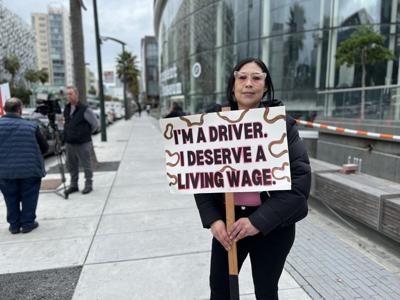
It’s official: Uber and Lyft drivers have formed a union.
Now comes what might be the harder part: negotiating a first contract with the San Francisco-based ride-hailing companies.
On Wednesday, the state Public Employment Relations Board certified the California Gig Workers Union — which is backed by the powerful Service Employees International Union — as drivers’ official bargaining organization.
As such, the union will be able to negotiate on their behalf on a sectoral basis, meaning it will be empowered to bargain with Uber and Lyft at the same time for a contract that will apply to drivers who work for either company or both.
Joseph Augusto, a San Francisco resident who drives for Uber and Lyft, said he’s been working with the SEIU to form a drivers union for six years. He said he was amazed at how quickly the process happened after a new law authorizing driver unionization — Assembly Bill 1340 — took effect at the beginning of the year.
The effort to form a union “took a lot of work, but there’s a lot of incentive by the drivers,” Augusto said.
“There’s a lot of motivation … they’re not too happy with Uber,” he said. “And so today is a big day.”
In a statement, Ramona Prieto, Uber’s head of public policy and communications for the western U.S., acknowledged PERB’s move as part of the process set up by the new law.
“PERB’s certification is the next step in delivering on AB 1340, a historic compromise that gives drivers a pathway to representation while preserving the independence and flexibility they’ve consistently said they value most,” Prieto said.
In a separate statement, Lyft spokesman CJ Macklin said the company would negotiate in good faith with the union.
“Lyft does well when drivers do well, and we’ll stay focused on helping drivers succeed while keeping rideshare affordable and dependable for everyone who counts on it,” he said.
PERB’s certification of CGWU was expected. The agency determined last month that the union had shown that it had the support of 30% of active drivers — defined as those who, among all ride-hail drivers in the state, had given at least the median number of rides during the most recent six-month period.
Following that determination, CGWU was set to become the certified bargaining unit unless a group representing at least 30% of active drivers who opposed unionization came forward and demanded a vote within 30 days.
No such group stepped forward during that window, PERB said in its certification document.
CGWU will represent not only the state’s 100,307 active drivers, but everyone who drives for Uber and Lyft, which account for 99.2% of all ride-hail rides in California, according to PERB data. It’s unclear exactly how many drivers that is.
In the first six months of the year, a combined total of 200,533 drivers for Uber and Lyft gave at least 20 rides, according to Joseph Eckhart, PERB’s acting general counsel. The companies weren’t required to disclose to the agency how many drivers gave fewer rides than that during the period.
Including those drivers, SEIU estimates CGWU will represent about 300,000 to 350,000 drivers total, said Cecille Isidro, the union’s spokeswoman. Those numbers would likely make the organization one of the largest unions in the state.
Under AB 1340, the union can now request to begin negotiations. CGWU expects negotiations to start by the end of the year, Augusto said.
But first, he said, the union plans to survey and hold meetings with drivers to understand their chief grievances and what the organization should prioritize in negotiations. CGWU also plans to train negotiators, he said.
While the union still has to do that research, Augusto said, he has a sense about what drivers are going to demand from talking with them.
Top of the list is likely to be increased pay and an end to algorithmic pricing, through which the companies determine the fares customers pay and the remuneration drivers receive based on what Uber and Lyft know about each.
Drivers have complained that since the companies adopted algorithmic pricing several years ago, their pay has plunged.
A study from the UC Berkeley Labor Center two years ago found that, when taking into account mileage expenses, waiting time and the cost of benefits they’d get if they were actual employees from the companies, drivers made about $7.63 per hour. At the time of the report, San Francisco’s minimum wage was $16.32 per hour.
For his part, Augusto said, he’d like to see a return to a rate-card system, in which all drivers are paid the same amount per mile and per minute of driving, to account for their investments in their cars and their time.
In addition to pay, another likely demand in negotiations will be that the companies provide a better system for drivers to challenge deactivations, he said.
Drivers have charged that when Uber and Lyft deactivate them — making it so they can no longer use their apps to drive for pay — they often are given little to no explanation and have no way to appeal the decision to a human being. Instead, their challenges are typically handled by automated systems.
Earlier this year, the advocacy group Rideshare Drivers United sued Uber, alleging that the company’s deactivation appeals process didn’t meet the requirements of Proposition 22, a law passed by voters in 2020.
That law designates drivers as independent contractors, rather than employees of Uber and Lyft, if the companies meet certain obligations — including having appeals processes for terminations.
In its lawsuit, RDU argues that because Uber doesn’t offer a “bona fide” appeals process, the company shouldn’t be able to treat drivers as independent contractors.
Pay and deactivations “are the two priorities we’re going to fix,” Augusto said.
Even though the legislation requires both sides to bargain in good faith, those negotiations — once they begin — could take well over a year or more to reach a final agreement under the timeline laid out within it.
The law gives the two sides 210 days to reach an agreement before one or the other can ask PERB to refer them to a mediator. It then allows them up to 22 days to agree on a mediator. After that, the legislation provides them up to 75 days to reach an agreement through mediation.
If they can’t strike a deal, either side can next request that PERB refer them to an arbitrator. The arbitrator has up to 105 days after that to meet with the parties and issue a recommended settlement.
Twenty days later, if the companies haven’t accepted the arbitrator’s recommended deal and the two sides haven’t reached an agreement on their own, the union can ask PERB to approve the deal unilaterally.
PERB’s general counsel has 60 days from then to review the settlement and make his own recommendation to the agency’s board. The board has up to 21 days after getting the recommendation to approve or disapprove the settlement.
If you have a tip about tech, startups or the venture industry, contact Troy Wolverton at twolverton@sfexaminer.com or via text or Signal at (415) 515-5594.


Bill McKibben is a prominent American environmentalist, author, and grassroots activist who is widely recognized for his pioneering work on climate change. He wrote The End of Nature (1989), which is regarded as the first book for a general audience about global warming.
He also co-founded 350.org, the first global grassroots climate campaign, and later launched Third Act, an organization that mobilizes Americans over the age of 60 to advocate for climate and racial justice.
Our 15th Anniversary!
Were this to be framed in marriage terms, Occupy will be celebrating its Crystal Anniversary. Quite fitting, actually, as it symbolizes clarity, transparency and enduring strength. We were very clear in our mission – wrongs need to be righted, transparency was needed in the banking and financial world, and the 1% had to be challenged. Our strength then, as it is now for any progressive movement, is our community.
Occupy Wall St – The Revolution Is Love w Charles Eisenstein
Whose streets? Our streets.
Today? The world has changed in unexpected ways since 2011: significantly increased economic disparity, accelerated social divide, voter intimidation and suppression, forever wars, resurgence of populism and fascism, Big Tech aligned with billionaires, and a government that doesn’t even pretend to care about the everyday American, much less our Constitution.
Let us make ourselves clear: Occupy is here not just to celebrate our successes, but to help replicate them; not just pass the baton, but step up to help fill the ranks of today’s activist organizations. Let’s get started…

Go to: https://occupy2026.org/

Was Occupy Wall Street a failure? Exactly what successes can we claim? Explore our legacy, impact, how our DNA showed up in the movements that followed.
Copyleft 2026 – Occupy 2026
Original content on this site is licensed under Creative Commons Attribution-ShareAlike 4.0 International (CC BY-SA 4.0) unless otherwise noted.
Any content used or mentioned from external sources remains the property of its respective creators.
| Laurie Woodward Garcia and People Power United Sep 10, 2026 |

9-11 We Remember, We Honor, We Pledge Memorial.
Twenty-five years ago, September 11, 2001 changed us forever.
Nearly 3,000 people left home that morning expecting an ordinary Tuesday. They kissed their families goodbye. They went to work. They boarded airplanes. They made coffee, answered phones, sat at their desks, and went about their lives.
So many never came home.
I know where I was that day, as do many of you. Time stopped. Our hearts broke.
Today, 25 years later, we remember them.
We remember every life stolen. Every family forever changed. Every empty chair at the dinner table. Every birthday, graduation, wedding, and ordinary Tuesday that came afterward without someone who should have been there.
We honor the firefighters who climbed those stairs while everyone else was coming down.
We honor the police officers, emergency workers, service members, recovery workers, and volunteers who ran toward danger.
We honor the passengers and crew of Flight 93 who knew what was happening and chose courage.
And we honor the survivors, families, and first responders who have carried the weight of that day for twenty-five years.
But when I think about September 11, I also remember what Americans did next.
We reached for one another.
Strangers helped strangers.
People opened their homes. They gave blood. They brought food. They searched for the missing. They stood beside grieving families. They asked what they could do, and then they showed up.
In one of our darkest moments, ordinary people reminded us of something extraordinary:
Caring for one another has tremendous power.
That is the America I still believe in.
And twenty-five years later, remembering must mean more than looking backward.
It must also be a pledge about what comes next.
Because the answer to fear is not more fear.
It is courage.
The answer to hate is not hate.
It is humanity.
The answer to division is community.
That is how we honor those we lost.
Not only with our memories, but with the country we choose to build in their name.
And today, we pledge to keep showing up for one another, protect our freedoms, and leave the next generation a democracy stronger than the one entrusted to us.
We remember. We honor. We pledge.
Hope over fear. Power to the people.
Together, we can champion our rights, freedoms, and democracy, hold our leaders accountable to the people’s will, and inspire voters to make a meaningful difference.
Laurie Woodward Garcia (paid with hugs and kisses, not bought by special interests) Leader, People Power United
People Power United | In this community, we will always speak out against racism, xenophobia, Islamophobia, antisemitism, homophobia, misogyny, sexism, ageism, ableism, sizeism, elitism, transphobia, misogynoir, and bigotry!
This is our moment to rise, resist, and reclaim our rights, freedoms, rule of law, and democracy. Millions of Americans are already refusing to back down — in the streets, at the ballot box, and in their communities.
Every movement that was ever won started with people who refused to quit. We are those people.
The future is not lost. It is being built — by us, right now.
City asked developers to either sell, transfer or wait out and activate the property
 by Oscar Palma September 10, 2026 (MissionLocal.org)

For nearly 20 years, the corner building at 18th and Mission has sat empty — and derelict. Not much remains of the structure, which was modernized in the 1930s with a sleek curved front, neon clock and large windows and that once housed the largest stove store on the West Coast. It has become a canvas for graffiti, wheatpasted advertisements and the backdrop for street vendors.
Then, in 2017, it became a symbol of some small hope: 63 below-market-rate condos for teachers were to be built on the lot, part of a push to make living in San Francisco affordable.
That project is now on hiatus. More than a year ago, after nearly a decade of trying, the city quietly hit pause on the Mission Economic Development Agency’s plans to build teacher housing. The city cited a lack of both funds and a feasible financing plan, according to emails obtained by Mission Local.
The emails, from Feb. 21, 2025 to April 9, 2026 between MEDA and the Mayor’s Office of Housing and Community Development, show that the project’s future has been very much in doubt for over a year. MEDA’s efforts to secure funding — first up to $9 million in federal tax credits and then $15.6 million in federal grants — have proven unsuccessful.
This is a story of how MEDA’s attempt to create teacher housing came to a standstill, one of a changing economic environment in which MEDA tried — and is still trying — to keep it afloat.
Unlike the 135 units at Shirley Chisholm Village in the Sunset that opened in 2024 for teachers and other school district workers, the project at 2205 Mission St. was envisioned as an ownership model, open to teachers with a household income of up to 120 percent of the city’s median income, or $136,150 for a single person and $194,500 for a household of four.

MEDA bought the building in 2017 from a former Facebook executive for $6.4 million, using a $5.7 million loan from the nonprofit Low Income Investment Fund with the intention of turning it into teacher housing.
The first big blow to the project came in the summer of 2024, when its application for a federal tax credit grant failed. This was expected to bring up to $9 million into the project, but the application failed because despite being eligible, the Mission District was not considered to be in “severe distress” (defined as, among other things, an area with a poverty rate 30 percent or more), which was a requirement for the funding.
In the latest American Community Survey data, which covered a period from 2016 to 2020, the Mission in fact saw a decrease in poverty and unemployment rates, and an increase in median family income — all metrics that went into the federal government’s designation.
MEDA then scrambled to get an Environmental Protection Agency grant in November 2024. Sheila Nickolopoulos, the mayor’s housing director of policy and legislative affairs, called it a “longshot.” Indeed, a few months later the application proved unsuccessful, according to a representative from the federal agency. The representative said the project failed an “eligibility review” but declined to elaborate.
By the summer of 2025, the project’s future seemed uncertain. “As you know there is no identified path forward for the project,” wrote Lydia Ely, deputy director at the mayor’s office of housing, in an email sent to coworkers on Aug. 15, 2025.
The failure to get the federal funding in turn cost the nonprofit additional dollars it had been counting on.
MEDA had secured a promise of more than $5 million in funding from two sources, each with its own deadlines for the start of construction: $2 million from the regional affordable housing program (a May 2025 deadline) and $3.1 million from the state’s CalHOME program (a June 2026 deadline). Time has run out on both.
Emails between city staffers and MEDA over the last year illustrate the developer’s increasing concerns about funding, and confusion among the mayor’s housing officials about some of the nonprofit’s requests.
In the spring of 2025, for example, MEDA requested half a million dollars to cover the building’s demolition. MEDA had previously planned to maintain the building’s facade — an example of Streamline Moderne — but, by 2024, MEDA was ready to let it go. It applied for, and received, a demolition permit.
In its response to the request for demolition funds, however, the city could not see the reasoning. “MEDA’s overall rationale for demo’ing the site is not compelling,” wrote Ely in a June 9, 2025, email to her colleague. She recommended declining the developer’s request.

MEDA argued that demolition would save $12,000 a year in holding costs (insurance, maintenance and security) and would benefit the surrounding area because the empty property had become a nuisance.
“We are not going to move forward with this request,” Ely emailed her colleague on June 25, 2025.
Still searching for funds, MEDA emailed the mayor’s housing office in July 2025 asking to discuss several items: a $112,076.93 request for holding costs, and either increasing the income levels for potential buyers or changing the housing model from homeownership to rental.
José García, MEDA’s chief real estate officer, said the nonprofit sought to increase the sale prices in order to raise more revenue and potentially close the funding gap.
At the proposed income levels — 130 percent of area median income — potential buyers could earn $168,600 for a household of two and $210,750 for a household of four. That, Garcia said, would make a significant difference. “Let’s say, instead of selling them at $600,000, we would sell them at $700,000.”
The income change was rejected, and while officials explored the possibility of changing the project to rentals, the city attorney rejected it. The project had received its initial $12 million in funding based on an application for condominiums. Changing to rentals would require returning the money and a new application process, the city explained.
Still, officials seemingly tried. In an August 2025 email, Ely also asked a colleague, “What if we wanted to abandon the educator housing concept and just do straight rental?”
As to paying holding costs, Ely told her colleagues in an email holding costs were “ineligible” for city funding per the original loan agreement.
At the same time, MEDA was facing shortfalls elsewhere in its portfolio. In October 2025, the Board of Supervisors approved a $37.8 million rescue package for its small sites program, one that purchases small buildings with low-income residents and seeks to preserve them as affordable housing.
It’s unclear if these developments impacted the city’s view of MEDA’s new requests. But by November, city officials were making pointed suggestions that MEDA consider letting go of the teacher housing project.
“At this point, the loan agreement requires MEDA to either proceed with development and construction of the educator homeownership project, or if the project cannot move forward, then transfer the property to another project sponsor,” wrote Ely on Nov. 1, 2025.
Ely then presented three options to MEDA:
García said that MEDA did not consider selling the property because the sale price — $6.4 million — would have been lower what it owed on the city loan. (MEDA had already used about $9.5 million of the $12 million loan in predevelopment costs.)
And García did not consider transferring the property because they didn’t want a market rate developer to take over. MEDA also didn’t know of any other nonprofits partners interested in taking over the project.
On March 31, MEDA presented two potential paths forward in a memo to the city: a $28 million city subsidy to close its funding gap and get the project off the ground, or a deal in which MEDA would transfer the land to the city in exchange for $3.4 million it had already put into the project, but which the city had not reimbursed.
The mayor’s office of housing responded that it had no authority to increase MEDA’s funding to that degree.
The very next day on April 1, housing staff emailed each other and said that MEDA wanted its money back. Nonprofit developers like MEDA typically front some of the cost of a project and are then reimbursed by the city — the $12 million was going towards those reimbursements. MEDA says it has some $3.4 million outstanding.
Both potential paths were rejected by the city. The path forward was unclear.
What is clear is that MEDA felt increasing financial pressure. By April 20, it announced it was cutting expenses by 21 percent for “long-term sustainability.” In doing so, MEDA laid off 12 employees and reduced salaries. Luis Granados, its CEO, took a voluntary 43 percent cut for one year.
What will happen to the project — now on pause — is unclear. García, for his part, said that MEDA might team up with another organization to move it forward, but said it was too early to provide details.

When a San Francisco neighborhood has a Mission Local reporter, it means someone is there. We’re following new housing projects proposed on your block, keeping tabs on what your district supervisor is up to at City Hall, and letting you know when longtime businesses close (and new ones open). When big news breaks, we already know the context.
Most neighborhoods don’t have that. Yours could.
That’s what Mission Local is building. Our reporters don’t parachute in — they write consistently on San Francisco, so you’re never reading about your neighborhood from someone who just looked it up.
So far we are in five of San Francisco’s neighborhoods. But we know all San Franciscans deserve our kind of coverage. Will you join us?


Reporting from the Mission District and other District 9 neighborhoods. Some of his personal interests are bicycles, film, and both Latin American literature and punk. Oscar’s work has previously appeared in KQED, The Frisc, El Tecolote, and Golden Gate Xpress.More by Oscar Palma
Jimmy Kimmel Live and James Talarico Sep 10, 2026 Jimmy’s interview with Democratic Senate candidate from Texas James Talarico was not televised because of threats from the FCC so we’re hosting their discussion here on YouTube. James talks about Republicans being scared of him winning, Jesus being co-opted by MAGA, the RNC Convention being held in Texas, not taking money from corporate PACs, Trump calling him a “freaky guy” and having second thoughts about endorsing his opponent Ken Paxton, and the GOP making it harder for people to vote.
Al Jazeera English Sep 10, 2026 A chilling new documentary about Israel’s AI-powered mass killing of civilians in Gaza received a 25-minute ovation at its premiere at the Venice Film Festival. The film was directed by two Oscar-winning Israeli filmmakers. The audience clapped continuously for Yuval Ibrahim and Rachel Szor after the screening on Thursday. The film “NAZA”, features conversations with Israeli military intelligence and whistleblowers about how they targeted Palestinians in Gaza. Al Jazeera’s Dmitry Medvedenko reports.
By Chronicle Editorial Board,Opinion StaffSep 10, 2026
Gift Article (SFChronicle.com)

The editorial board recommends voting no on San Francisco’s Proposition B, which would enable the first step in creating a city-run public bank.S.F. Chronicle illustration from Getty Images elements
San Francisco isn’t exactly a city known for the transparency or efficacy of its expenditures. The city has a $16.9 billion budget and no shortage of ways to get that money out the door — with decidedly mixed results.
And yet Proposition B, a City Charter amendment on the November ballot, would potentially launch an entirely new municipal entity to disperse taxpayer money.
The details are complex.
Prop B would allow for the creation of a Municipal Finance Corp. — the first step toward starting a city-run public bank. It would be a nonprofit, non-depository institution able to provide or arrange financing for affordable housing, home ownership, small businesses, climate infrastructure and environmental-justice projects. After at least three years of operation — and only after securing state and federal regulatory approvals — it could then transition into a full public bank.
Governance would be divided among professional boards and a public oversight commission. The Board of Supervisors would appoint four of the initial nine Municipal Finance Corp. commissioners, the mayor would appoint two, while the treasurer, controller and city attorney would each appoint one.
Prop B provides no funding. The Controller’s Office, citing a 2023 working group viability report, estimated that the city would have to come up with $310 million to $460 million to establish, capitalize and operate a public bank.
That’s quite an outlay at a time of federal funding shortfalls and perennial budget insecurity.
So, why now?
Some context is helpful. In 2019, California enacted Assembly Bill 857, the California Public Bank Act, which allows cities, counties and joint powers authorities to establish their own local public banks. The initial licensing window for the legislation will expire in 2029, so several cities and counties in the state are scrambling to launch their respective public banking efforts before the deadline.
Trinity Tran, the executive director of Public Bank LA, an organization that has been working to establish a public bank in Los Angeles since 2017, told the editorial board that the establishment of a municipal finance commission would prove that it could “responsibly use public dollars for public good and then after a few years, scale that up to a public bank.”
The idea of a public bank designed to support social and economic justice is a noble one. But good intentions do not automatically make a good institution.
Especially because San Francisco already has existing policy tools in service of these goals.
The Housing Trust Fund, for instance, provides direct support for building, purchasing and rehabilitating affordable housing, as well as down-payment assistance and programs intended to help people avoid losing their homes. Prop C on the November ballot would increase the city’s annual contribution to this fund, eventually, to $125 million and extend it through 2058.
Then there are housing bonds, which San Francisco funded to the tune of $300 million in 2024.
Meanwhile, the Office of Workforce and Economic Development and the Office of the Treasurer operate millions of dollars in small business loan and grant programs.
These redundancies are among the reasons Mayor Daniel Lurie told us he doesn’t support Prop B: “Creating a new institution, rather than investing those resources directly in housing, small businesses and other critical needs, is irresponsible.”
Prop B’s sponsors, including Supervisor Chyanne Chen, countered that unlike most existing funding mechanisms, a public bank would provide an ongoing source for needed projects. Its dollars would recirculate in the community as loans were paid off and then disbursed to the next recipient.
But would they?
Larry Marso, an attorney who worked as a mergers and acquisitions investment banker at Morgan Stanley, pointed to the Los Angeles Community Bank — established in 1995 with $430 million in federal funding — as a cautionary tale. Focused on rebuilding neighborhoods following the 1992 Los Angeles riots, the bank faced heavy criticism from federal and local housing officials for poor management, severe political meddling and rushing into non-compliant deals. The bank aggressively pushed to fund high-risk, ill-conceived projects, had an astronomical loan default rate and was forced to close by 2004.
Banks, Marso told the editorial board, “need to loan to a wide variety of people in a wide geography who are under widely different conditions. It’s called diversification. You have to diversify your loan portfolio.”
Prop B directs San Francisco to do the exact opposite.
Proponents note that North Dakota’s public bank has operated successfully for over 100 years. But that bank invests not just in feel-good green and socially just projects but fossil fuels. That’s not a model San Francisco should be holding up.
Moreover, Prop B’s authors arguably set the effort up to fail by being overly prescriptive. The 25-page measure cements into the City Charter a wide variety of dubious micromanaging — including a host of citizen oversight commissions and advisory committees of the ilk that voters said they wanted to move beyond when they passed Prop E for commission reform in 2024.
“This is the perfect example as to why we have these problems with our charter,” Sean Elsbernd, president and CEO of the local think tank SPUR, told the editorial board. “There is so much detail that doesn’t need to be in there.”
Elsbernd believes, as do we, that Prop B’s authors could have simply authorized a public bank in San Francisco and instructed the mayor and Board of Supervisors to pass legislation implementing it. This would have allowed for more flexibility.
San Francisco already has other ways to raise and deploy capital for social good. It can issue bonds. It can expand the Housing Trust Fund. It can partner with community-development financial institutions and nonprofit lenders. It can streamline approvals, reduce unnecessary fees and help affordable-housing developers control costs — all priorities of Mayor Lurie’s administration. These methods are more immediate and easier for voters to evaluate.
A bank, public or private, cannot make construction costs disappear or eliminate the risk that a borrower will default. If a project genuinely needs a subsidy, a loan is not a substitute for one. It merely changes who carries the risk.
About Opinion
The editorial positions of The Chronicle, including election recommendations, represent the consensus of the editorial board, consisting of the publisher, the editorial page editor and staff members of the opinion pages. Its judgments are made independent of the news operation, which covers the news without consideration of our editorial positions.
And with a public bank, that risk would ultimately belong to the public.
San Francisco doesn’t need to create complicated new mechanisms and hope they work. It needs to strengthen the institutions we already have. Vote no on Prop B.
Reach the Chronicle editorial board with a letter to the editor: www.sfchronicle.com/submit-your-opinion.
Sep 10, 2026
Opinion Staff
The editorial positions of The Chronicle, including election recommendations, represent the consensus of the editorial board, consisting of the publisher, the editorial page editor and staff members of the opinion pages. Its judgments are made independent of the news operation, which covers the news without consideration of our editorial positions.
Freedom Trainers

Election Defense Scenarios is a field guide for protecting democracy. This resource walks readers through eighteen detailed scenarios — from voter roll purges and redistricting attacks to armed intimidation at polling places and post-election certification battles — giving organizers, poll workers, community leaders, and everyday citizens the knowledge they need before a crisis hits. Each scenario draws on real historical examples from Georgia to Belarus to Tuskegee, showing not just how threats unfold, but how ordinary people have successfully pushed back.
What makes this guide indispensable is its refusal to inspire helplessness. Rather than cataloguing threats for their own sake, every scenario pairs clear-eyed analysis with concrete, actionable responses grounded in law, history, and proven organizing strategy constantly asking “What would you do?” Because the best time to prepare is now.
Using the Scenarios
The People’s Election Playbook
(scenarios roughly ordered by timing)
BEFORE ELECTION DAY
Scenario 1: Redistricting to Erase Representation
Scenario 2: The Voter Roll Purge
Scenario 3: ID Requirements Close to Election Day
Scenario 4: Mail-In Ballot Deadline Changes
Scenario 5: Drop Box Sabotoge/Bomb Threats
Scenario 6: DOJ Election Fraud Investigations
ELECTION DAY
Scenario 7: Last-Minute Voting Location Chaos
Scenario 8: Mass Voter Challenge Campaign
Scenario 9: Disinformation Flood: Place, Time, Day
Scenario 10: Armed Civilians at Polling Places
Scenario 11: Federal Agents at Polling Places
AFTER ELECTION DAY
Scenario 12: Recounts and Ballot Curing
Scenario 13: SCOTUS Overturns Counting
Scenario 14: Canvassers Refuses to Certify
Scenario 15: Federal Seizure of Ballots
Scenario 16: Congress Refuses to Seat Winners
SPECIAL SCENARIOS
Scenario 17: DC: Override of Home Rule Election
Scenario 18: Puerto Rico: Federal Interference
Bonus: 1-day Scenario Planning Agenda