- By Adam Shanks | Examiner staff writer |
- May 17, 2023 Updated 9 min ago (SFExaminer.com)
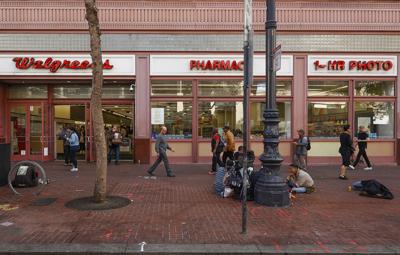
Walgreens will pay San Francisco $230 million for its pharmacies’ role in facilitating the opioid epidemic.
The long-awaited settlement is the largest of its kind with a local government in the country, City Attorney David Chiu announced on Wednesday, and will help fund The City’s efforts to combat addiction and overdoses.
Settlement talks began after a federal judge found last year that Walgreens, a national pharmacy chain based in Illinois, could be held liable for wantonly dispensing prescription opioids in violation of federal law.
“They were more concerned with profit than following their legal obligations,” Chiu said. “They did not give their pharmacists time to conduct due diligence, pressuring their pharmacists to fill, fill, fill.”
In its lawsuit, first filed in 2018, The City alleged that Walgreens’ and other opioid distributors’ failure to rein themselves in helped lead to the epidemic currently playing out in San Francisco homes and — more visibly — on its streets.
San Francisco will be paid over 14 years under the terms of the deal. However, the settlement’s payouts are front-loaded, allowing city leaders to expect a $57 million payout by June 2024.
Walgreens was not the only company identified in the suit, but it was the last to settle. In total, the settlements from the lawsuit have amounted to more than $350 million for The City. The case will now be dismissed.
The City’s initial request from Walgreens was a settlement of $8.1 billion, dozens of times more than the eventual settlement.
After the federal judge’s ruling on Walgreens’ liability last year, Walgreens remained defiant. It remained so
Wednesday.
“Walgreens disputes liability and there is no admission of fault in the settlement agreement,” the company said in a statement. “We never manufactured or marketed opioids, nor did we distribute them to ‘pill mills’ and internet pharmacies. The settlement allows us to focus on our mission of reimagining healthcare and well-being for our patients, customers, and communities. Our thoughts are with those impacted by this tragic crisis.”
It remains to be seen how The City will use the settlement funds — a decision that will be made by the mayor and Board of Supervisors.
“San Francisco has been dealing with the impacts of opioids for years, including the need for direct treatment and support for those struggling with addiction. But we’ve also had to deal with associated impacts of opioid addiction such as the need for community ambassadors and other neighborhood support,” Mayor London Breed said Wednesday in a statement. “This funding secured by the City Attorney will help us to maintain and expand key programs in these areas with solutions that we know are working like, treatment beds, dual diagnosis beds, abstinence-based programming, and transitional housing.”
Dr. Grant Colfax, director of the San Francisco Department of Public Health, touted The City’s efforts to expand treatment services in recent years. Combating criticism that The City fails to meet its goal of providing “treatment on demand,” he stressed that access to medication-assisted-treatment for substance abuse disorder is readily available.
“We have substance-use treatment beds available as we speak,” Colfax said.
The funds from the settlement, Colfax added, will be “critical” support for sustaining The City’s treatment programs.
Many have called on The City to use opioid settlement money to fund a supervised consumption site, where people could use drugs under the watch of a person trained in reversing overdoses.
But Chiu balked, expressing worry that The City could incur liability if it funds such a program, which remains illegal under federal law. He has endorsed the model used in New York City, which allows a private nonprofit to operate two supervised consumption sites without direct (but plenty of indirect) city money.
“There have been many conversations about safe consumption sites and we’ll continue to move things forward,” Chiu said. “Those conversations continue; we’ll see how it goes.”
The City continues to grapple with the consequences of the opioid epidemic about five years after it first filed the lawsuit.
Last year, it opened the Tenderloin Center, which aimed to connect people experiencing homelessness and addiction to treatment and housing. It also served as a de facto supervised consumption site for drug users, the first of its kind in San Francisco, until Mayor London Breed allowed it to close in November.
This year, The City has seen an unprecedented number of fatal accidental drug overdoses, with 66 deaths last month alone. In the first four months of 2023, 268 people have already died of overdoses, according to the most recent city estimate.
Chiu’s press conference on the steps of City Hall took place a short walk away from sidewalks, ledges, and alleyways where numerous people sat slouched over.
These street conditions were central to San Francisco’s legal argument, which was that Walgreens’ negligence created a public nuisance. It’s a claim Walgreens argued was a stretch, but U.S. District Court Judge Charles R. Breyer gave credence.
“The effects of the opioid epidemic on San Francisco have been catastrophic,” Breyer wrote. “The city has fought hard and continues to do so, but the opioid epidemic, which Walgreens helped fuel, continues to substantially interfere with public rights in San Francisco.”
Chiu traced the epidemic back more than a decade, when opioid manufacturers pushed to treat pain with powerful synthetic drugs that had previously been reserved for end-of-life care.
The city’s attorneys connected the dispensation of prescribed opioids by pharmacies to the eventual use of illicit drugs like heroin and fentanyl.
Walgreens joined a long list of companies to settle with San Francisco that includes CVS ($11 million), opioid manufacturers Allergan and Teva ($54 million), and Walmart ($6 million).
As with the other settlements, the Walgreens agreement will require approval by the San Francisco Board of Supervisors.