


Sep. 20, 2023 (SFChronicle.com)
In his weekly homily, Father Louie Vitale could not contain himself when he looked out upon his flock of the poor and distraught at St. Boniface Catholic Church in the Tenderloin.
He’d smile and raise his hands and say, “It is just about love, all about love” to his audience, some of whom would be lying down in the pews asleep. These were his “brothers and sisters,” and he spoke to them in English at the 8 a.m. sermon, and in Spanish at 10 a.m.
If Vitale did not have his hands outstretched in a gesture of giving, they were usually behind his back being cuffed. True to his Franciscan spirituality, Vitale proved his love for all mankind by participating in acts of nonviolence and demonstrations for peace. He claimed to have been arrested some 400 times.
Most of his legal trouble came through his position as co-founder of the Nevada Desert Experience, which pressured the government to end nuclear weapons testing. Closer to home, he founded the Gubbio Project, which made St. Boniface the first church in America to let homeless men and women sleep in its pews during daytime.
That program continued long after he retired to the Mercy Retirement and Care Center in Oakland, where he died Sept. 6 after an all-night prayer vigil as he clutched his rosary beads. The cause of death was pneumonia, said his close friend and fellow activist Anne Symens-Bucher, who was with him until the end. He was 91.
“Louie was a dynamic and charismatic prophet for our times,” said the Rev. John Hardin of St. Boniface, which was established in 1864 as the first German language parish in San Francisco. A huge complex that houses a school, residences for the friary and a high-ceilinged church that seats 400, St. Boniface is across Golden Gate Avenue from St. Anthony’s Foundation, where parishioners often take their meals.
“This is a sanctuary for the voiceless,” Hardin said, “and Father Louie became their spokesperson.”
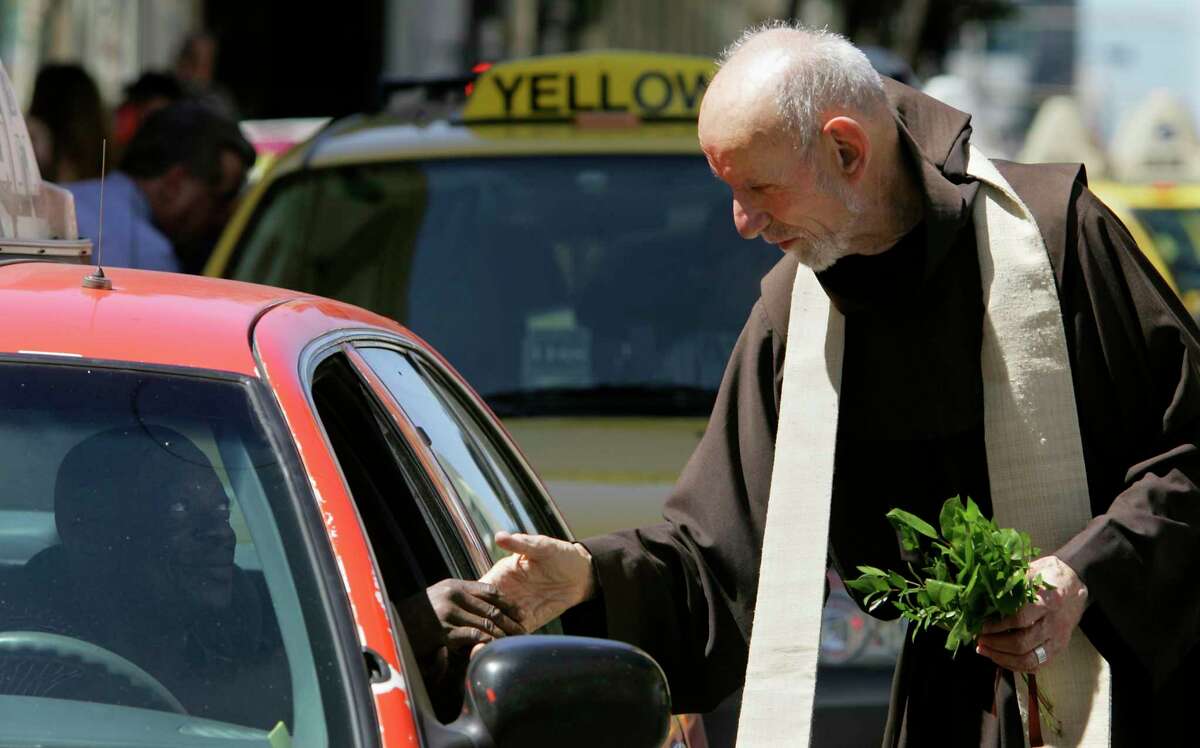
The 100 block of Golden Gate Avenue is now closed to auto traffic, but before that, Vitale would stand in the street in his Franciscan habit for the annual Blessing of the Taxicabs, a drive-thru ceremony in which he would sprinkle holy water on car hoods and lean into windows to touch the drivers.
“Bless you, brother. Please drive safe,” he’d say. Or, “I pray God keeps you safe. You doing OK today?”
At age 84, in 2016, Vitale published “Love Is What Matters: Writings on Peace and Nonviolence,” detailing the life of what Chronicle reporter Kevin Fagan described as “one of the most — if not the most — rabble rousing peace activist priests in Northern California.”
Vitale had the credentials to back that statement. In 1982, he and Symens-Bucher created the Nevada Desert Experience to bring protesters out to the Mojave Desert near Las Vegas, and bring awareness to a federal weapons test site. They helped get the testing stopped, but it took years and years of persistent witness, including the 40-day season of Lent.
Vitale would stand by the road in his habit, tall and thin, always holding a sign calling for disarmament. Hours of this, in heat or cold and wind, were followed by a homily he’d deliver to as many as 100 protesters in a circle. Among those standing and listening was Martin Sheen, the actor and activist. “Father Louie is the best follower of St. Francis of Assisi that I know,” Sheen later wrote.
Another witness was Sally Hindman, a Berkeley advocate for the unhoused and Quaker minister involved in civil disobedience.
“Louie Vitale lived his Franciscan values at the deepest level,” she said, “and put his faith into action in profound ways by putting his body on the line over and over again, as needed in order to live out his Christian faith.”
Louis Vitale was born June 1, 1932, in San Gabriel (Los Angeles County) and raised in Pasadena, where his father was a seafood distributor. Vitale attended a military academy and joined the ROTC at Loyola University in Los Angeles. Upon graduation in the early 1950s, he was commissioned a lieutenant in the U.S. Air Force.
He was a navigator and bombardier, and in one instance his plane targeted what was detected to be a Soviet military aircraft headed over the North Pole. Vitale was preparing to fire a missile when the target plane was determined to be carrying civilians. That near miss turned his head around, and he soon left the military for the ministry.
When he arrived at St. Boniface in 1992, it was to fill an interim position for nine months, which turned into 13 years. He lived in a monk’s cell below the church tower.
Known for fasting, he kept getting thinner, which only accentuated his ears, which were huge to begin with. “The better to hear you with,” Vitale would say.
One thing he heard was the Loma Prieta earthquake of 1989, which damaged St. Boniface. Vitale oversaw a retrofitting project after raising $13 million to get it done.
While working on that project, Vitale co-founded Pace e Bene (Peace and All Good), an action organization that trained 40,000 people worldwide in how to carry out nonviolent strategies for change. Its annual mobilization is Sept. 21, to involve some 5,000 actions.
“Louie lived by a simple equation,” said Ken Butigan, a professor of peace studies at DePaul University in Chicago. “Love plus clarity plus determination plus hundreds of arrests leads to a life well-lived for the well-being of all.”
Aug. 31, 2005, was his final day at St. Boniface, the annual Blessing of the Taxicabs.
“This isn’t the end of my work for God,” he said afterward. “You’ll probably see me again, maybe getting arrested somewhere.”
He was true to his word. Within six months he had been arrested at the Western Hemisphere Institute for Security Cooperation in Fort Benning, Ga., for protesting the teaching of interrogation techniques.
When he got arrested for a second time at Fort Benning, he earned himself six months in federal prison, first in Georgia, then in Lompoc in Santa Barbara County. He got a job cleaning the prison chapel and had no complaints about the accommodations or the company.
“I’m getting to know a lot of guys here, and they’re very receptive,” he told the Chronicle’s Fagan in a collect phone call — the way they always communicated. “A lot of guys want to talk.”
In 2011, when Vitale was 79 and had been released from one of his longer sentences, his return to San Francisco was celebrated by Pace e Bene with a mass at the National Shrine of Francis of Assisi monument in North Beach. More than 100 people came, with speeches delivered by Daniel Ellsberg and Laura Slattery of the Gubbio Project, which has since moved to St. John the Evangelist in the Mission District.
St. Boniface still offers Sacred Sleep, a project run by the St. Anthony Foundation. The people who pass their days in the church and everybody else can give thanks to Vitale at a Memorial Mass at 3 p.m. Oct. 6 at St. Boniface.
“The greatest tribute that we can give to Father Louie is to follow his example as peacemakers in a world that is headed toward destruction,” said Hardin, who will be master of ceremonies at the event. “He saw all of humanity and Mother Earth herself as divinely created and dedicated his life to peace and justice.”
Reach Sam Whiting: swhiting@sfchronicle.com
Written By Sam Whiting
Sam Whiting has been a staff writer at The San Francisco Chronicle since 1988. He started as a feature writer in the People section, which was anchored by Herb Caen’s column, and has written about people ever since. He is a general assignment reporter with a focus on writing feature-length obituaries. He lives in San Francisco and walks three miles a day on the steep city streets.

 ©2023 Hearst Communications, Inc.