- By Patrick Hoge | Examiner staff writer
- Nov 19, 2024 Updated 22 hrs ago (SFExaminer.com)
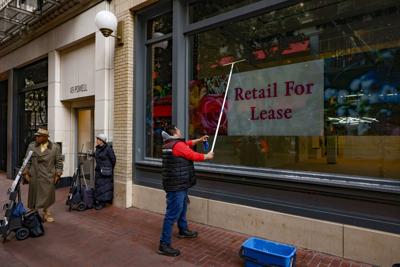
The three-block stretch of Powell Street between San Francisco’s Union Square and the cable-car turnaround on Market Street has been blighted for years with a large percentage of commercial vacancies in the wake of the COVID-19 pandemic.
Shortly on the heels of electoral defeat, Mayor London Breed’s administration announced this week a nearly $3 million expansion of her signature Vacant to Vibrant program to Powell Street and other parts of downtown, as well as the availability of $4.9 million in loans and grants to help small businesses open downtown.
Breed was touting the latest initiatives among a panoply of city contributions made under her leadership that were aimed at bolstering The City’s commercial sector, which has been stubbornly sluggish downtown.
“Powell Street is going to be something different,” promised Breed following a Tuesday press conference staged to highlight “more than $115 million” in investments in small businesses her administration claimed The City has made since the pandemic.
Despite those investments and a robust city economy and an unemployment rate of just 3.4%, The City’s retail market vacancy rate rose to another record high of 7.9% in the third quarter of 2024, up from 7.7% in the second quarter and 6.4% a year earlier, according to a report from Cushman & Wakefield.
On Powell Street between Geary Street and Market Street, significant ground-floor stretches on all three blocks remain vacant, though just blocks away numerous luxury retailers around Union Square continue to operate.

Breed’s administration has committed about $2 million to lower Powell Street over a two-year period to support four to six “pop-up” businesses in vacant storefronts, said Simon Bertrang, executive director of SF New Deal, the nonprofit organization that has administered the Vacant to Vibrant program in concert with The City’s Office of Economic and Workforce Development since last year.
Bertrang said he hopes there will be some small-scale food and beverage operators, as well as other retailers. Full-service food and beverage operations are unlikely because of the cost of converting retail spaces for such use, he said.
For other vacant spaces on Powell, Bertrang said his organization wants to arrange for art installations to make the street feel more connected and vibrant.
Breed said the voters’ recent approval of Proposition B, which authorized funding for improvements of streets and public spaces, among other purposes, could lead to upgrades of the physical environment along Powell Street.
At least some of the elements which prevented Harris from winning the presidency were evident even on her home turf
Elsewhere downtown, Bertrang said The City is making about $1 million more available for sponsoring about 20 more small, local businesses to open in vacant spots on a rolling basis.
In addition to public dollars, the Vacant to Vibrant program has received private philanthropic support, including a recent $500,000, two-year commitment from J.P. Morgan Chase Bank and a $1 million grant from Wells Fargo in May. Visa has also been a sponsor.
Proposals chosen will likely be larger in scope than prior Vacant to Vibrant offerings, and the businesses behind them will get roughly one-year runways, rather than three months, reflecting the larger investments needed to open in the relatively big empty spaces on Powell Street, Bertrang said.
A lot of downtown retailers were national players, and SF New Deal wants to give local entrepreneurs a crack at the market, Bertrang said.
“So we want to use this Vacant to Vibrant program to give the opportunity for small businesses to create the energy and the additional vibrancy that clearly Powell Street needs,” he said. “We’re going to be bringing some small businesses that really are ready to take the next stage.”

Santino DeRose, a principal with Maven Commercial who is steeped in the area, said he was encouraged that the Vacant to Vibrant was offering to support business owners for a year initially because that will give them a better opportunity to last.
‘It really gets people rooted in the community, and there’s a greater chance of popups turning permanent,” DeRose said.
The Vacant to Vibrant program, run initially in the Financial District, SoMa and the East Cut neighborhoods, started in August 2023 with a group of 17 small businesses in nine unused properties. It provided seed money and other assistance to businesses opening in vacant spaces downtown, which landlords provided free of charge. Seven of the main tenants have since signed long-term leases. Six of the eight businesses in the second cohort stayed on for an additional three months as they continue to assess whether they want to remain long-term.
Also this week, Breed’s office announced with the nonprofit lender Main Street Launch and other private funders a new $3.6 million loan and grant program for helping small businesses facing barriers to capital fill vacant storefronts downtown. Loan amounts could be up to $100,000 with a 4% interest rate, and those qualified could get a $25,000 city grant.
In addition, starting early next year, The City will make up to $1.3 million in grants to small businesses locating downtown, with awards of up to $25,000 for businesses occupying vacant spaces.