


By J.K. Dineen,ReporterNov 22, 2024 (SFChronicle.com)
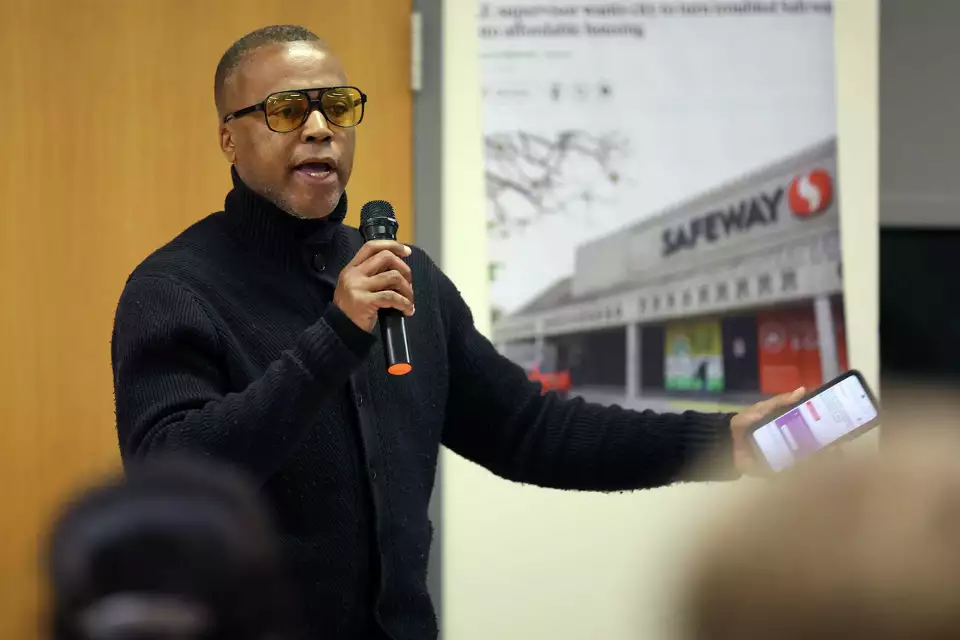
Daniel Landry speaks during a Fillmore United Town Hall at the Hamilton Recreation Center on Thursday about the controversial plan to close the Fillmore Safeway in San Francisco. “We have some bad corporate neighbors and they need to be called out,” he said.Scott Strazzante/The Chronicle
It seems everyone has plenty to say about the looming closure of the Safeway on Webster Street in the Fillmore District.
Everyone, that is, except Safeway itself.
With less than two months to go until the possible demise of the San Francisco neighborhood’s only full-service grocery store, residents of both the Fillmore and Japantown gathered Thursday night to both lash out at the grocery chain and strategize about ways to pressure the company to resume negotiations with the community.
There was talk of a citywide Safeway boycott. A protest at the company’s Pleasanton headquarters. A rally outside the store. A lawsuit. Pushing Supervisor Dean Preston’s call for the city to seize the property by eminent domain and develop it as affordable housing above a new grocery store.
“We have some bad corporate neighbors and they need to be called out. We can’t pussyfoot around,” said Fillmore District community activist Daniel Landry. “We need to think of options other than saying, ‘Please stay, come sit at the table with us.’ You can only appeal for so long.”
The meeting came 10 months after Safeway announced it would be closing in March of this year, a date that was pushed back to at least January of 2025 after community outrage and lobbying by Preston and Mayor London Breed. At the time, Safeway confirmed that it was in contract to sell the property to Align Real Estate, which intends to build upward of 1,000 mostly market rate apartments on the 3.5 acre site. The planned closure followed months of complaints about public safety issues at the store.
Since then, Safeway has been mum about its plans. The company has not said when in January, or later, it intends to shutter. It has not given 60-day notices to any employees it intends to lay off, something required by state law. It has not responded to city agencies working to either keep the store open or come up with a plan to activate the parcel in the transition period — which could last five years or longer, depending on the economy — after Safeway closes but before Align starts construction.
“The reality is Safeway has not been at the table,” said Preston Kilgore, chief of staff for Preston. “They are not here tonight, they were not at the last meeting in June.”
In a statement on Friday afternoon, Safeway said the store “will close in early 2025 as planned” and that all employees would be reassigned to other stores. Pharmacy customers can be transferred to other stores and that the company “continue to work with Align Real Estate on a proposed mixed-use development project to include housing and commercial retail space.”
Vallie Brown, director of strategic partnerships for the San Francisco Human Rights Commission, said the city asked Safeway if it would be willing to leave behind the freezers and refrigerators and lease the building to another grocer, and the answer was “no.”
The city has also inquired as to whether Safeway would allow the property to be activated in other ways — senior fitness classes, farmers markets, movie nights, Brown said. Again the answer was “no.”
“We have had a lot of ‘no’s’” Brown said. “These are all the things that are in motion but we are also in limbo because Safeway isn’t communicating with us or giving us the answers that we need.”
Jada Jackson, a lifelong Fillmore resident and project manager for the Office of Economic and Workforce Development, called the situation “beyond frustrating.”
“From the city side, unfortunately, there has been no communication from Safeway, which is disheartening personally and professionally because this is important and January is coming close,” said Jackson. “Unfortunately we have nothing to report.”
Safeway did not respond to an email seeking comment.
Like many larger Safeway stores, the Webster Street location offered more than groceries — with a pharmacy, a Starbucks and a full-service Wells Fargo branch, which has already closed.
“It’s obviously a grocery store, but also such a significant community hub,” said Erika Scott, who owns Honey Art Studio, just off Fillmore Street. “I remember watching it being built when walking to school.”
The countdown to the likely closure comes as the neighborhood is also in political limbo with both Preston and Breed, who grew up nearby, having lost their bids for reelection. Supervisor-elect Bilal Mahmood, who will take over for Preston in January, had two aides at the community meeting; Mayor-elect Daniel Lurie did not have a representative at the meeting, which was sponsored by the Fillmore United Alliance, which also includes representatives from the Japantown Task Force.
Japantown Task Force member Alice Kawahatsu said the neighborhood has a disproportionate number of elderly residents who don’t drive and rely on having groceries and a pharmacy nearby.
“We need to make sure we have food access for everyone, not just for the rich or people who have cars,” she said. “We’ve gotta get out there and beat drums. We gotta fight for what we want.”
Erris Edgerly of the Fillmore United Alliance said the recent rezoning of District 5 — in which the Tenderloin was added — may have taken attention away from the fight to save Safeway. Long-standing animosity between the moderate Breed and the Democratic Socialist Preston may not have helped either.
“They are both working on it — but not together,” Edgerly said. “The Safeway closure brought the community together but the government is still split.”
Meanwhile, Edgerly said, “From the shelves it looks like they are not going anywhere. They still have a lot of food in there.” But he said he and other neighbors may go elsewhere for their Thanksgiving provisions.
“We’re going on a turkey strike,” he said.
Reach J.K. Dineen: jdineen@sfchronicle.com
Nov 22, 2024
REPORTER
J.K. Dineen covers housing and real estate development. He joined The Chronicle in 2014 covering San Francisco land use politics for the City Hall team. He has since expanded his focus to explore housing and development issues throughout Northern California. He is the author of two books: “Here Tomorrow” (Heyday, 2013) and “High Spirits” (Heyday, 2015).


