


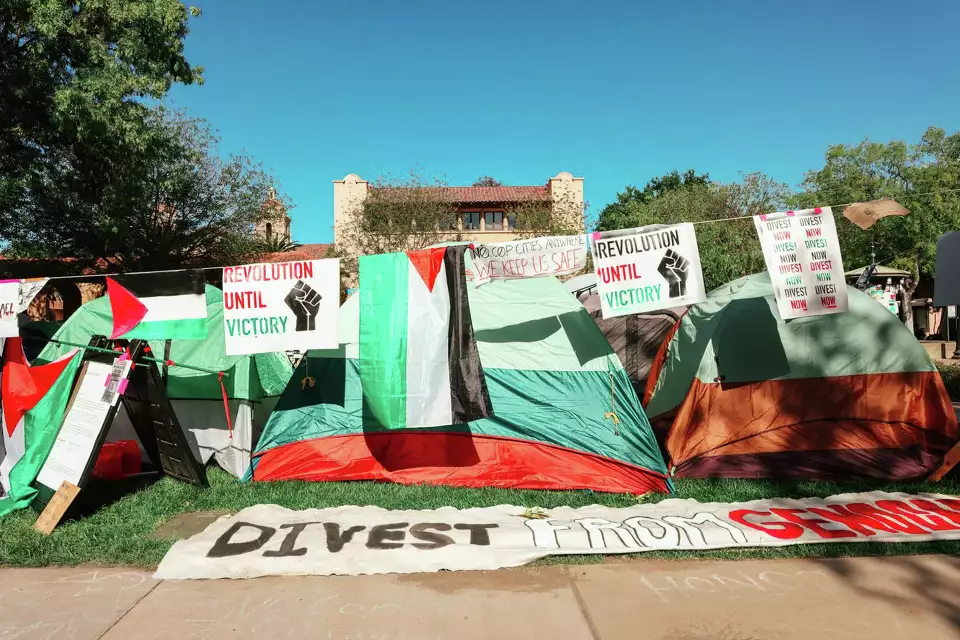
Protest banners hang at Stanford University’s student encampment in support of the Palestinians on May 1, 2024.Clara Mokri/Special to the S.F. Chronicle
By Yousef Helal
As a child growing up in Santa Clara, I was diagnosed with an aggressive form of Ewing’s sarcoma, a bone cancer. I was blessed to survive with full use of my legs. But others are not as lucky, often losing limbs in their fight against the disease.
As I worked my way through school, my dream was to build robotic prosthetics that could offer those individuals the same chance at the full life that I was given. It’s a dream I still have, one that brought me to Stanford University as a first-year master’s student in electrical engineering.
But circumstances have now compelled me to put this dream on hold.
Since March 2, Israel has enforced a total blockade on Gaza, cutting off food, fuel, medicine and all humanitarian aid. The result has been catastrophic: mass starvation, collapsed hospitals and the death of thousands. This is not an inevitable byproduct of war. It is a deliberate act: the use of starvation as a weapon against innocent civilians.
And yet, as Israel’s assault on Gaza continues to stream across my newsfeed in real time, I find myself on a campus where peers are taking classes like “Hacking for Defense,” and many more are eager to break into the defense tech industry. Many of the bombs, drones and artificial intelligence systems that are killing innocent children, mothers and fathers in Palestinian territories are being funded and designed by the minds here at Stanford.
On May 12, I, along with 14 students and faculty members alongside other Students for Justice in Palestine chapters across the nation, began a hunger strike meant to raise public consciousness about the starvation of Gaza and to pressure Stanford to confront its financial ties to what even former Israeli Prime Ehud Olmert calls war crimes.
If the university can ignore the starvation in Gaza, we will bring that suffering right to its doorsteps.
We are doing this because we have exhausted every other channel. During the past year, thousands of Stanford community members have protested, organized petitions, submitted our divestment proposal and sustained an encampment.
The result? Silence. Repression. And, for 12 of our classmates, criminalization.
This is all despite overwhelming support for divestment on campus; A 2024 “statement on divestment” by the Associated Students of Stanford University Elections Commission was backed by 74.64% of graduate student voters and 72.86% of undergraduates.
Lacking alternatives, we are now staking our own bodies, refusing food until Stanford listens.
I am Muslim, and my faith teaches me that silence in the face of oppression is not an option. The Prophet Muhammad said, “Whoever among you sees an evil, let him change it with his hand; if he cannot, then with his tongue; and if he cannot, then with his heart — and that is the weakest of faith.”
That principle is hardly exclusive to Muslims, yet it shapes every moral calculation I make.
We are pleading only for Stanford to inhabit its own professed values. It can start by prying open its nearly $38 billion endowment, larger than the gross domestic product of many small nations, and divesting from companies that make the drones, databases or compliance software that help level civilian neighborhoods.
Then there are my classmates, the Stanford 12, who have been charged with felonies for a protest occupation of the university president’s office in 2024. They have already served two-quarter suspensions, lost their dorm rooms and meal plans, and watched graduation dates slide out of reach. Branding them felons will only sandbag the lives of young people who did exactly what our ethics education applauds: They acted.
Finally, if Stanford truly believes in academic freedom, President Jonathan Levin should add his signature to the American Association of Colleges and Universities’ open letter rebuking federal attempts to police scholarship and protest — a letter signed by hundreds of university leaders and urged by our own faculty.
Yet Stanford has remained silent.
Every day from 6 p.m. to 8 p.m., my fellow hunger strikers and I gathered in White Plaza, just two minutes from President Levin’s office. (I remained on strike until May 12, succeeded by 13 new strikers on May 19 and 10 others on May 26. Another wave is expected on Monday. There are 10 to 15 strikers active at any time. Organizers aren’t tracking who and how many of us are active, but we’ve been told the medical team does.)
Not once has anyone from the administration crossed the quad to hear us out. When we decided to bring the conversation to the annual Academic Council meeting, all student invitations were revoked hours before we were set to walk in.
In this silence, Stanford has aligned itself with the Trump administration’s assaults on free expression and the violent atrocities inflicted daily on the people of Gaza.
The Bay Area has long stood as a stronghold of free speech and democratic values, ideals now under unprecedented attack. All we ask is that President Levin and Stanford’s Board of Trustees honor their commitments to the stated ethics and ideals of this institution.
Yousef Helal is a Bay Area native and a first-year master’s student in electrical engineering at Stanford University.
June 2, 2025
Yousef Helal


