San Francisco has 130 miles of abandoned roads. More are in Bayview than any other neighborhood.
 by MARINA NEWMAN and KELLY WALDRON July 11, 2025 (MissionLocal.org)
When is a street not a street? The answer’s not so simple.
About 130 miles of San Francisco’s roadways aren’t considered streets at all, at least not by the city.
These “unaccepted streets” — public rights-of-way that were never adopted as city or state roads, where residents are in charge of repairs and maintenance — make up 10 percent of city roads.

Want the latest on the Mission and San Francisco? Sign up for our free daily newsletter below.Sign up
But in one area, it’s much more: In District 10, the historically-Black southeastern corner of the city made up of Bayview-Hunters Point, Dogpatch, and Potrero Hill, 21 percent of the district’s roads are unaccepted, according to a Mission Local analysis.
Of the 130 or so miles of unaccepted streets in the city, 34 miles are District 10, a full quarter.
Those who live near them are fed up.
“What about the streets that no one wants to claim?” a Bayview resident asked Mayor Daniel Lurie at a town hall held at the Ruth Williams Opera House in Bayview earlier this month. “There’s so much debris.”
“It’s these kinds of policies that attract blight,” the resident said, referring to the streets surrounding Candlestick Park and the large, empty plot of land where development has been stalled for over a decade. Development, he said, is “happening all around us.” But for Bayview residents, “We feel like we aren’t getting that due.”
San Francisco has over 130 miles of unaccepted streets
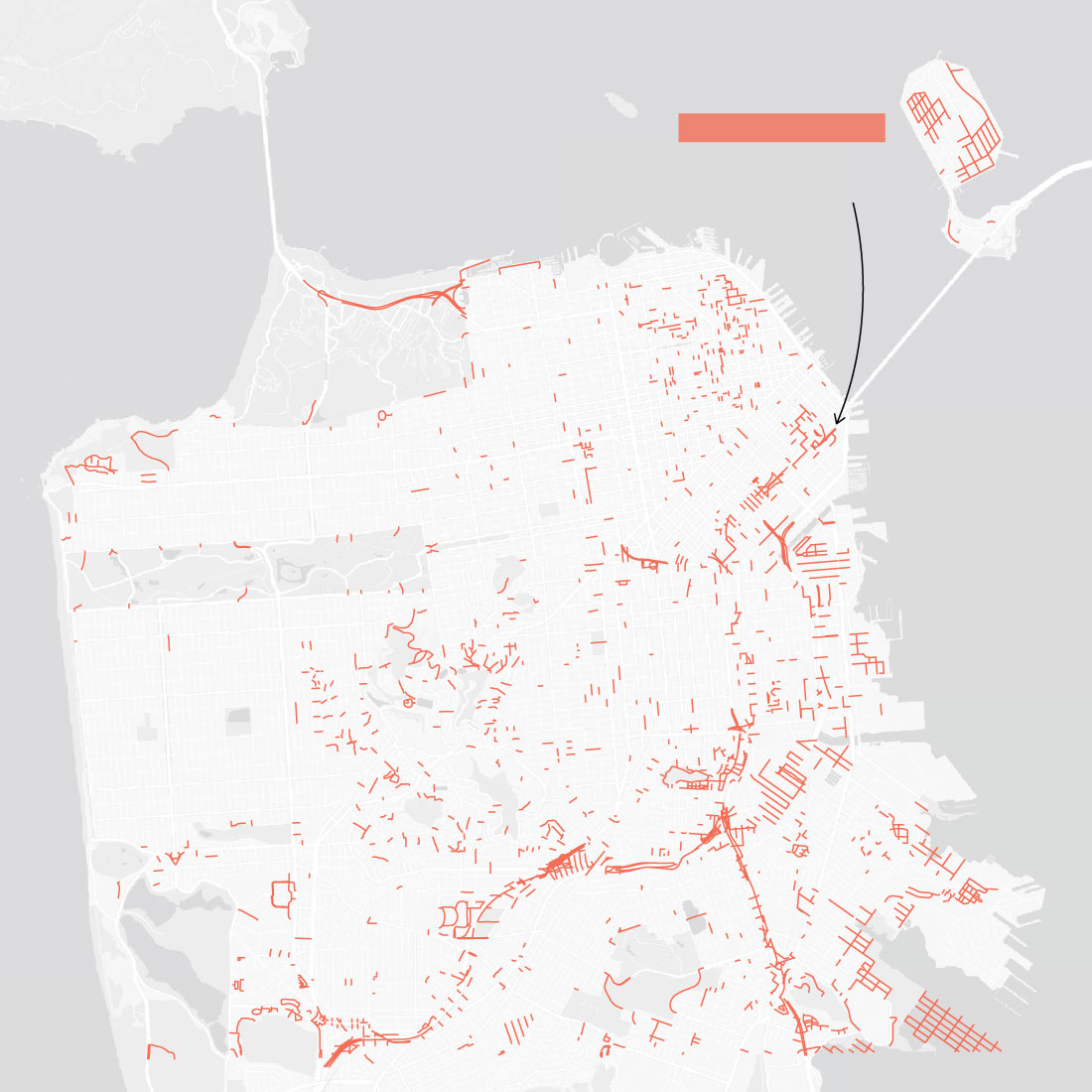
Many unaccepted streets
are found around highways
or in former industrial
areas
Note: Data includes a small portion of “paper” streets, which are captured in DPW / Assessor-Recorder records but do not exist in reality, namely those under water near Candlestick Park. Source: The list of unaccepted streets was provided by the Department of Public Works on July 10, and mapped using spatial data from S.F. Open Data. Basemap from Mapbox. Map by Kelly Waldron.
In well-to-do parts of the city, unaccepted streets are beloved because they often become community green spaces. But in less well-to-do areas, they’re are an expense few can afford. When a construction crew drops a busted toilet and a load of broken drywall at the end of an unaccepted street it isn’t — technically — the Department of Public Works’ responsibility to come by and cart it away.
When the pavement splits and potholes reach the size of paella pans, residents who file a complaint are told that they need to pay for the cost of repaving on their own.
In District 10, an influx of recent development has incorporated some unaccepted streets into new housing, offices, or even turned them into parks in Dogpatch and Mission Bay.
But in Bayview, development has been slower, and large swaths of unaccepted streets — leftover from the post-industrial neighborhood’s past, or sitting next to empty, undeveloped plots of land — are now a kind of no-man’s land.
District 10 has the largest share of unaccepted streets
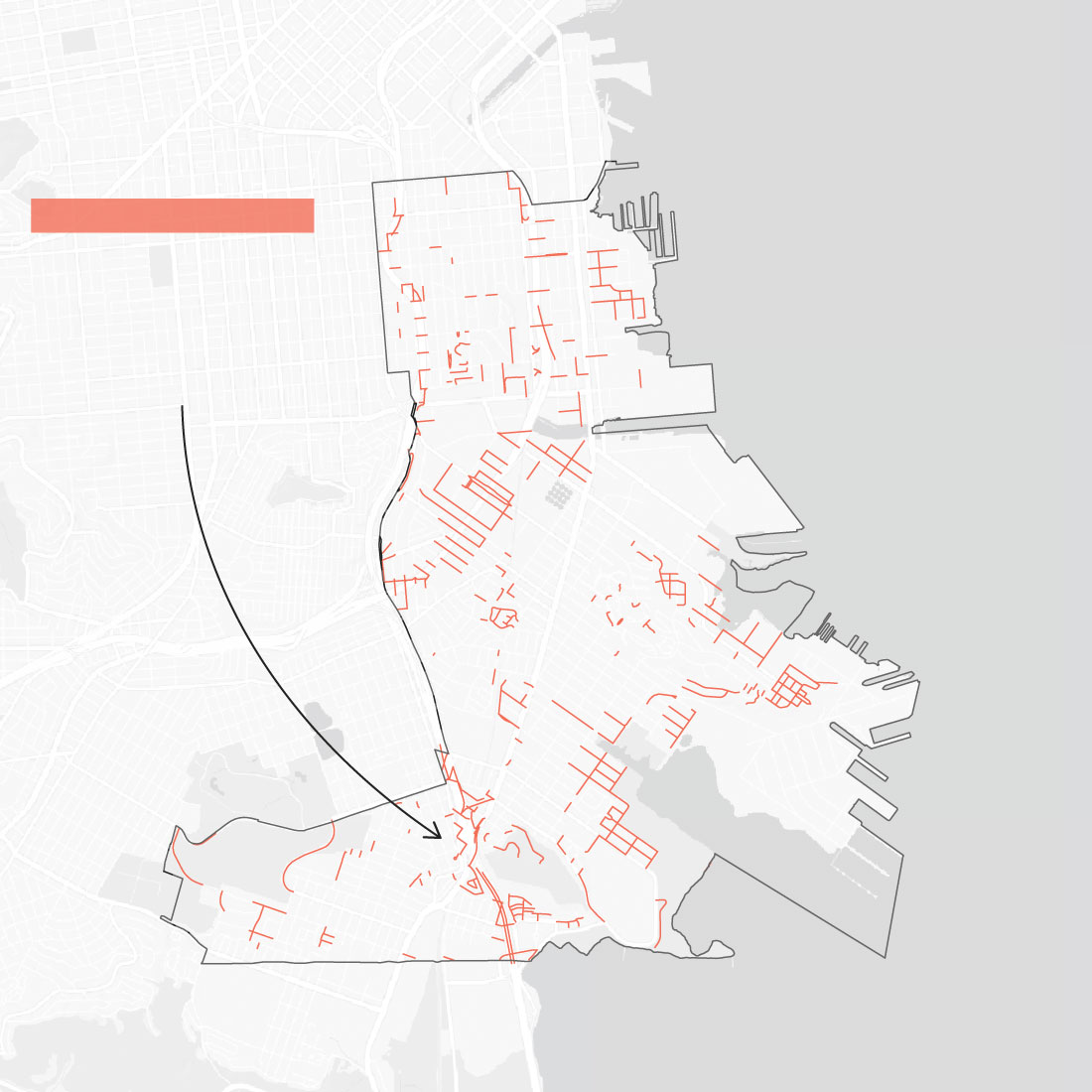
In Bayview-Hunters Point,
long stretches of
unaccepted streets
are more common,
especially near
empty developments
like Candlestick Point.
POTRERO
HILL
BAYVIEW
Source: The list of unaccepted streets was provided by the Department of Public Works on July 10, and mapped using spatial data from S.F. Open Data. Basemap from Mapbox. Map by Kelly Waldron.
‘We do our best … but it’s tough’
“When people talk about Bayview, they call it an industrial neighborhood,” says Barbara Tassa, a member of the Bayview Hill Neighborhood Association who lives near Carroll Avenue. “But people live here. There are families here.”
Carroll Avenue near Candlestick Park is a bustling industrial street connected to several small contracting and fabrication businesses, as well as Bayview Greenwaste Management, a recycling center that takes in downed trees and yard waste and hands out free mulch and compost.
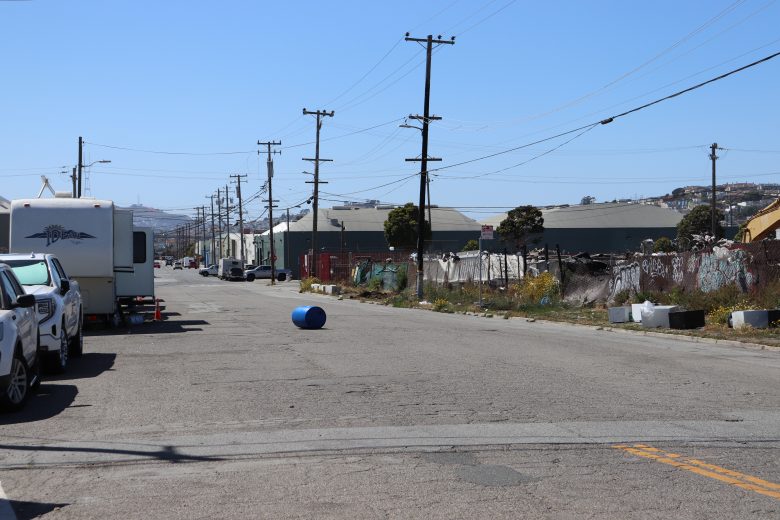
But halfway down the road, pavement markings regulating traffic suddenly stop, and a smooth, repaved road gives way to cracked pavement scattered with refuse and large pools of standing water.
On a particularly windy afternoon, an empty barrel rolled across the street, landing in a pile of discarded furniture and clothing.
Though the neighborhood is still largely industrial, it is home to more than 14,000 residents, many of whom live near unaccepted streets that have become targets for illegal dumping. Those residents say they feel neglected.
Residents living on or near the city’s unaccepted streets have sent Mission Local photos of piles of burning trash next to nearby encampments, broken refrigerators, discarded clothing, and strange refuse they have found by the side of the road.
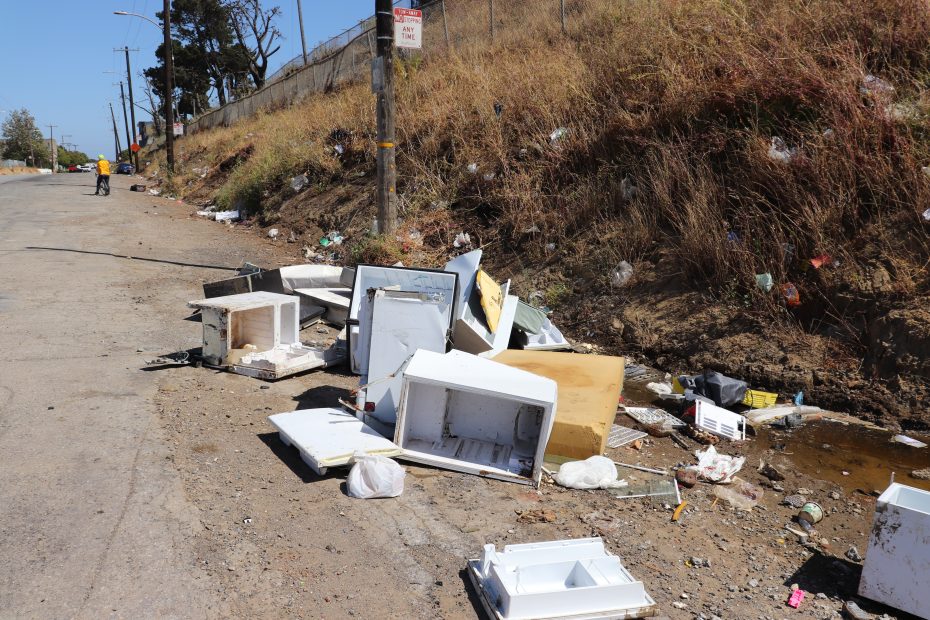
For them, it’s a regular occurrence, and one they’re at a loss for how to solve.
They’ve attended community meetings, spoken out at City Hall, compiled their own data, and emailed the Department of Public Works, the San Francisco Municipal Transportation Agency, Supervisor Shamann Walton, and the mayor numerous times, attaching photos of burning trash and refuse strewn about the ground.
They’ve joined community groups like the Bayview Hill Neighborhood Association, which does regular trash cleanups around the neighborhood and pressures the city to conduct emergency cleanups on unaccepted streets.
It’s been happening for decades, and hasn’t let up.
Tenants at Alice Griffith Apartments have long complained of illegal dumping on Gilman Avenue, an unaccepted street a few blocks south of Carroll. Despite also serving as a route to Candlestick Point State Recreation Area, Gilman lacks a sidewalk, and the wide, cracked road is overgrown with weeds. Gilman, like many other unaccepted streets, has become a regular spot for RV parking.
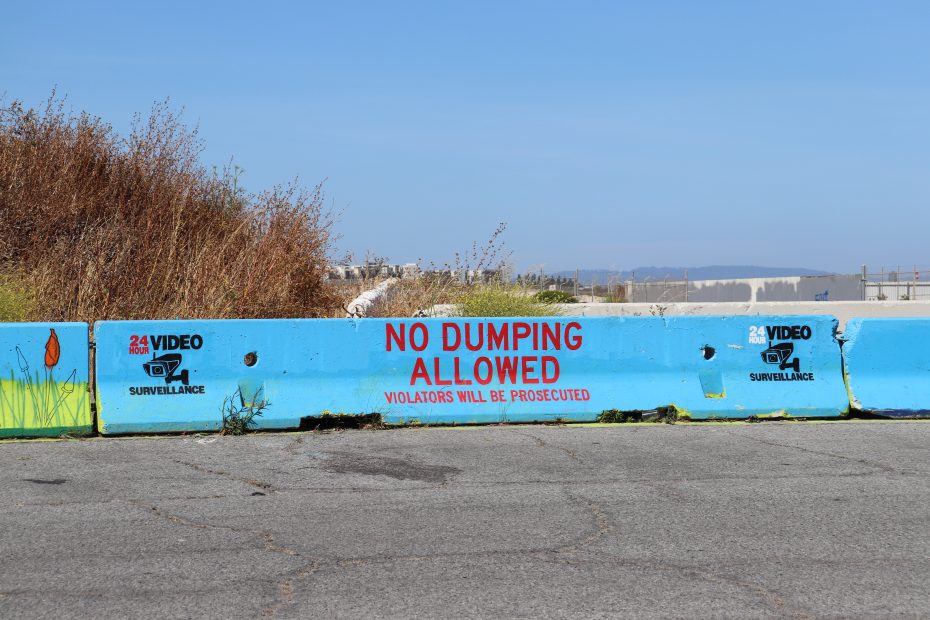
After pressure from neighborhood groups, the city recently installed K-rails — large concrete barriers often seen by the side of highways — to provide a narrow pathway. The barriers were painted with flowers and words reading, “NO DUMPING ALLOWED,” alongside an illustration of a surveillance camera.
But the illegal dumping, often in the form of construction debris or garbage from nearby businesses, continues.
The Department of Public Works regularly visits illegal dumping hotspots and even conducts “sting operations” — overnight drives in unmarked vans, where city workers try to catch dumpers, set up surveillance cameras, and even sift by hand through trash to look for clues.
https://videopress.com/embed/u9hHJaYA?cover=1&autoPlay=0&controls=1&loop=0&muted=0&persistVolume=1&playsinline=0&preloadContent=metadata&useAverageColor=1&hd=0Video taken by a nearby resident shows debris erupting into flames on Hawes Street Corridor, an unaccepted street. Video courtesy of Topher McMullin.
It’s not enough, the department acknowledges.
“A truck can come in very quickly, dump their goods, and get out of there,” said Rachel Gordon, the spokesperson for Public Works. “We do our best to try to catch people, but it’s tough … People come from out of town to dump where you think you can get away with it … It’s a scourge on our neighborhood and our communities.”
Gordon estimates Bayview is hit with 20,000 pounds of illegal dumping a day.
What makes a street not a street?
San Francisco’s unaccepted streets sometimes look like any other paved roadway, or like an outdoor staircase or narrow dirt path. But they all have one thing in common: They don’t meet the city’s street-design standards, and thus don’t receive public dollars.
Gordon from Public Works says the use of city money for “unaccepted streets,” to conduct street sweeping or maintenance, for instance, is illegal. Any upkeep of these streets is up to a nearby property owner, or a willing developer.
If a resident wants the city to “accept” a street, all minimum standards must be met, which could mean installing a fire hydrant, a sidewalk, or otherwise improving the road on one’s own. Then finally, the Board of Supervisors would need to approve new legislation to adopt the street and undertake responsibility for its maintenance.
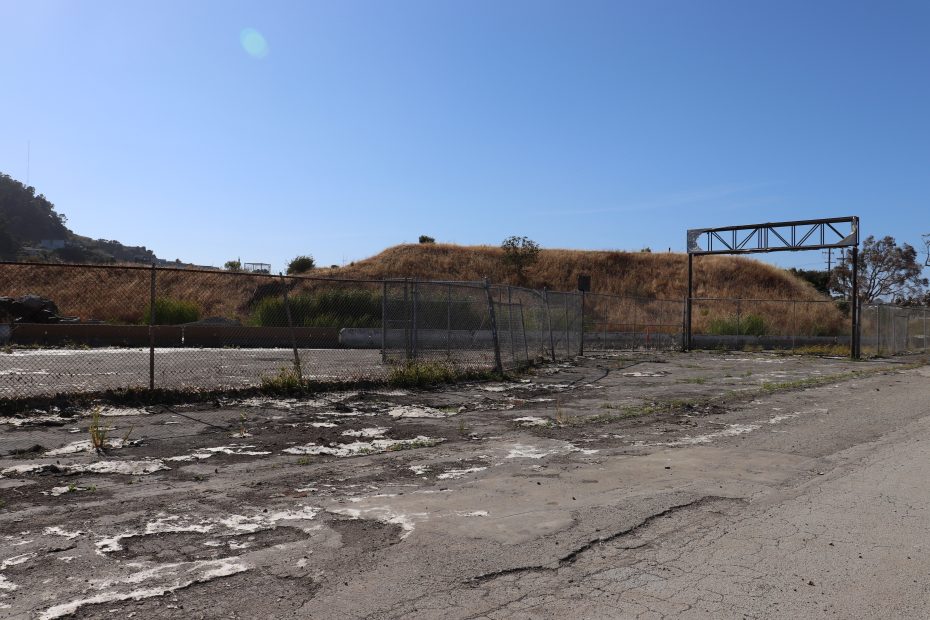
Unaccepted streets are sometimes too steep, too narrow, or inaccessible by foot or by car. Sometimes, they simply weren’t built up to code when plans for San Francisco’s roadways were first drawn up in the 1800s and early 1900s.
Nearby developers sometimes build roads as part of larger projects, or make small improvements to existing streets. But if those improvements aren’t quite up to par, the street remains “unaccepted.”
In Chinatown or Russian Hill, unaccepted streets usually take the form of a small back alleyway; in SoMa, they’re often short segments running under Highway 80.
But in more industrial neighborhoods like Bayview, unaccepted streets are long stretches of paved, cracked roads along the waterfront or empty plots of land waiting to be developed.https://datawrapper.dwcdn.net/YIUsM/1/
The neighborhood has changed a lot since the 1920s, when it was referred to as “Butchertown” for the slaughterhouse industry that dominated a neighborhood once covered with cows and mud flats.
Since World War II, an influx of manufacturing and shipbuilding created a bustling industrial zone. Today, the ruins of the shipyard are left to rot, or have become affordable studios for an eclectic group of San Francisco artists, but much of Bayview’s industrial hub remains.
The result is a hodgepodge of warehouses, businesses and residential homes, but with many of the remaining features — and roads — of an industrial neighborhood.
Residents who live on or near unaccepted streets were surprised to learn that they would have to pay for maintenance of their street themselves. One neighbor says she paid out of pocket to replace her sidewalk. Another for a fix to a faulty sewer grate.
Sidewalk repairs in San Francisco can cost up to $25 per square foot, but can add up to thousands of dollars for extensive repairs, especially if a resident wants to add a sidewalk to an unaccepted street in order for it to be approved by the Board of Supervisors.
In a largely low-income neighborhood, these fixes are expensive and time-consuming.
Sarah Moos, a former researcher for public policy nonprofit SPUR, argues that Bayview’s streets have historically been under-resourced compared to more northern neighborhoods, and that the streets on public land should be the responsibility of the city to improve. Moos says that all unaccepted streets are, technically, public land.
Moos’s research envisioned a network of trails across the eastern half of the city, called the “bluegreen way,” spanning from the Embarcadero to the southeast waterfront, incorporating some of the unaccepted streets near the ports into a park, and connecting what some residents have observed as an isolated southeast waterfront to the rest of the city.
While Moos says that the city has been laser-focused on revitalizing downtown, she predicts the southeastern neighborhoods will soon, hopefully, see that same energy. “It’s just waiting for the right moment.”
Until then, all residents can do is join in on neighborhood cleanups to pick up the refuse themselves, or show up to public meetings when government officials are present, and try desperately to draw their attention to a decades-old issue. One that, currently, has no end in sight.
KELLY WALDRON
Kelly is Irish and French and grew up in Dublin and Luxembourg. She studied Geography at McGill University and worked at a remote sensing company in Montreal, making maps and analyzing methane data, before turning to journalism. She recently graduated from the Data Journalism program at Columbia Journalism School.More by Kelly Waldron