


By Alyce McFadden, Staff Writer May 19, 2026 (SFChronicle.com)
Gift Article
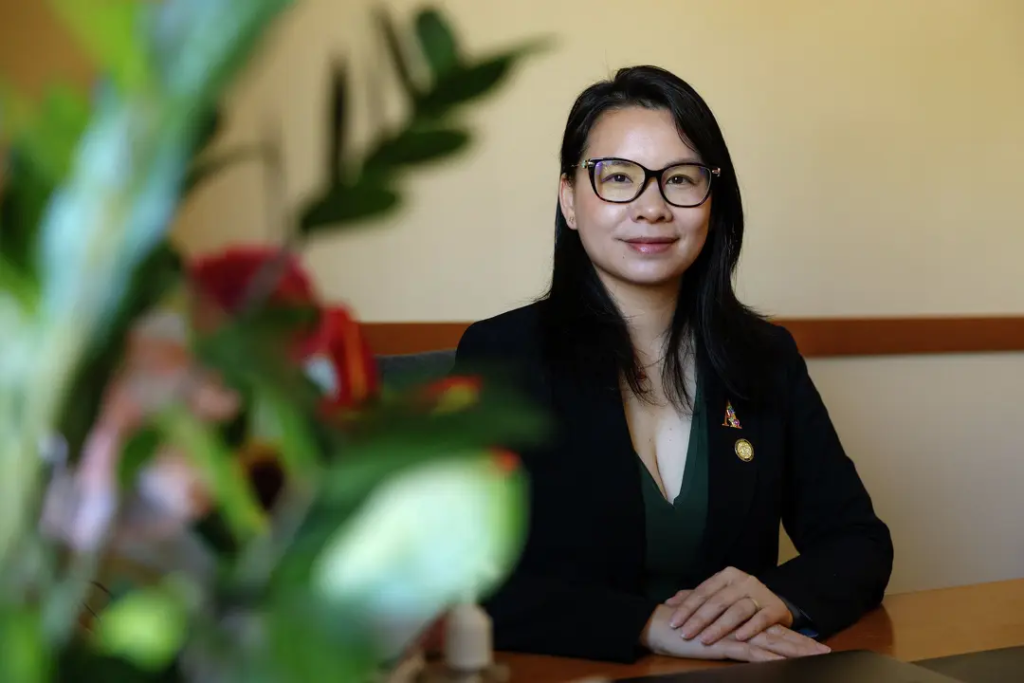
Supervisor Chyanne Chen will introduce a charter amendment at the Board of Supervisors meeting that would establish a municipal financial corporation, a precursor institution to a public bank. Manuel Orbegozo/For the S.F. Chronicle
San Francisco is taking a step toward opening a public bank, with time running out to move the plan forward. Supervisor Chyanne Chen will introduce a charter amendment at the Board of Supervisors meeting that would establish a municipal financial corporation, a precursor institution to a public bank.
Proponents of the measure say a public bank would help San Francisco fund programs that align with its highest priorities, like building more affordable housing, supporting small businesses and meeting its climate goals. But such an institution could be the first in any contemporary American city, and some experts say it is unclear whether a public bank would succeed.
“San Franciscans need and deserve bold solutions to address our most pressing challenges,” Chen said in a statement. “We must use every tool we can to keep San Francisco affordable and to advance solutions that lead towards a just economic recovery for all.”
The proposal will need to win the approval of a majority of the Board of Supervisors to appear on voters’ ballots in November. Four supervisors — Jackie Fielder, Bilal Mahmood, Myrna Melgar and Shamann Walton — have already signed onto the measure as co-sponsors.
If it passes in November, it would codify the framework for how the institution would operate, drawing on a plan published in 2023 by a group convened to study how a public bank could work in San Francisco. The charter amendment would not provide a revenue stream to fund the bank but it would enshrine its rules, structure and mission in the city’s charter. To pass, it would require a simple majority of voters to approve it.
The bank would be run by a board of qualified bankers appointed by an oversight committee whose members would be selected by the supervisors, the treasurer, the city attorney, the controller and the mayor. The layered appointment structure is designed to help insulate the bank against corruption or political influence, according to the 2023 report.
Some San Francisco progressives have been pushing the city to create a public bank for years. In 2023, supervisors unanimously approved the plan outlined by The San Francisco Reinvestment Working Group, a body created by supervisors in 2021. The group’s final report forms the basis of Chen’s charter amendment.
Fielder, a progressive who represents the Mission and who has been on a leave of absence since March, founded the San Francisco Public Bank Coalition in 2017. The group helped push state lawmakers to pass a 2019 law giving cities and counties in California a path to creating their own public banks, but the law expires in 2028, giving San Francisco a short window to move on the plan.
“It feels like an incredible tool to add to the city’s tool kit,” said Misha Steier, a spokesperson for the coalition. “This is the culmination of years and years of movement effort.”
In February, Fielder proposed a separate ballot measure that would fund a public bank through a tax increase on lending companies including mortgage brokers and credit card companies, according to Mission Local. Daniel Anderson, a spokesperson for the Our City Our Bank campaign that had been gathering signatures for that measure, said the campaign’s efforts will now focus instead on passing the charter amendment.
Chen’s proposal would not designate a funding stream to direct money into the bank’s coffers, but bank leadership and San Francisco voters could separately decide how best to fund the institution later on, according to Steier. Raising money for the bank could prove challenging. San Francisco’s business community has organized to oppose a tax on big businesses that will come before voters as a ballot measure in June, arguing that new taxes could push employers out of San Francisco at a critical moment in the city’s economic recovery.
Several other jurisdictions in the state, including Los Angeles and Berkeley, have also explored public bank measures, but none have yet moved ahead.
A public bank in San Francisco would be among the first of its kind in the United States. As a point of reference for how it might work, public banking advocates frequently point to North Dakota, which has had an effective public bank since the early twentieth century. It boasts significant profit margins and has administered disaster relief programs in the wake of flooding and agricultural crises.
But Robert Chirinko, a professor of finance at the University of Illinois Chicago who has researched the effectiveness of public banking, says he sees little evidence that the model would necessarily work as well in San Francisco. According to his research, much of the North Dakota bank’s success stems from the state’s fracking boom and the fact that its funds are uninsured. Unlike a traditional bank, where deposits are insured by the federal government, North Dakota’s bank has no such protection. That saves the bank money but also means the state takes on a significant amount of risk.
More broadly, Chirinko said local legislative bodies — like San Francisco’s Board of Supervisors — are best equipped to decide which public programs to fund in the name of social good.
“Infrastructure, education, pollution, extending credit to low-income communities, et cetera: I have nothing against doing those things, but you should do it through the legislature,” he said. “You shouldn’t do this through this, basically, runaround.”
Steier said San Francisco’s proposal includes several layers of protection to reduce risk for money that is kept in the bank.
Some examples of the types of projects the public bank could help finance include multi-family housing, electrification projects and small business expansions, according to Chen’s office. A public bank has several advantages over bonds, according to Steier, including the fact that “we’d be keeping the interest, the loans would be cheaper.”
A municipal finance corporation “and Public Bank can help jumpstart the more than 10,000 affordable housing units in our pipeline that are stalled due to lack of financing, and incubate and grow our treasured local small businesses to help provide economic security for local entrepreneurs and their families,” said Chen in the statement.
May 19, 2026
City Hall reporter
Alyce McFadden is a City Hall reporter at the San Francisco Chronicle covering the Board of Supervisors. McFadden previously worked at the New York Times, where she was a news assistant and reporting fellow. She covered Andrew Cuomo’s history of sexual harassment, the trial of the man accused of attacking Salman Rushdie, the Los Angeles wildfires and the reaction to the killing of Charlie Kirk. McFadden has also written for Law360, OpenSecrets and the Maine Beacon. She’s a graduate of Bowdoin College, where she studied government and legal studies and was editor in chief of the student paper.