


- By Marc Sandalow | Special to The Examiner
- 17 hrs ago. (SFExaminer.com)
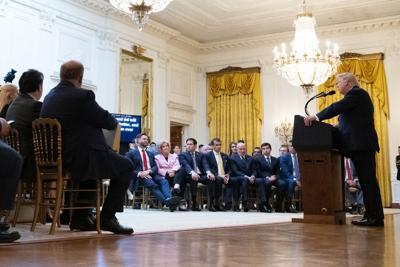
If you take President Donald Trump at his word, there is good reason to doubt that he was legitimately elected.
That’s the inescapable conclusion from Trump’s prime-time speech Thursday regarding U.S. elections, which he called “catastrophically” vulnerable to manipulation and “worse than any Third World country.”
Trump declassified evidence that purportedly shows American democracy is jeopardized by foreign manipulation and voter fraud. As one example of the “insanity,” as he called it, he pointed to California’s June 2 primary, which took a month to certify.
“I wonder what they were doing,” he said, insinuating that cheating was the likely explanation.
In Trump’s mind, this is all evidence that the election he lost to Joe Biden in 2020 was rigged. After all, he is a winner — so if he didn’t come out on top, it must be that others cheated.
But vulnerability is not proof that cheating occurred. The evidence released by the White House didn’t establish that a single vote was changed or illegally cast. Instead, it suggested that the system has multiple weak spots that make it susceptible to such mischief.
Voting machines, he asserted, are “vulnerable and they’re easily compromised.”
“We judge that the United States’ adversaries — including at a minimum Russia, China, Iran, North Korea, as well as non-state groups — have the capability to compromise U.S. election infrastructure,” he said.
If adversaries manipulated the election Trump lost in 2020, why should anyone assume they did not manipulate the elections he won in 2016 and 2024?
That’s what makes the logic of last week’s speech so remarkable — the man who won two of the last three presidential elections is making the case that election results can’t be trusted.
It makes no sense that U.S. adversaries would have intervened in 2020 but stayed out of the other two elections. In fact, the only hard evidence of actual interference comes from Trump’s first victory.
Ex // Top Stories
OpenAI preps for what could be another bitter battle — this time, with Apple
The iPhone maker has charged the San Francisco AI giant with stealing its trade secrets. Don’t expect a quick resolution, legal experts say
Board of Supervisors approves creation of SF cannabis cafes
New legislation by Board of Supervisors President Rafael Mandelman is making a new revenue stream for legal retailers
These SF events will help you break through ‘no-sky July’
Over seven days, The City will welcome a night market celebrating South Asian culture, an international art-book fair and Danny DeVito
A two-year investigation into the 2016 presidential election by special counsel Robert Mueller concluded that Russia “interfered in the 2016 presidential election in sweeping and systematic fashion,” to help Trump win.
While it found insufficient evidence to prove that Trump coordinated with the Russians or “committed a crime, it also does not exonerate him.”
Trump is right when he says that threats to American democracy should be a commander-in-chief’s primary concern. But more telling than his warnings are his proposed solutions.
Trump did not call for restoring the $10 million he cut from a program to enhance election protection against hacking. Nor did he rush to replace the two people he fired earlier in the week from the Election Assistance Commission, leaving the agency that oversees election standards without members.
Instead, he called on Congress to pass the SAVE Act, a Republican bill that would do away with most mail-in ballots and require proof of citizenship to register to vote, provisions that appear aimed at reducing Democratic Party turnout.
Forcing the nine out of 10 San Franciscans who currently cast ballots by mail to vote in-person in the future will do nothing to minimize the catastrophic risks to American democracy that Trump describes.
Many believe Trump’s fixation on the 2020 election springs from his inability to accept his rejection by more than 81 million voters. Others, including Gov. Gavin Newsom, have portrayed it as a cynical manipulation aimed at stirring doubts about the process in the event that the 2026 midterm elections produce results he doesn’t like.
Both explanations are disturbing. Trump is warning that American elections are perilously vulnerable — and simultaneously dismantling efforts to protect them. He offers no evidence that voting restrictions would address the threats he describes.
For Trump, election integrity appears to have less to do with protecting democracy than with ensuring that democracy produces the result he wants.
Marc Sandalow has been writing about California politics from Washington, D.C., for more than 30 years.