


The most expensive city in America still has more than 2,000 undeveloped parcels. What gives?
By Christian Leonard and Harsha Devulapalli | Updated Sept. 8, 2026 (SFChronicle.com)
In one of the most expensive cities in the world, some parcels of land have sat empty for years — as if to mock housing-seekers desperate for more options.
Take 1125 Market St., an empty 12,000-square-feet lot that hides behind a wall of boards directly across from Civic Center Plaza. The parcel sticks out like a missing tooth, yawning between two four-story buildings. But the vacant lot, which has remained undeveloped since the Embassy Theater was demolished 30 years ago, is not the only one of its kind.
Out of the city’s roughly 230,000 active parcels, about 2,000 privately owned lots sit undeveloped. That means less than 1% are vacant, according to a Chronicle analysis of data from the San Francisco Planning Department. But in a city where squares of dirt are worth seven figures, and where the city is trying to boost housing production to meet demand, why are any lots empty at all?
© OpenMapTiles © OpenStreetMap contributors
The list of potentially vacant lots the Planning Department gave us isn’t perfect. Some lots are obviously not vacant, while others are active streets or passageways. A few lots were literally underwater.
We removed parcels that probably aren’t vacant, as determined by us or the Planning Department, as well as publicly owned ones. We also added in a few that were excluded from the original data. That gave us these 2,000 parcels, out of an original 5,000.
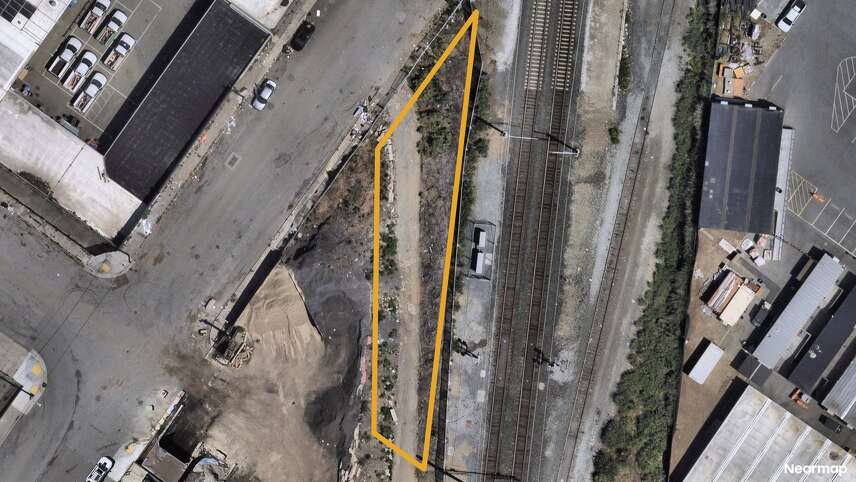
Even with this slimmed-down list, some vacant parcels aren’t eligible for housing at all. Lots like this one are zoned for “production, distribution and repair,” a district the city created in the early 2000s in an attempt to protect blue-collar jobs by banning new housing and large offices.
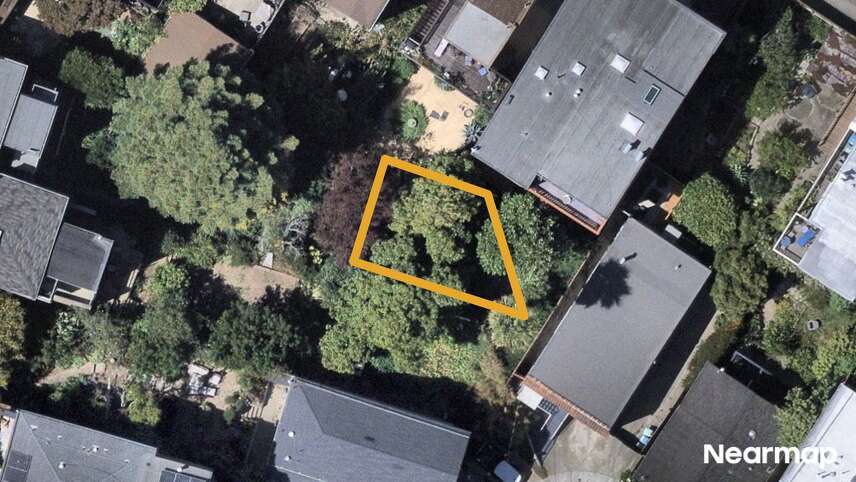
Others have likely remained empty because of their shape or position. These can be super narrow, surrounded by other buildings or just plain tiny. In some cases, the owners of these lots even stop paying property taxes on the land, eventually allowing the city to auction off the parcel.
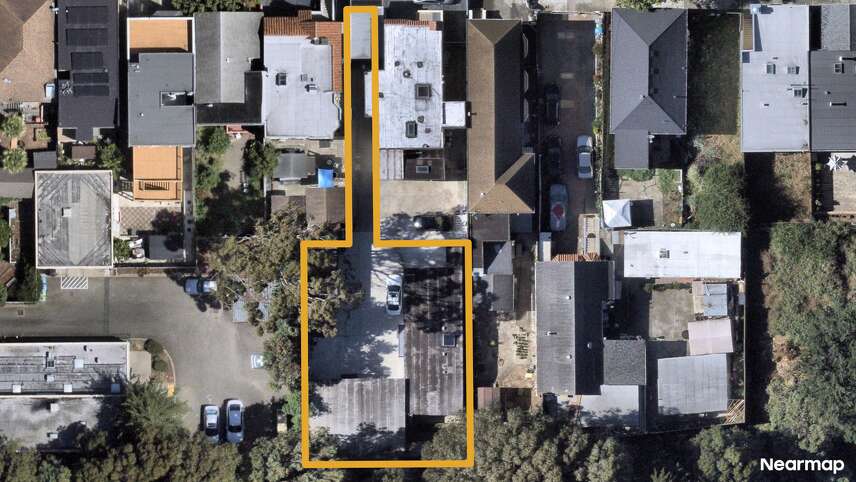
Yet other pieces of empty land are actively being used, often as private parking lots, driveways or yards. While they may not be ideal building locales, recent changes to state housing laws have made it easier for homeowners to construct small units on their adjacent lots.
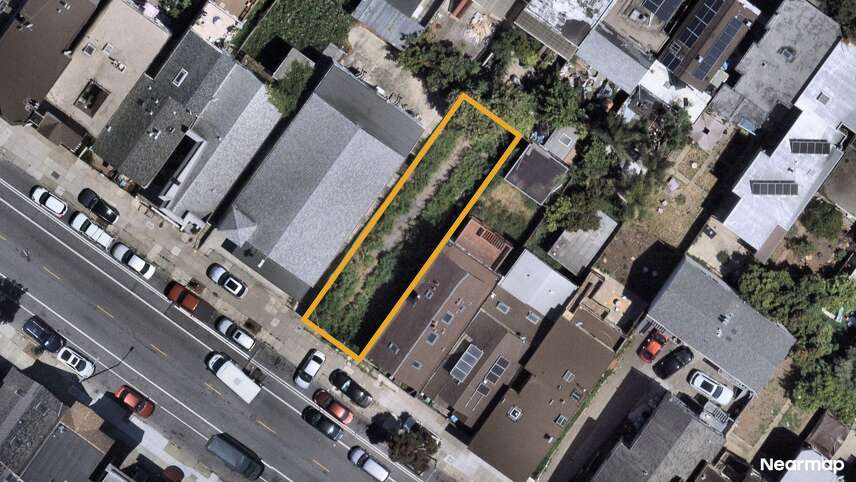
There are signs of growth on some vacant parcels. A developer has received a permit to build a fourplex on an empty infill lot at 1750 Oakdale Ave.
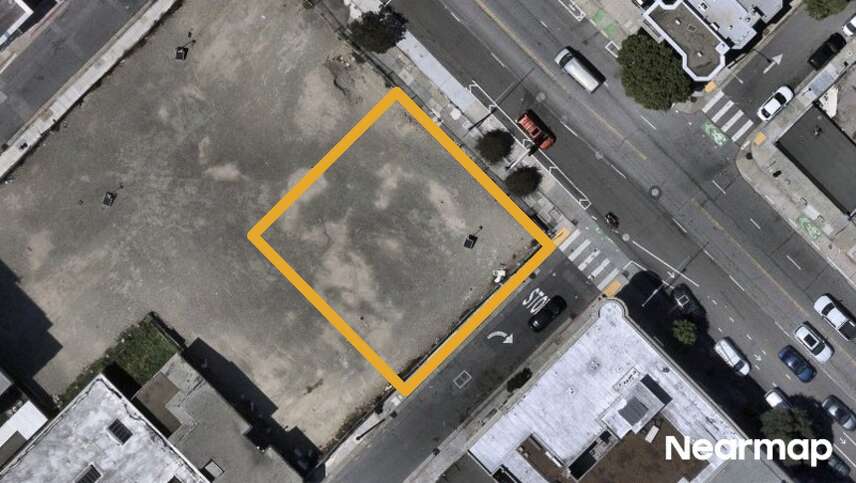
Others are stuck in the development pipeline. A developer demolished three structures at 360 Fifth Street several years ago, intending to build apartments. The hole in the ground later became a swamp, though a new developer aims to build an eight-story tower there.
When the opportunity to develop one of these lots arises, developers can have a field day.
“Every time a client calls us saying, ‘I have a vacant lot,’ the smile grows on my face,” said Geoff Gibson, whose firm is developing the 1750 Oakland Ave. project. “We have a lot more elbow room of what we can do.”
All else being equal, it’s usually easier to build on a vacant lot than one that already has a structure. An empty parcel means no demolition, which can be costly. And San Francisco generally requires developers to replace affordable or rent-controlled units they demolish.
But changes to local and state housing laws have made it easier to replace single-family homes and small storefronts with multifamily buildings, meaning vacant lots don’t quite carry the advantage they used to, Gibson added.
Still, some experts say vacant lots will have a role to play in providing more homes. Emmanuel Proussaloglou, who helped lead a project identifying empty lots in Los Angeles that could be turned into middle-density buildings, explained that building on undeveloped land allows builders to sidestep potential displacement impacts, unlike redeveloping a property with an existing residence.
“It’s not that every development always needs to happen on vacant land, but we think that’s the door that’s a little bit ajar,” said Proussaloglou, who co-directs UCLA’s cityLAB think tank.
But as the Planning Department argues, there just aren’t many vacant lots left in San Francisco, and that many of those that do exist aren’t necessarily primed for construction — the tiny slivers of land squeezed between more regular parcels, for example.
And there’s plenty of reasons why even parcels well-suited for development remain unbuilt, said Mike Reilly, a housing data scientist for the UC Berkeley-affiliated Terner Labs. Some might serve as a backyard or other open space. Parking lot owners might prefer their regular income and low upkeep over selling to a developer. A few could be holding out for land prices to rise even more.
To those owners, “that vacant lot is useful as it is — vacant,” Reilly said. “It might not make sense to you and me, but to the person who owns it … they want it that way.”
If San Francisco seriously wants to expand its housing supply, it can’t depend on a handful of vacant parcels alone: The city is going to have to demolish some existing buildings if it wants to tackle its housing shortage, Reilly said.
But that’s a whole other can of worms. Demolition, Reilly said, tends to raise fears of displacement and loss of neighborhood character.
In a city that generally loves how it looks, Reilly added, demolishing old buildings to make way for new ones “is a pretty sensitive topic.”
Are there vacant lots you know about that aren’t on this list? Or do you see lots we’ve erroneously displayed as vacant? If so, please write to Harsha Devulapalli (sriharsha.devulapalli@sfchronicle.com) or Christian Leonard (christian.leonard@sfchronicle.com).
Use ⌘ + scroll to zoom the map
Addresses may only be approximate in some cases.
Map: Harsha Devulapalli and Christian Leonard/S.F. Chronicle • Source: San Francisco Planning Department
Read More

With rents surging, developers race to build San Francisco apartments again

Newest map reveals who owns every property in California

Do S.F. two-bedrooms really rent for $6,000 now? What the viral claim leaves out
Credits
Reporting by Christian Leonard. Design and development by Harsha Devulapalli. Editing by Aseem Shukla.
Originally published on Sept. 8, 2026Powered by the Hearst Newspapers DevHub.