San Francisco once again finds itself at a crossroads between corporate interests and the urgent need for affordable housing. The Mosser Hotel, located at 54 4th Street in the South of Market, seeks permission to convert 72 out of 81 existing residential hotel rooms to tourist hotel rooms, adding to the existing 78 tourist hotel rooms already operating there. If approved, this move would further deepen the city’s affordable housing crisis, hurt hotel workers, and set a dangerous precedent for other property owners looking to prioritize profits over housing stability.
Despite these concerns, the Mosser’s owners claim that lost residential units will be replaced at 509 Minna Street. However, this site has already been in use as supportive housing since 2021, housing people transitioning out of homelessness through a city-supported program run by the Department of Public Health, the Department of Adult Probation, and Westside Community Services.
The Mosser Hotel conversion would destroy affordable housing and hurt hotel workers. Wikimedia images photo.
The Planning Department’s draft motion falsely claims that 509 Minna still contains 72 tourist hotel rooms, when in reality, these rooms have been used as transitional housing since the pandemic. Counting these existing rooms as “new” replacement units is misleading at best, and the project at 54 4th fails to provide one-for-one replacement housing as required by the city’s regulatory codes put in place to prevent the loss of residential hotels. Moreover, the Minna Project serves a specific population in a sober living environment, which is not a direct replacement for general residential housing available to all.
This is not the first time the Mosser has attempted to abandon its obligations as a residential hotel, having applied for a similar conversion of units in 2017. For nearly a decade, the property has claimed a “lack of demand” for low-income housing, despite the city’s ongoing affordability and homelessness crisis. During these years, between 53 and 76 low-income residents could have been housed in the Mosser.
The Mosser’s residential vacancy rates raise serious concerns about the city’s role in approving the unit conversions. Granting a conversion permit now would send a clear message to landlords that not renting out residential units can ultimately lead to approval for more lucrative tourist accommodations.
In addition to the conversion of units, the Mosser must also apply for a Conditional Use Authorization permit to expand its tourist operations, a process that requires the Planning Commission to evaluate impacts on housing, transit, and social services.
Hotel workers at the Mosser are currently not unionized. Expansion of the Mosser’s hotel services would add jobs that do not pay enough for workers to afford living in San Francisco, pushing more employees into long commutes from cities such as Modesto and Sacramento. This would further strain regional transit systems, increase reliance on public assistance, and place additional pressure on surrounding communities.
The economic argument for this hotel expansion is also weak. The Mosser Hotel’s market study, conducted in 2018 with a brief 2023 update, projected visitor spending would return to pre-pandemic levels by 2024—a forecast that has already proven incorrect. The Mosser’s current tourist occupancy rate of 59 percent mirrors citywide averages. Converting more rooms to tourist use would not create new demand but instead take business from existing hotels, leading to job losses and reduced working hours elsewhere in the City’s hospitality sector.
Sponsored link
Help us save local journalism!
Every tax-deductible donation helps us grow to cover the issues that mean the most to our community. Become a 48 Hills Hero and support the only daily progressive news source in the Bay Area.
Given these economic risks, the Planning Commission must carefully weigh whether this project serves the city’s long-term interests. The conversion of residential units into tourist accommodations is not a right in San Francisco—it requires explicit city approval. The Planning Commission has a duty to reject projects that remove housing that is affordable to low-income residents, strain public resources, and fail to offer meaningful economic benefits. San Francisco cannot afford to lose more residential hotels for the sake of yet another tourist hotel. The Commission must deny this application.
Join us at City Hall (Rm 400) Thursday/20 at 1pm to tell the Planning Commission to STOP THE CONVERSIONS.
Angelica Cabande is the executive director of SOMCAN. Established in 2000, SOMCAN is a multi-issue and multi-strategy organisation that uplifts the lives of youth, families, individuals, and workers. We work on a wide range of issues—from tenant rights to community planning to Filipino language access to workers’ rights—and provide culturally competent direct services ranging from tenant counselling, family support, youth empowerment, employment, and health and wellness activities. SOMCAN believes in uplifting the voices of immigrant, people-of-color, and low-income communities so that they will be heard in local policy-making decisions and so that government officials are accountable to their needs.
The National Association of Letter Carriers has been embroiled in a contract fight with the USPS for years. Who should we trust with our mail—the workers who deliver it, or the billionaires who want to gut the postal service?
Barbara O’Donnell, front center, local union members and members of National Association of Letter Carriers rally to protest increase in assaults and robberies on letter carriers in recent years in front of Aurora Main Post Office in Aurora, Colorado on Tuesday, October 24, 2023. Photo by Hyoung Chang/The Denver Post
This week, we’re taking a more national focus, and checking in with the National Association of Letter Carriers, who have been embroiled in a years-long contract negotiation with the US Postal Service.
In our episode today, I’m sitting down with Melissa Rakestraw, member of the National Association of Letter Carriers, Branch 825 in Chicago, IL, to discuss the state of negotiations with our nation’s letter carriers, the unprecedented rejection of the recent Tentative Agreement and what happens next, and what would happen if the US Postal Service was privatized.
As a short editorial note before we begin, the interest arbitration process between USPS and the Letter Carriers began on March 17th, with Dennis R. Nolan set as the neutral arbitrator. This episode was recorded at the end of February, before those dates had been set.
Postal workers are also set to hit the streets this weekend–“Fight Like Hell!” rallies are scheduled for March 23 across the country to protest the proposed privatization of the US Postal Service.
Studio Production: Mel Buer Post-Production: Jules Taylor
TRANSCRIPT
The following is a rushed transcript and may contain errors. A proofread version will be made available as soon as possible.
Mel Buer:
I got work. Welcome everyone to Working People, a podcast about the lives, jobs, dreams, and struggles of the working class today. Working People is a proud member of the Labor Radio Podcast Network and is brought to you in partnership within these Times Magazine and the Real News Network. This show is produced by Jules Taylor and made possible by the support of listeners like you. My name is Mel Er and I’m your host for the month of March. Continue to stay tuned this month as we share the mic with workers from all over this country and discuss pressing issues central to today’s labor movement. In these last two weeks, we’ve spoken with workers at multiple unions in Southern California who are working diligently on breaking Deadlocks in their own negotiations. If you haven’t checked those out, you can find those episodes@therealnews.com under our podcast page. This week we’re taking a more national focus and checking in with the National Association of Letter Carriers who have themselves been embroiled in a year’s long contract negotiation with United States Postal Service.
In our episode today, I’m sitting down with Melissa Rakestraw, member of the National Association of Letter Carriers Branch 8 2 5 in Chicago, Illinois, and we’re discussing the state of negotiations with our nation’s letter carriers, the unprecedented rejection of the recent tentative agreement and what happens next and what would happen if the US Postal Service was privatized. As a short editorial note before we begin, this episode was recorded at the end of February before interest arbitration dates had been set. Those interest arbitration dates began on March 17th with Dennis R. Nolan set as the neutral arbitrator in this situation with me today to discuss their current negotiations and the threat of a privatized postal service is Melissa Rastro, member of the National Association of Letter Carriers Branch 8 2 5 in Chicago, Illinois. Thanks for coming on, Melissa.
Melissa Rakestraw:
Thanks a lot. I appreciate you having me.
Mel Buer:
I’m glad you’re here. I’d like to kick off this conversation first by giving our listeners a chance to get to know a bit more about you, your work, your organizing, and your union. So what is na? The Association of Letter Carriers, right? National Association of Letter Carriers and who do they represent? How many members do you have, that kind of stuff.
Melissa Rakestraw:
Right. So the NALC is a national association of letter carriers. We’ve existed since the 1890s. We didn’t have collective bargaining rights with the post office until after the great postal strike of 1970 largest wildcat strike in US history. And at that point too, that’s when they moved the post office out of the cabinet and into its own organization. The NALC. I personally have carried mail since 1995. I’m a letter carrier. The last two years I’ve been a full-time officer for my local branch 8 25. We have a lot of offices that we represent all throughout Chicago suburbs. We also represent some smaller offices throughout the state of Illinois. We represent around 1800 active letter carriers and we have around 3000 members total in our branch. So I’m also on the executive council for the Illinois State Association of Letter Carriers. We represent all letter carriers throughout the state of Illinois in our region within the NALC, there’s 15 regions and we’re one of 15.
Mel Buer:
How many members nationally do you have whereabouts?
Melissa Rakestraw:
Yeah, I think it’s around 200,000 in that range. It varies. It might be 189,000, but it does vary. And then around 60% of that would be active carriers because we have a large pool of retirees
Mel Buer:
And these are the folks who are outside of the mail handling post office who are delivering your mail to on route to your house every day.
Melissa Rakestraw:
So yeah, we’re the people that everybody sees as their mailman, the person in the truck in funny little truck where we drive on the wrong side and we’re coming to your doorstep hopefully every day to deliver your mail Monday through Saturday and we are one of the most beloved group of workers out there. Most people love their mailman. We call ourselves letter carriers, but I don’t have any problem with the term mailman myself again and again in pollings you see that the American public is very happy with their letter carrier and their mail service. Over the last few years we’ve seen some of that get deteriorated because of a postmaster general who was slowing down service and increasing rates. But letter carriers are out there every day watching kids grow up, checking on elderly residents who greet them at their mailbox every day. I’ve worked with people who have saved people from burning homes who have donated kidneys to their customers on their route. We are embedded in our communities. We aren’t just out there to do a job. We are out there to look out for the people who live on our routes.
Mel Buer:
I mean, I just certainly in my lifetime have had numerous friendships with letter carriers on the various routes that I’ve lived on, and so I definitely see that. One thing that I would like to kind of draw in our listeners’ attention to is you’ve been in the midst of bargaining a national contract for quite some time, a couple of years at this point, and just recently members voted to reject a tentative agreement with the postal service. For the benefit of our listeners, can you give us a bit of an overview about these negotiations, what’s been going on, what’s at stake and what the demands are for where members across the country, and then maybe we can kind of discuss why this tentative agreement was rejected.
Melissa Rakestraw:
Sure. So right before covid hit, we negotiated a contract and it was set to expire in May of 2023. Throughout covid letter carriers kept working every day. We made sure our customers got all the things that they needed to order online because they couldn’t go to stores. We delivered testing kits for covid, we delivered everything. We kept the economy running in a lot of senses. We were told we were essential workers. We were not paid hazard pay, we were not paid anything extra. We were told by our national leadership that we would get our pay and we would get what we deserve for being so crucial to the US public. When our contract expired, our contract expired in May of 2023. Our national president has pretty much full control over bargaining. He doesn’t have to include any of the rest of the elected officers, so he runs it.
He was negotiating with the postal service throughout the summer. He was giving us updates at different wrap sessions saying that he was planning on seeing seven to 9% salary increases for us year wage wise, our wages were the worst of any. If you look up wages with the rate of inflation, the letter carrier or postal workers’ wages suffered the worst in comparison to inflation over the last five years. So even though we actually have cost of living allowance adjustments, we don’t get full call. So our national president was telling us he’s trying to get seven to 9% increases and people expected that We’re seeing UPS, which we feel is comparable to us, same industry. They don’t actually have to walk house to house like we do, and their top of scale is $49 an hour. Right now our top of scale is under $37 an hour.
Sign up for The Real News Network Newsletter and stay ahead with news and analysis designed to inform—and inspire action.SIGN UP
So it’s a huge gap and the law actually says that the postal service is supposed to pay us wages that are comparable to the private sector. We are nowhere near that, nowhere close to it. It takes 13 years for letter carrier to get to the top of the pay scale, which is interminably too long. We’ve had problems staffing post offices ever since Covid because the starting pay and the conditions are too low, the conditions are terrible, people are abused by management, they have low wages and we can’t keep people. And so we’re having very high expectations out of this contract to get considerable pay increases and to address poor working conditions, management’s refusal to comply with the contract, violating the same things over and over, forced mandatory overtime all across the country. Here in Chicago, the post office has paid out millions of dollars to the local NALC branch for not complying with contract settlements.
Now it is ludicrous if you think that them just failing to abide by the agreements they’ve already signed, that alone is costing them millions of dollars. Nobody in management does anything about it. We wanted some resolutions through our contract to force management to comply with our settlements, to give carriers the right to say, when I’m done with my shift, I can go home. You can’t keep me here. 12, 13, 14, 15 hours. You’re seeing people forced to work 16 hours. And it’s so dangerous because our jobs are mainly on the street all day. You’re dealing with traffic, you’re dealing with so many unknown things. We’ve seen crimes against letter carriers skyrocket at one point every day in Chicago, there were numerous robberies of letter carriers out on their route. We’re like sitting ducks out there and nobody’s doing anything to help us. So we had such high expectations of this contract.
We finally were handed tentative agreement in October of 2024, well past 500 days, and it was 1.3% increase per year. A pitance and insult, quite frankly, no protections around the mandatory overtime for people who don’t want to work overtime, no protections in regards to enforcing our contract and management compliance with our contract. And we actually had giveaways where we were agreeing to lower our fixed office time. We have certain things we have to do every morning and they give us credit for that amount of time and they were trying to take back some of that time arbitrarily.
It wasn’t just that the monetary amount of 1.3% was so insulting, which it was also the fact that we’re getting work rules that don’t make sense for us either and make our jobs worse and harder and more difficult, which should not be the goal of a collective bargaining situation. So there were a record amount of people who voted in the vote for the tentative agreement. We at least have that right to vote it up or down. It was rejected by two thirds of the people who voted, which was also something that was historic. A tentative agreement hasn’t been voted down in the NALC since the early eighties, and we organized a vote no campaign. It went across the country. There were folks that started kind of a caucus that you call Build a Fighting NALC, that originated up in Minnesota that was talking about open bargaining and letting the membership know exactly what’s going on during bargaining because our national president wasn’t letting us know that there have been other groups too that have formed around these demands for open bargaining so we know what’s being bargained for and we can hold our leadership accountable.
And these same groups that had fought for open bargaining, like Build A Fighting NALC, the Care for President campaign and the concerned letter carriers group all said when we got this tentative agreement, well now this is an insult and we’re going to have to build a vote no campaign, which was very successful and it was a relief to see that the membership said, this is not sufficient. We will not accept this. You have to do better.
Mel Buer:
Right. I want to take a moment to talk about the historic nature of this vote no campaign. As you said, a contract hasn’t been voted down since the eighties, and there have been a number of labor reporters in the last couple of weeks who have really kind of underscored the sort of unprecedented nature of that. Does that sort of speak to the ways in which conditions either under this current postmaster, general Louis Dejo who may be leaving soon or the sort of deterioration of these conditions and what it means to work as a letter carrier, which historically has been a pretty stable career position? Right,
Melissa Rakestraw:
Right. Yeah, absolutely. So when people take a job in the post office, historically it was looked at as a career. It was looked as something that you’re working towards a pension, particularly with letter carriers. After we reach a minimum retirement age of around 57 and we have 30 years in, we can retire. And by that point your body’s been through enough that you really can’t, in a lot of cases work longer than that. We have the highest rate of injury of any federal worker just because of the physical nature of our job. So people’s expectations with this contract coming out of Covid, seeing what’s going on around us with other unions having historic wins with UPS, with UAW and their standup strikes, it was so invigorating to see those victories and what those workers were able to win. And then feeling like, Hey, it’s our turn now and we were made this promise that you are going to be rewarded for sticking with it, for sticking through covid, for putting up with all the mandatory overtime and now is your time.
That’s how letter carriers felt like now is our time. And when we saw this tentative agreement, it felt like it was an insult from management. Number one, they’ve just given themselves raises. And then it was also an insult from our national president that he would think this was an acceptable deal to try to get us to accept. He went around and campaigned for this deal all over the country and had wrap sessions where he would tell people how wonderful it was and when we’re like, no, it’s not wonderful. We’re not stupid. Don’t try to force feed us this nonsense. And he did everything he could to try to get it to be accepted and people still said no. And that’s not been over the last four decades since the early eighties. It’s not been the type of union where leadership was opposed and leadership was seen as not having fought for us for a very long time. Our national president was one of the people that had led the wildcat stripe, then Sobrato out of New York City, and he was a fighter and he won a lot of advances for letter carriers and we maybe slept on that tradition and got to a point where it was just a business unionist approach that the head of our union thought he could sit down with the head of management and they could figure out a deal and it would be fair and it was anything but
Mel Buer:
Right. Well now you’ve reached the tentative agreement has been rejected and the executive council voted unanimously on February 19th not to agree to terms with a postal service that would’ve given you a modified tentative agreement to vote on. So now technically we’ve reached the point where US Postal Service officials have been notified that they are at impasse, which for the benefit of our listeners really means that there is a stalemate that cannot really be sort of adjudicated between the two parties. They need to bring in a third party to kind of talk about this. And so coming up, this is being recorded on February 28th, likely we will hear dates about hearings that will be coming up in the coming weeks and months in what’s called an interest arbitration process. The proposals on both sides will be considered by a three person panel and then hopefully that means that there will be an agreement that can be reached through this arbitration process. My question for you, watching all of this, being a part of this vote no campaign and hearing from membership over the last months and really years, how do you feel about this development? Do you feel like this is moving in a positive direction? Is it something that is frustrating because you wish it hadn’t gotten to this point? How do you feel?
Melissa Rakestraw:
Well, it’s very frustrating because it’s been over 600 days now since our contract expired, and that means no raises for anybody, no cost of living increases, nothing flat, stagnant wages that we’re already behind. So that’s extremely frustrating. The other aspect of it that’s really frustrating is the union could have forced this negotiation to go into interest arbitration in the fall of 2023. Our national president could have said, then listen, you guys are not anywhere near offering us what we deserve. We’re sending it to the interest arbitration panel and we’ll take our chances. We feel like we have a good argument. And that didn’t happen. He allowed management to drop the plow and slow negotiations and not, and draw this out to the point that where we’re at now and this interest arbitration process, normally both sides will present briefs and witnesses and go through all aspects of the contract.
We present economic issues, work related issues, all of that. But now with the threat of the postal service being moved in the Department of Commerce, having our independent authority taken away, not being run by the Board of Governors anymore, realizing that we may not have anyone in management to negotiate with if those things happen, the union has decided to agree with management to go to an expedited process wherein the union is only going to present economic issues or pay scale management is entitled to put forward what they would like, but the union will put forward our issues. We are not going to be doing briefs, so the membership isn’t going to know after the fact what was asked for on our side, which is very disappointing and it’s a process that lacks transparency and quite frankly needs to be changed. So we’re going to put forward our economic proposals to the arbitrator.
The arbitration panel is three arbitrators, one picked by the union, one picked by management, and then one who we both agree on who’s the tiebreaker. And it sounds to me like in the expedited process, we basically play our case out to the mutually agreed upon arbitrator. He’ll go back and forth and talk to both sides and try to make an expedited ruling. We’re not putting forward as many things as we normally would. Now our national president is telling us that he wants to keep some of the work rules that they agreed on with management. He thinks they’re good even though the membership didn’t just vote down the contract because of the economic issues. People aren’t happy with the work rule issues either. He seems to think they’re a quote win so he can agree to memos with management to put a lot of these work issues into the contract. People are trying to push back on that in the union and say, Hey, let’s leave the work rules how they are right now in the current contract, extend that out and just simply deal with the pay because we know we can work with the current rules we have and how to navigate those,
But we think that your new work rules are not going to be helpful to us. So that fight now is playing itself out as well. And the threats, it’s not existential. I guess it’s an actual real threat from this current administration to attack and get the postal service and invalidate our collective bargaining agreements. So we’ve waited over 600 days for a raise and the longer this plays out, the worse we feel it will be for us. So
Mel Buer:
Yeah, it sounds like to me you waited till the house was on fire before you turned on the hose. And now with these threat, we will talk more when we come back from the break specifically about privatizing the postal service and what that would do to both workers and consumers. But it seems like at this point there’s not enough runway left to be able to get a decent contract out of this current contract period. And again, I want to underscore here that the contract expired in May of 2023. So the contract that is currently being negotiated to a stalemate at this point is supposed to run from 2023 to 2026. And we ran into this with the railroad unions a couple of years back where two and a half years of contract negotiations, we almost went to a national rail strike. The real news reported on this at the time, by the time that it was all said and done and the ink was dry, they were two and a half months out from negotiating the next contract because the periods expire. And so there’s this bottlenecking here that seems to be pretty pronounced, particularly in the NALC that is making it difficult for workers to get paid and also to plan for a much more uncertain future.
Protesters rally outside the Israeli Consulate, demanding an end to violence in Gaza after Israel broke the ceasefire, in Chicago, United States on March 18, 2025. Photo by Jacek Boczarski/Anadolu via Getty Images
My name is Mahmoud Khalil and I am a political prisoner. I am writing to you from a detention facility in Louisiana where I wake to cold mornings and spend long days bearing witness to the quiet injustices underway against a great many people precluded from the protections of the law.
Who has the right to have rights? It is certainly not the humans crowded into the cells here. It isn’t the Senegalese man I met who has been deprived of his liberty for a year, his legal situation in limbo and his family an ocean away. It isn’t the 21-year-old detainee I met, who stepped foot in this country at age nine, only to be deported without so much as a hearing.
Knowing fully that this moment transcends my individual circumstances, I hope nonetheless to be free to witness the birth of my first-born child.
Justice escapes the contours of this nation’s immigration facilities.
Sign up for The Real News Network Newsletter and stay ahead with news and analysis designed to inform—and inspire action.SIGN UP
On March 8, I was taken by DHS agents who refused to provide a warrant, and accosted my wife and me as we returned from dinner. By now, the footage of that night has been made public. Before I knew what was happening, agents handcuffed and forced me into an unmarked car. At that moment, my only concern was for Noor’s safety. I had no idea if she would be taken too, since the agents had threatened to arrest her for not leaving my side. DHS would not tell me anything for hours — I did not know the cause of my arrest or if I was facing immediate deportation. At 26 Federal Plaza, I slept on the cold floor. In the early morning hours, agents transported me to another facility in Elizabeth, New Jersey. There, I slept on the ground and was refused a blanket despite my request.
My arrest was a direct consequence of exercising my right to free speech as I advocated for a free Palestine and an end to the genocide in Gaza, which resumed in full force Monday night. With January’s ceasefire now broken, parents in Gaza are once again cradling too-small shrouds, and families are forced to weigh starvation and displacement against bombs. It is our moral imperative to persist in the struggle for their complete freedom.
I was born in a Palestinian refugee camp in Syria to a family which has been displaced from their land since the 1948 Nakba. I spent my youth in proximity to yet distant from my homeland. But being Palestinian is an experience that transcends borders. I see in my circumstances similarities to Israel’s use of administrative detention — imprisonment without trial or charge — to strip Palestinians of their rights. I think of our friend Omar Khatib, who was incarcerated without charge or trial by Israel as he returned home from travel. I think of Gaza hospital director and pediatrician Dr. Hussam Abu Safiya, who was taken captive by the Israeli military on December 27 and remains in an Israeli torture camp today. For Palestinians, imprisonment without due process is commonplace.
I have always believed that my duty is not only to liberate myself from the oppressor, but also to liberate my oppressors from their hatred and fear. My unjust detention is indicative of the anti-Palestinian racism that both the Biden and Trump administrations have demonstrated over the past 16 months as the U.S. has continued to supply Israel with weapons to kill Palestinians and prevented international intervention. For decades, anti-Palestinian racism has driven efforts to expand U.S. laws and practices that are used to violently repress Palestinians, Arab Americans, and other communities. That is precisely why I am being targeted.
I have always believed that my duty is not only to liberate myself from the oppressor, but also to liberate my oppressors from their hatred and fear.
While I await legal decisions that hold the futures of my wife and child in the balance, those who enabled my targeting remain comfortably at Columbia University. Presidents Shafik, Armstrong, and Dean Yarhi-Milo laid the groundwork for the U.S. government to target me by arbitrarily disciplining pro-Palestinian students and allowing viral doxing campaigns — based on racism and disinformation — to go unchecked.Columbia targeted me for my activism, creating a new authoritarian disciplinary office to bypass due process and silence students criticizing Israel. Columbia surrendered to federal pressure by disclosing student records to Congress and yielding to the Trump administration’s latest threats. My arrest, the expulsion or suspension of at least 22 Columbia students — some stripped of their B.A. degrees just weeks before graduation — and the expulsion of SWC President Grant Miner on the eve of contract negotiations, are clear examples.
If anything, my detention is a testament to the strength of the student movement in shifting public opinion toward Palestinian liberation. Students have long been at the forefront of change — leading the charge against the Vietnam War, standing on the frontlines of the civil rights movement, and driving the struggle against apartheid in South Africa. Today, too, even if the public has yet to fully grasp it, it is students who steer us toward truth and justice.
The Trump administration is targeting me as part of a broader strategy to suppress dissent. Visa-holders, green-card carriers, and citizens alike will all be targeted for their political beliefs. In the weeks ahead, students, advocates, and elected officials must unite to defend the right to protest for Palestine. At stake are not just our voices, but the fundamental civil liberties of all.
Knowing fully that this moment transcends my individual circumstances, I hope nonetheless to be free to witness the birth of my first-born child.
Mahmoud Khalil, a student activist and negotiator in the 2024 Columbia University pro-Palestinian campus occupations, was taken from his apartment building by U.S. Immigration and Customs Enforcement (ICE) agents on March 8, 2025.More by Mahmoud Khalil
You don’t have to wait until the 2026 midterms–or even this November’s races for governor in New Jersey and Virginia–to send a message to Donald Trump, the GOP and America. You can do all of that right now with the two congressional special elections slated for April 1. The time to shock the nation is now!
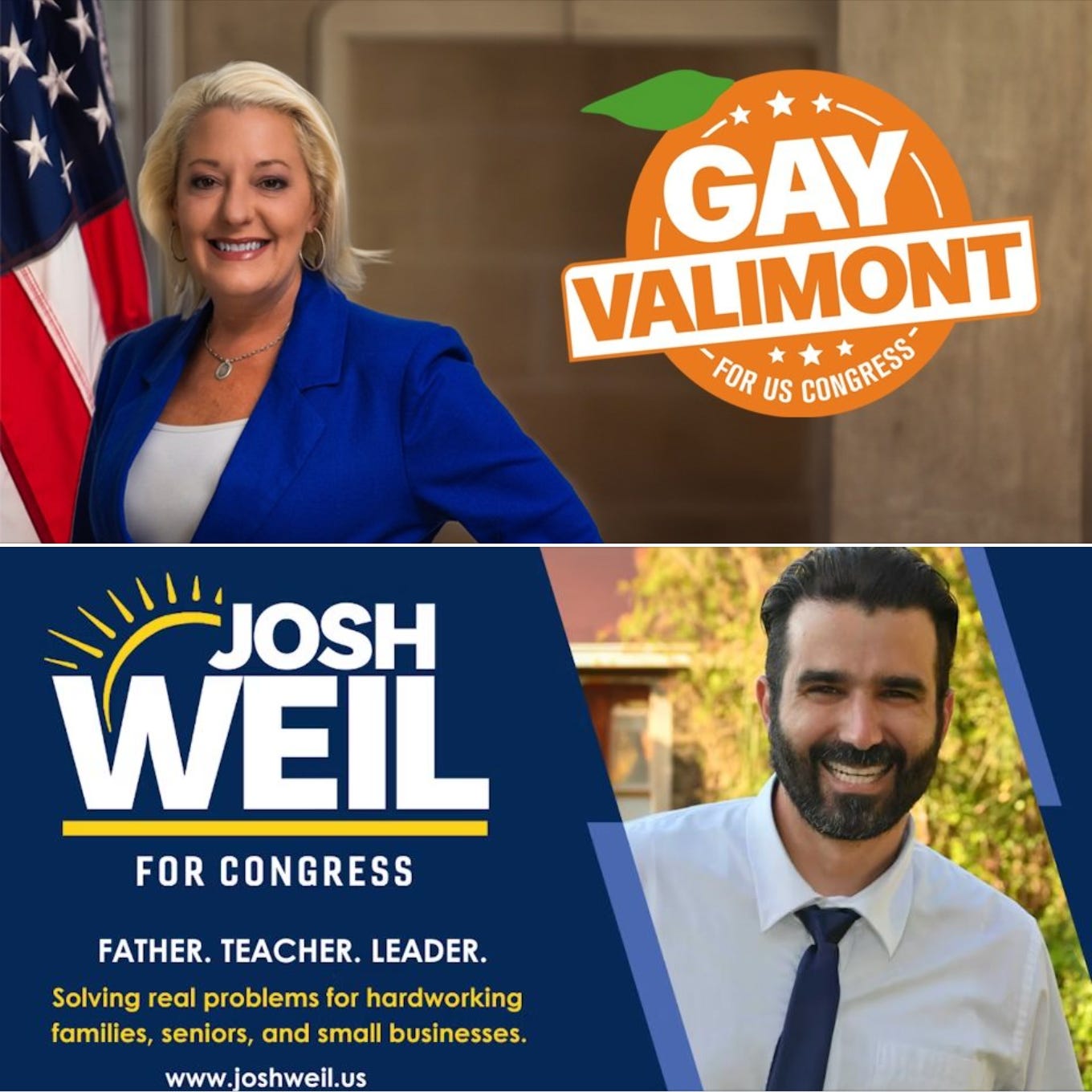
Both of these special elections are taking place in Florida after Republican members of the House recently resigned. In Florida’s District 1, Democrat Gay Valimont is taking on Trump backed Jimmy Patronis—who unbelievably wanted Florida taxpayers to fork over $5 million to reimburse Trump for his legal fees spent in his criminal cases.
And in Florida’s District 6, Democrat Josh Weilis taking on Randy Fine—who is not just a Trump backed candidate but a vile religious bigot. I’ll explain more on that below—but Fine doesn’t hide his religious supremacy just as MAGA doesn’t hide their white supremacy.
As we all know, in special elections the turnout is generally very low. That means despite these two districts being solidly red, an upset in one or both races is truly possible. And bluntly, even a close finish in these districts that the GOP candidates in November won by nearly 30 points would send a message to the nation that Trump and his MAGA agenda are as unpopular as polling now shows they are.
Think back to 2017 and the early special elections that year where Democrats greatly closed gaps from the November 2016 elections just a few months earlier. That both grabbed headlines and importantly helped energize the opposition to Trump. We need that same thing now!
When you look at these two races, there is a real path for success. Democratic nominee Gay Valimont is running in Florida’s first (the Pensacola area) to fill the seat that became open when Matt Gaetz—remember that scumbag?!—resigned after Trump nominated him to be Attorney General.
Gay is a tireless activist who first became active in politics after the 2012 Sandy Hook school shooting that left 20 students and six adults dead. Valimont’s story though includes painful heartbreak when in 2020, her husband Brian was diagnosed with ALS and a few months later their 8-year-old son Eli was diagnosed with a rare and terminal brain tumor. Gay served as the primary caretaker for both until they passed away within months of each other. This experience left her with more than $100,000 in medical bills, making her keenly aware of how our healthcare system is broken and needs to be fixed.
Her opponent Jimmy Patronis not only wanted Florida taxpayers to pay for Trump’s personal legal fees but in his past elections he was funded by the very same insurance companies he was charged with regulating as Florida’s elected Chief Financial Officer. That is why under his leadership, property insurance rates have skyrocketed.
Valimont is packing venues and recently announced she has raised nearly $7 million to flip this red seat. I spoke to Valimont on Wednesday about her run for Congress— which you can hear below. She shared that the top issue by far is the slowing to bad economy.Valimont also explained that veterans of all political backgrounds are outraged with the GOP’s cuts to veterans’ care—which could decide this election given Florida’s First district is home to the most veterans in the Sunshine state.
Over in Florida’s 6th district on the east coast of Florida that includes Daytona Beach, Democratic nominee Josh Weil is also running a great campaign. A teacher and father who is raising his two sons on his own, is outspoken on the need to reduce costs, protect Social Security and make insurance more affordable in Florida. Given Weil’s work as a teacher, he has also made preserving and improving our education system a cornerstone of his campaign.
You can check out a clip of my recent interview of Josh below talking outrageous insurance costs.
Then there is Weil’s opponent, the vile bigot Randy Fine. For starters, Fine doesn’t even live in the district. Trump wanted him to run so he did. But Fine has openly feuded with Ron DeSantis–meaning the DeSantis political machine is not helping him and likely wants to see him lose. That is great for Weil.
Fine has made this campaign about smearing Weil for his Muslim faith, calling him “Jihad Josh” and claimed Weil supports “Muslim terror.” (Weil had been raised Christian, but converted to Islam years ago after marrying a woman who was Muslim.)
The despicable Fine—who is a subscriber of the same far right religious supremacist views of people like Benjamin Netanyahu–has a long, documented history of demonizing Muslims. In September 2024, Fine celebrated the killing of 26-year-old American citizen Ayşenur Ezgi, an activist killed by the Israeli forces while peacefully protesting illegal settlements in the West Bank.
In a November 26, 2024 tweet, Fine targeted Congresswomen Rashida Tlaib (D-MI) and Ilhan Omar (D-MN), writing, “The ‘Hebrew Hammer’ is coming. @RashidaTlaib and @IlhanMN might consider leaving before I get there.” He then added, “#BombsAway,” as a reference to Netanyahu’s massive bombings in Gaza that have slaughtered thousands of women and children.
But Fine also has shown deep contempt for Christians. He has been outspoken in not only supporting the oppression of Christians in the West Bank (there are more than 50,000) but also advocating for the ethnic cleansing of Christians—along with Muslims—from the area to make it exclusively for Israeli Jews. For example, he pledged during this campaign that: “My first bill in congress will be to recognize Gaza and Judea and Samaria as parts of the State of Israel and to call for the expulsion of these monsters [Palestinians] from Israel.”
He has also smeared the Catholics of Ireland as being pro-terrorism for showing support for Palestinian Christians and Muslims–and the list goes on of the hate he has peddled.
Like Valimont, Weil is drawing big crowds and has raised nearly $10 million dollars. Based on early ballots returned, both of these campaigns are well positioned to upset their GOP opponents—or at least greatly close the gap from the 30 point wins the Republicans had in November in their respective districts.
People keep asking what more can I do to take on Trump and Musk?! Well here you go! You can donate, volunteer and/or ensure friends in these two Democrats respective districts get out to vote by April 1. This how we send a message and potentially shock the nation!
Early last week, Mahmoud Khalil, a recent graduate and leader of pro-Palestinian protests at Columbia University, was arrested by immigration officers and sent to a detention center in Louisiana.
The government has provided no evidence as to why Khalil — a green-card holder married to an American citizen — was detained. Instead, it claimed his activities “would have potentially serious adverse foreign policy consequences” and alleged that Khalil supports Hamas, which his legal team denies.
Khalil’s story has become the face of the Trump administration’s crackdown on pro-Palestinian protesters — really, a crackdown on free speech.
The exercise of student protest is fundamental to our campus’s history, from more than 60 years ago, through last spring, to this past week: Hundreds gathered on Sproul Plaza in response to Khalil’s detainment, calling for the protection of their free speech. More than a hundred Jewish Berkeley professors signed a statement condemning the tactic of deporting protesters for expressing their views.
Khalil’s arrest — which is an abuse of immigration status to suppress speech that opposes the government — is blatantly unconstitutional.
While the federal government’s decision to detain Khalil has resulted in widespread outrage, Columbia University’s administration is succumbing to pressure from Washington. Under federal investigation into alleged antisemitism on campus, which UC Berkeley also faces, Columbia recently issued multiple suspensions, revocations and expulsions of students involved in the pro-Palestinian occupation of a building at the university last spring.
With the Trump administration holding a $400 million cut in funding over their heads, Columbia’s leaders now face the impossible decision of whether or not to bow down to government mandates that demand harsh punitive measures against demonstrators.
Columbia is an important case. It sends a clear message that academic institutions are having to choose between their students and their survival, and sets a dangerous precedent exemplifying the threat to free speech. It’s a threat that public and federally funded research universities across the country, including UC Berkeley, can’t ignore.
While the Trump administration’s crackdown is worrying, it should not be paralyzing. UC Berkeley has a responsibility to protect its students and, as a public institution, uphold the right to free speech. The constitutional right to assembly is essential to a democracy. Forsaking this right would be a betrayal of the students under the institution’s care.
The university must follow the law and its own enshrined bylaws to protect students’ information and right to protest. Campus should always be a space where students can voice dissent and challenge institutions without fear of retaliation, detainment or deportation.
Editorials represent the majority opinion of the editorial board as written by the spring 2025 opinion editor, Amara McEvoy.
After his multiple previous attempts to throw out zoning restrictions in areas near transit hubs have failed, state Senator Scott Wiener has a new measure to streamline larger housing projects near a more limited number of those hubs.
State Senator Scott Wiener has been on a crusade to pump up taller and denser housing projects near transit stations ever since his political career took him to Sacramento. He had a 2018 measure to allow five-story apartment buildings near public transit hubs, even if the area was zoned for only single-family housing, but that died in committee early on. His similar sequel 2020 measure SB-50, which would have essentially upzoned all of San Francisco to a five-story height limit, also died on the full state Senate floor.
But Wiener has gotten closer to the finish line with each consecutive attempt, and now he’s trying again. Streetsblog reports that Wiener introduced yet another housing density near transit hubs measure, this one called SB-79. Under this new bill, apartment buildings could be up to seven stories high, though only closer to a more limited number of what Wiener calls the state’s “highest quality transit” stops.
This time around, that would not include Muni. Those higher limits would only apply to systems like BART and CalTrain, or SoCal systems like the LA Metro and Burbank’s Metrolink.
“It will offer more housing overall, and it will support our public transportation systems with increased revenue and increased ridership,” Wiener said Friday, according to KQED. “We really need more housing, more and better transit, and the two truly go hand in hand.”
This bill will likely not play well with many suburbanites — after all, think of all the Caltrain and BART stations where you do not see housing anywhere near seven stories. But this version of Wiener’s bill seems to single out land owned by the transit agencies, much of it used as parking lots, which may not be seeing as much use these days.
And this version is also likely to draw concerns that it could actually drive up housing prices and aid displacement, concerns heard with that whole “Monster in the Mission” condo project that was slated for the 16th and Mission BART station.
But despite recent years’ momentum for easing restrictions on housing production, that housing is still largely not getting built. Supply-siders blame union work requirements, affordable unit requirements, and legislative carve-outs. But it may be more that construction costs and interest rates are just making this not a good time to build. And Scott Wiener may not be able to legislate his way out of that, no matter how many bills he introduces.
U.S. Federal Reserve Chair Jerome Powell speaks at a news conference after a meeting of the Federal Open Market Committee on Wednesday, March 19, 2025 in Washington, D.C.
(Photo: Tom Williams/CQ-Roll Call, Inc. via Getty Images)
“Launching chaotic trade wars with our allies and gutting Social Security, Medicaid, and other vital programs in order to fund tax breaks for his billionaire donors isn’t making life more affordable for working-class families.”
A former Obama administration economic adviser said Wednesday that the Federal Reserve’s forecast of increased unemployment, accelerating inflation, and slower growth driven by President Donald Trump’s economic policies could portend a return of the “stagflation” that plagued the nation in the 1970s.
The Federal Open Markets Committee, which sets U.S. monetary policy, downgraded its economic outlook for 2025 from an initial projection of 2.1% growth to 1.7%. FOMC also revised its inflation forecast upward from 2.5% to 2.8%.
While FOMC said that “recent indicators suggest that economic activity has continued to expand at a solid pace,” the committee noted that “uncertainty around the economic outlook has increased.”
Fears of an economic slowdown or even a recession have increased dramatically since Trump took office and imposed tariffs on some of the nation’s biggest trade partners while moving to gut critical social programs in order to fund a $4.5 trillion tax cut that will overwhelmingly benefit wealthy Americans.
“Inflation has started to move up now. We think partly in response to tariffs and there may be a delay in further progress over the course of this year,” Federal Reserve Chair Jerome Powell said during a Wednesday news conference, at which he said interest rates will remain unchanged. “The survey data [of] both household and businesses show significant large rising uncertainty and significant concerns about downside risks.”
The economic justice group Groundwork Collaborative said the FOMC projections show that “Trump is steering our economy toward disaster,” while warning of the possible return of stagflation, a combination of low or negative economic growth and inflation.
Alex Jacquez, the chief of policy and advocacy at the Groundwork Collaborative and a former adviser at the White House National Economic Council during the Obama administration, said in a statement that “the Federal Reserve’s projections confirm what millions of Americans are already thinking: President Trump is steering our economy toward disaster.”
“Voters elected President Trump to lower the cost of living, and instead, they continue to be saddled with persistently high inflation and interest rates,” Jacquez continued. “Launching chaotic trade wars with our allies and gutting Social Security, Medicaid, and other vital programs in order to fund tax breaks for his billionaire donors isn’t making life more affordable for working-class families. It is, however, a perfect recipe for stagflation.”
Trump’s economic policies—which some observers believe could be designed to deliberately tank the economy so that the ultrawealthy can buy up assets at deep discounts—have sent consumer confidence plummeting. Meanwhile, recent polls have revealed that a majority of voters disapprove of Trump’s handling of the economy and inflation.
The latest FOMC forecast came as the world braces for yet another escalation of Trump’s trade war, with the president threatening to implement worldwide reciprocal tariffs starting April 2.
The Organization for Economic Cooperation and Development (OECD) said Monday that Trump’s trade war is likely to slow economic growth in the United States and around the world.
“The global economy has shown some real resilience, with growth remaining steady and inflation moving downwards,” OECD Secretary-General Mathias Cormann said. “However, some signs of weakness have emerged, driven by heightened policy uncertainty.”
“Increasing trade restrictions will contribute to higher costs both for production and consumption,” Cormann added. “It remains essential to ensure a well-functioning, rules-based international trading system and to keep markets open.”
Our work is licensed under Creative Commons (CC BY-NC-ND 3.0). Feel free to republish and share widely.
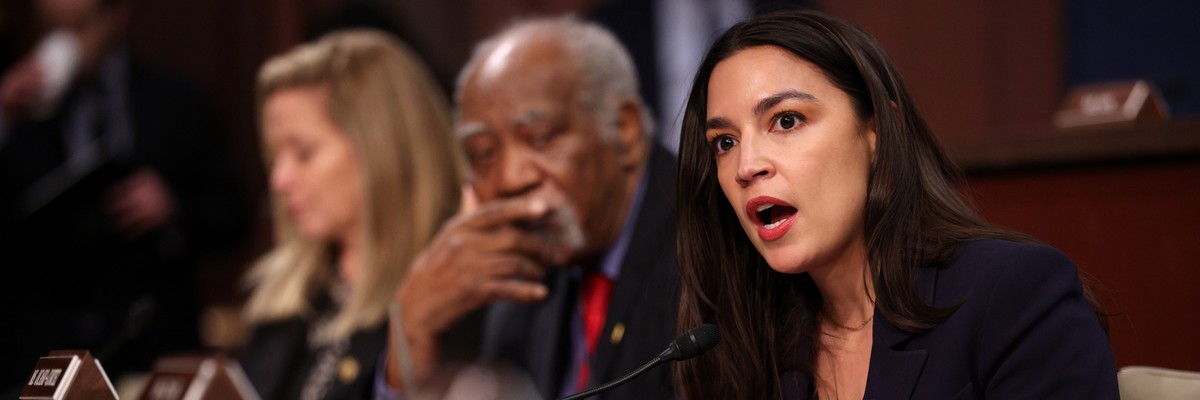
U.S. Rep. Alexandria Ocasio-Cortez (D-N.Y.) speaks during a House Oversight and Government Reform Committee hearing on sanctuary cities’ policies at the U.S. Capitol on March 05, 2025 in Washington, D.C.
(Photo: Kayla Bartkowski/Getty Images)
“The fact is, we work for everybody. If Republican politicians can’t get that we work for the public, then the public should give them the boot,” said the Democrat from New York.
U.S. Rep. Alexandria Ocasio-Cortez, a Democrat from New York, had sharp words for Republican Rep. Andy Biggs of Arizona and two other Arizona elected officials, following reporting that the trio was scheduled to speak at a town hall on Tuesday evening—which only Republicans were allowed to attend.
“It’s only ‘free speech’ if you agree with them. Everyone else gets stripped from their community’s town hall,” wrote Ocasio-Cortez on X in response to the reporting. “The fact is, we work for everybody. If Republican politicians can’t get that we work for the public, then the public should give them the boot.”
According to a flyer posted to the Legislative District 12 Republican Committee website, Biggs, Arizona Senate President Warren Petersen (R-12), and Maricopa County Sheriff Jerry Sheridan were slated to speak at a town hall event in Chandler, Arizona on Tuesday evening.
Camaron Stevenson, chief political correspondent for the outlet The Copper Courier, posted a screenshot of the flyer on X on Tuesday, alongside a screenshot of an email from the First Vice Chair of the Arizona Legislative District 12 Republican Committee Patty Porter that reads: “Tonight’s townhall is a private event. I have been reminded that only members of the Republican Party will be admitted into the venue.”
According to The Phoenix New Times, Porter did not answer queries about why the event was being called a “townhall”—the spelling used by Porter and on the flyer—if it is private.
Neither Petersen nor Biggs responded to requests for comment, according to the outlet, though Biggs called Stevenson’s social media post saying that he is “hosting” the town hall “false.” He did not address the Republican-only nature of the event, per the New Times.
Stevenson on Tuesday shared a video of an Independent voter who said he registered for the town hall but was turned away after they reviewed his voting history.
This news out of Arizona follows multiple instances where GOP lawmakers have faced angrycrowds at town halls, with constituents showing up to express concerns about President Donald Trump’s efforts to slash federal programs and personnel.
House Speaker Mike Johnson (R-La.) has encouraged Republican lawmakers to skip the town halls, according to The Associated Press. “They’re professional protesters,” Johnson said at a news conference in early March. “So why would we give them a forum to do that right now?”
Democrats have sought to capitalize on the development. Minnesota Gov. and 2024 vice presidential candidate Tim Walz recently launched a town hall tour targeting GOP districts and the Democratic National Committee is targeting vulnerable House Republicans with ads that say the lawmakers “won’t talk to his/her constituents,” according to Tuesday reporting from Axios.
Ocasio-Cortez is set to join Sen. Bernie Sanders (I-Vt.) for five stops of his “Fighting Oligarchy” tour in Arizona, Colorado, and Nevada from Thursday through Saturday.
This article has been updated to correct the quote in the headline.
Our work is licensed under Creative Commons (CC BY-NC-ND 3.0). Feel free to republish and share widely.
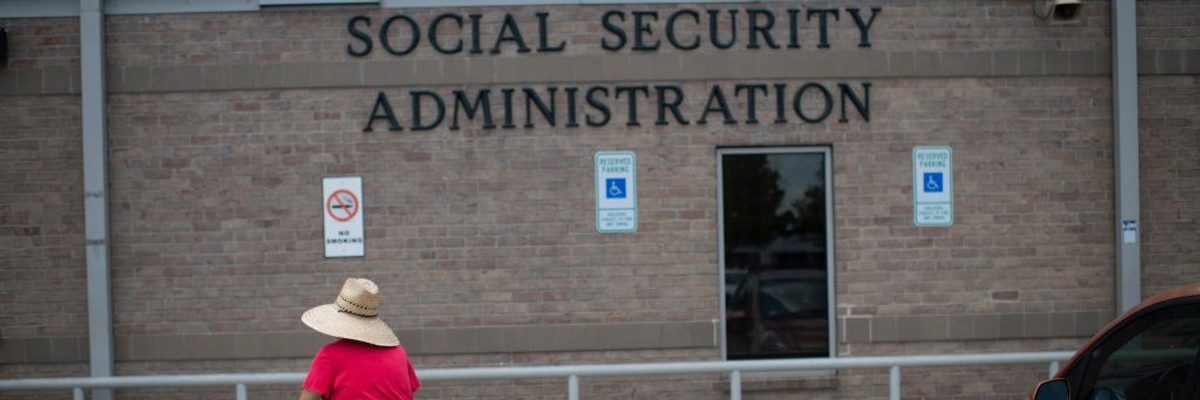
A woman walks into a Social Security office in Houston, Texas on July 13, 2022.
(Photo: Mark Felix for The Washington Post via Getty Images)
“One has to ask why the world’s richest man—who has received in the tens of billions of dollars in federal contracts—is targeting the agency that helps so many Americans keep their heads above water,” said one advocate.
The Trump administration aims to “ultimately collapse the system” that allows tens of millions of Americans to collect their earned Social Security benefits each month, said one leading advocate for the system Wednesday after officials announced a major change to the Social Security Administration.
Acting SSA Commissioner Leland Dudek claimed the agency needs to “identity-proof” Social Security beneficiaries as he told reporters that millions of people will now be required to verify their identities using an online system—and will have to provide documentation at local field offices if they’re unable to use the SSA website’s verification system.
The change is set to take effect March 31 and comes as President Donald Trump and Elon Musk, his billionaire ally whom he named to lead the so-called Department of Government Efficiency( DOGE) with the aim of slashing government jobs and spending, have baselessly claimed that the Social Security system is riddled with fraud and sends benefits to millions of deceased Americans and to undocumented immigrants.
A source at the SSA told Judd Legum, author of the newsletter Popular Information, that there are “no significant concerns about fraud at intake” and said the change is aimed at creating “additional hurdles to filing claims and [overwhelming] the system.”
Max Richtman, president and CEO of the National Committee to Preserve Social Security and Medicare, noted that for decades, senior citizens and people with disabilities who rely on Social Security payments have been able to verify their identities over the phone when applying for benefits.
“The new process would force seniors and people with disabilities to navigate a needless technical hurdle in applying for their earned benefits. If these claimants (who do not always have computers or smartphones, reliable internet service, or the technical skills to complete the process online) cannot verify their identity online, they would have to call SSA via the already overburdened phone line to set up an appointment, and travel in person to an SSA field office,” said Richtman.
“The combination of fewer workers, fewer offices, and a massive increase in the demand for in-person services could sabotage the Social Security system.”
With DOGE pushing to cut 7,000 jobs within the SSA and close at least 47 regional and local field offices, the change would particularly harm the ability of people in rural areas, with mobility limitations, and with limited internet access to obtain their monthly benefits.
“The combination of fewer workers, fewer offices, and a massive increase in the demand for in-person services could sabotage the Social Security system,” said Legum, who reported on the SSA memo on Monday.
Doris Diaz, the SSA acting deputy commissioner for operations, is among those who have warned Dudek against forcing seniors to verify their identities online, saying the change would cause longer wait and processing times and would send an estimated 75,000-85,000 beneficiaries to increasingly understaffed field offices per week.
Nancy Altman, president of Social Security Works, which works to counter right-wing claims about Social Security and lobbies to strengthen the system, told Common Dreams that “despite Leland Dudek’s claims, the only thing putting the American people’s personal Social Security data at risk is that Dudek turned it over to DOGE operatives.”
The new plan “will make it far harder for the American people to claim their earned benefits. It could even cause major delays, and ultimately collapse the system, by overwhelming the field offices,” said Altman.
“It is part of what appears to be an ongoing effort to cause Social Security to collapse,” she added.
Richtman said that the only “rational conclusion” regarding the coming change in SSA operations is that Trump and Musk want to “undermine public support for Social Security by rendering the SSA dysfunctional, so that the program can be squeezed for cash, cut, and privatized.”
“Intentionally erecting obstacles for the people who’ve earned these benefits (and who pay for SSA operations with every paycheck) betrays at the least an indifference—and more likely, an outright hostility—to the elderly, people with disabilities, their families, and survivors who rely on Social Security,” said Richtman. “One has to ask why the world’s richest man—who has received in the tens of billions of dollars in federal contracts—is targeting the agency that helps so many Americans keep their heads above water financially.”
Our work is licensed under Creative Commons (CC BY-NC-ND 3.0). Feel free to republish and share widely.
Barbara Lee (left) and Loren Taylor are running for Oakland mayor in the April 15 special election. Credit: Kelly Sullivan
There are nine candidates running for Oakland mayor, but two have garnered the most financial support and media attention: former Councilmember Loren Taylor and former Congresswoman Barbara Lee. Oaklanders will have a chance to vote for multiple candidates on April 15, but these two stand the greatest chance of winning.
Taylor and Lee have presented different visions of how they would approach the job of being mayor. While they agree on many things, at a recent debate, Lee emphasized her desire to unite people while Taylor talked about needing to fix a broken city. Taylor said the city needs to be self-sufficient while Lee said Oakland should demand its fair share of resources from the state and the feds.
Those are the broad-stroke differences. On a more granular level, the candidates also diverge in key areas on the policies they’d like to pursue.
To get a clearer picture of what distinguishes the candidates from each other, we looked at their campaign websites, public statements, and media interviews. Here’s what we found.
Oakland police vehicles near the intersection of Harrison and 24th Streets on July 12, 2023. Credit: Florence Middleton
Lee and Taylor share some similar ideas for how to make Oakland safer. They both want to fully staff the city’s 911 call center and continue funding the anti-gun violence program Ceasefire. They each embrace a public safety strategy that includes traditional police services along with violence intervention and prevention programs.
However, their plans do have some noteworthy differences.
Taylor and Lee both want to hire more police officers but disagree on the right number, and they’ve outlined different paths to increase staffing.
Lee believes Oakland should hire up to 850 officers. But she said in an interview this would take a long time to implement. In questionnaires, Lee has said the city should rely on Measure NN to increase the force up to 700. On her website, Lee said she wants to start a partnership with Merritt College to attract qualified candidates to OPD. She also wants Oakland to have housing options so first responders can live in the city.
Taylor plans to bring OPD’s sworn staff to 800 officers. He wrote that he would do this by adequately budgeting for more police academies and by improving graduation rates and recruitment strategies. Taylor said he would also increase lateral hires from other departments and create a pathway for retired officers to return to work for OPD. At a forum, Taylor said the city needs to also focus on retention.
Both candidates believe OPD’s policy on vehicle pursuits may need to change, although they haven’t shared many details.
At a recent debate, Lee said, “maybe that policy needs to be revised,” adding, “We know people do get killed and hurt behind police chases, so I’m not saying get rid of it, but I think we need to come up with a framework that allows those who are coming into Oakland to know there’s a consequence for doing what they’re doing.”
In a questionnaire, Taylor said he would advocate for “modifications of OPD’s pursuit policy to lessen restrictions on holding officers accountable.” In February, Taylor announced his “Smart Pursuit Plan,” which envisions the use of drones and other technology to aid police in vehicle pursuits. “Whether it be by an officer or drone, all crimes must be pursued,” Taylor said in a press statement.
Lee and Taylor both say they support programs that provide a non-police response to some kinds of crisis situations, but they disagree about what to prioritize.
In a recent social media post Taylor wrote “Either (MACRO) delivers on its mandate, we establish a new mandate it delivers to, or we cancel future investments.” In a questionnaire, Taylor said he wants to “refocus MACRO on its original purpose of offloading 911 calls from the OPD queue.”
In questionnaires and on her website, Lee has said she wants to expand “successful programs like MACRO” and mental health crisis response services. Lee also wrote that she’d like to explore shifting traffic enforcement away from armed officers in cases like minor infractions and continue pedestrian safety programs and street design improvements.
Oakland’s budget crisis and the local economy
“Shop in the Laurel” mural in East Oakland’s Laurel district promotes buying from local businesses. Credit: Amir Aziz
Lee and Taylor share some views about Oakland’s finances and local economy. They agree it was a bad idea to tie the sale of the Oakland Coliseum to the city’s budget, and they both believe an expert should take a closer look at Oakland’s finances. They want to help small businesses by improving security in commercial corridors. They’re both firmly behind Measure A, the proposal to increase the rate of Oakland’s sales tax from 10.25% to 10.75%.
They both want to cut waste, rein in spending, and avoid relying on one-time funding. But they don’t agree on how to deal with the city’s employees, who have already borne dozens of layoffs.
Taylor wants to restructure the city’s debt and refinance all of its loans to secure lower interest rates to free up funding. Taylor hasn’t specifically addressed layoffs, but said as mayor he is prepared to make “hard, necessary, and potentially unpopular choices” to help the city. At a recent forum, he said the city needs to have an “honest” conversation with its labor partners about personnel costs.
Lee said the city needs to manage its unfunded liabilities by “negotiating sustainable pension agreements” with the unions. She’s emphasized that “everything is on the table” in terms of potential cuts, but believes layoffs should be a last resort.
Never miss a story.Sign up for The Oaklandside’s free daily newsletter.Email
Police overtime spending is one of the larger factors driving the budget deficit. Both candidates have talked about addressing it, but it’s unclear if they agree on a plan.
At a recent debate, Lee vaguely said the city needs to “look at efficiencies within the police department, and where the overtime is not accounted for or transparent, we need to make sure we know exactly where those dollars are” and use technology to find more efficiencies.
Taylor said at the same event that if the city takes “the overtime that exists, if we apply that overtime to actual full-time employees, we will be able to compensate for a significant portion of the FTEs that we require.” That would require hiring more officers, which is hard to do.
Both candidates plan to drum up more revenue for Oakland. They also believe the city needs to chase philanthropic dollars and cut waste. But they differ on some other strategies.
On his website, Taylor said he wants to partner with businesses to “define new investment opportunities and incentives,” apply for a bunch of grants, and “require every city department to contribute to revenue generation.” He also wants to “activate revenue potential of stagnant City of Oakland assets.” In a questionnaire, he referred to vacant buildings, under-utilized land, and “naming rights for some assets.” Taylor also said he would tell Oakland’s contractors and vendors to reduce their contract pricing by 10-15% if they want to continue working with the city. (On Taylor’s website he said he would renegotiate contracts greater than $5 million to generate a 6-8% reduction in spending).
In questionnaires, Lee has said she wants to use the state and national networks she built as a member of Congress to “drive investment” and secure additional state and federal funding. At a recent forum, Lee said the city needs to leverage funding from the Department of Veteran Affairs to support homeless vets. How this would work with the Trump administration and GOP cutting federal spending isn’t clear.
They both agree small businesses are important, and have promised to cut red tape and streamline permitting. But they have different strategies to help that part of Oakland’s economy. Taylor’s plans are more detailed.
Taylor wants to create a dedicated OPD unit for retail and property crime and expand Oakland’s use of surveillance technology to address crime. Taylor has also proposed creating a “Business Concierge Service” to help business owners navigate city departments and permitting. He wants to end the business tax for businesses earning less than $1.5 million per year and create an “Economic Development Corporation,” which would try to bring new industries and companies to the city. Taylor has also said he would conduct an “aggressive campaign” to register unregistered small businesses and make sure the city is monitoring and communicating with companies about their needs.
In a questionnaire, Lee said she would “support small businesses, and attract responsible investment to develop Oakland’s economy.” Lee plans to leverage state and federal resources and “aggressively pursue grants, infrastructure funding, and emergency financial support.” Lee has also proposed creating an office of public and private partnerships to secure funding from the philanthropy and business sector. In another questionnaire, Lee said she would expand job training and apprenticeship programs.
Homelessness and housing
Housing under construction in Oakland. Credit: Amir Aziz
While both support services to help homeless people find housing and mental health care, Taylor plans to take a more aggressive approach than Lee when it comes to sweeping encampments.
At a recent forum and in a questionnaire, Taylor said he plans to fully implement the city’s Encampment Management Policy, saying that “many” existing encampments need to be moved away from schools and businesses. Taylor plans to also publish a monthly report documenting progress. In a questionnaire for The Oaklandside, Taylor said he intends to establish “a legal and administrative solution” to stop encampments from appearing in highly sensitive areas.
Lee has raised concerns about using enforcement efforts that displace homeless residents without ensuring there are places to house people. She has stressed that improvements should focus on faster access to shelters, more transitional housing, and better outreach on mental health issues. At a recent forum, Lee said she’s interested in exploring universal basic income and paying unhoused people to clean up blight. She also would like to make sure the city gets its “fair share” of dollars from Alameda County through Measure W, which is a county-wide sales tax approved by voters in 2020 to fund programs for unhoused people.
Lee and Taylor each have plans to build more housing in Oakland. They share an interest in streamlining permitting for new housing . But their strategies differ sharply in other areas.
Lee says on her website that she wants to build 10,000 units of affordable housing in Oakland by 2030. She plans to raise money for housing by working with the Alameda County Board of Supervisors on a county-wide housing bond measure. Lee also wants to advance an “equitable capital investment framework” to prioritize housing development for extremely low-income people. And Lee plans to leverage her federal connections to help pass pending legislation, including the Family Stability and Opportunity Vouchers Act. This bill would offer more housing vouchers to low-income families with young kids. She also advocates for tenant protections. Lee has also promised to enforce Oakland’s rental control policies and ensure “landlords are held accountable for illegal evictions and rent gouging.”
On his website, Taylor said he wants to establish an investment fund that Oakland residents can pool money in to invest in affordable housing development projects. He has proposed reducing fees on affordable housing projects with deed restrictions for at least 55 years. Taylor also wants to end exclusionary zoning, establish a program to support emerging developers, and develop a fund for acquiring and preserving land. Taylor wrote that he will adequately fund and enforce tenant protections and fully support the Rental Assistance Program to help landlords.
Government ethics, accountability, and transparency
Oakland City Hall reflected in the windows of a nearby office building. Credit: Amir Aziz
The candidates have both promised to create mechanisms for holding elected officials and special interests more accountable. But they’re focusing on different areas and tools.
In a questionnaire, Taylor said he would also “reinstate funding” for Oakland’s Public Ethics Commission, which has been hit with big budget cuts in recent years that have prevented the commission from investigating cases and implementing new programs like the “Democracy Dollars” initiative. Taylor wants to crack down on illegal lobbying by nonprofits and have them held to the same transparency standards as other organizations..This would force nonprofits to register and publicly report their interactions with politicians and city employees. Taylor also wants to publish “department-level performance management dashboards within 90 days” of taking office.
On her campaign site, Lee wrote that she wants to create a user-friendly portal to let the public examine city contracts. “Creating a portal so any Oaklander can view City contracts and key budget items would expand transparency.” In a questionnaire, Lee said the current ban on gifts to elected officials is “too loosely worded and should be strengthened to ensure no one is prone to influence.”
Both candidates support reviewing the City Charter to potentially make big changes to the powers and authorities of city government, but not for the same reasons.
On her website, Lee said the current charter was first adopted in 1968 and that many people don’t know the mayor is not actually a member of the City Council who can only vote in the event of a tie. She said Oakland’s current “hybrid” form of government means that “lines of accountability to the public are not clear, and this needs to change.” Lee is also interested in clarifying the “lines of accountability between the City Administrator and elected Mayor.”
In a questionnaire, Taylor said that as mayor he will “push forward a charter amendment to create an office of the controller” which would monitor Oakland’s finances.
Eli Wolfe reports on City Hall for The Oaklandside. He was previously a senior reporter for San José Spotlight, where he had a beat covering Santa Clara County’s government and transportation. He also worked as an investigative reporter for the Pasadena-based newsroom FairWarning, where he covered labor, consumer protection and transportation issues. He started his journalism career as a freelancer based out of Berkeley. Eli’s stories have appeared in The Atlantic, NBCNews.com, Salon, the San Francisco Chronicle, and elsewhere. Eli graduated from UC Santa Cruz and grew up in San Francisco.More by Eli Wolfe
Help Outreach Working Group lift the fog of corporate media. Donate to help us maintain this website and distribute literature on the street.
This Sunday’s Town Hall: Announcing This Week’s Progressive Town Hall: Every Sunday at 4pm ET/1pm PT RSVP HERE Join PDA activists online from across the country to discuss the importance of progressives reclaiming the American story from the MAGA right, an issue of heightened importance as we’re now within one... Continue reading →
Community Coffee – Outer Sunset Sunday, April 19 | 1–3 PM Location: Java Beach Cafe, 1396 La Playa St Sign-up The San Francisco Democratic Party has been hosting community coffee events to connect with residents of our many different neighborhoods in SF every month. No speeches, just conversations and hearing... Continue reading →
We protest Heritage Foundation EVERY MONDAY (Join us!!!!) By admin | September 2, 2025 | Uncategorized Cliff Cash Comedy Premiered Jul 26, 2025 Every Monday at The Heritage Foundation 214 Massachusetts Ave. Washington D.C. 4pm protest 6pm pizza Every Friday at Fox News D.C. 400 N. Capitol St. Washington D.C. 4pm protest 6pm pizza We are... Continue reading →
Milk Club April General Membership Meeting Date: Tuesday, April 21 Time: 7-9 PM Location: SF LGBT Center, 1800 Market Street, San Francisco Zoom Link: Click here
One Million Rising: Strategic Non-Cooperation to Fight Authoritarianism Virtual Event · Hosted by No Kings Time Wednesdays 8 – 9:30pm EDT Location Virtual event Join from anywhere About this event Across the country, authoritarian forces are getting bolder and more dangerous. Trump and his allies are not hiding their agenda: mass deportations,... Continue reading →
Meeting Agenda April 22, 2026 The San Francisco Democratic County Central Committee will meet on Wednesday, April 22, 2026 at 6:30 pm at Milton Marks Auditorium, 455 Golden Gate Ave, San Francisco, CA 94102. A security screening will be required to enter the building. Members of the public can live... Continue reading →
SF Green Party Showing events after 3/27. Look for earlier events Wednesday, April 20 7:30pm SF Green Party Council Meeting WhenWed, April 20, 7:30pm – 9:00pm WhereEl CafeTazo, 3087 16th St, San Francisco, CA 94103 (map) Description: This elected group is the equivalent to other political parties Central Committee. The San Franciso... Continue reading →
THURSDAY, JUNE 29, 2023 AT 2 AM – 4 AM PDT How to create trust in a group? Details Event by Extinction Rebellion Empathy Circles online EMPATHY CAFE Duration: 2 hr Public · Anyone on or off Facebook How to create trust in a group? This is the question that arose in our... Continue reading →
When you volunteer for Saikat, it’s on us to give you a great experience and a genuine chance to make a difference. We don’t want to waste a second of your time. That’s why we’re always optimizing. And I’m excited to report that this Saturday we talked with 300% more... Continue reading →