Rep. Nancy Pelosi, D-Calif., left, and Senate Majority Leader Chuck Schumer, D-N.Y., right, speak before President Joe Biden delivers the State of the Union address to a joint session of Congress at the Capitol, Thursday, March 7, 2024, in Washington.Shawn Thew/Pool via Associated Press
Mar 17, 2025 Updated Mar 18, 2025 (SFExaminer.com)
U.S. Senate Minority Leader Chuck Schumer has postponed an appearance at San Francisco’s Sydney Goldstein Theater this weekend, citing security concerns in delaying his weeklong national book tour as he faces criticism from Democratic voters and politicians for voting to move forward Republican spending legislation last week.
City Arts and Lectures, which was co-presenting the event with Manny’s of the Mission, wrote on its website that Schumer’s tour promoting the book, “Antisemitism in America: A Warning,” had been “postponed for security reasons.” The Arab Resource & Organizing Center had planned a protest of the event, citing Schumer’s support of Israel, which organizers said would include sidewalk chalk art and a picket line.
The New York senator has faced growing criticism from the party’s liberal wing — and his peers on Capitol Hill — since he and nine other Democratic senators voted to advance a six-month spending bill that passed along party lines in the Republican-controlled House of Representatives.
Schumer was not one of the two Democratic caucus members who voted to pass the legislation, but Schumer and his peers’ vote overcame the Senate’s 60-vote threshhold to advance the bill to a floor vote and all but ensured its passage in the Republican-controlled chamber. The New York senator said the bill’s passage was preferable to a government shutdown.
“Donald Trump and Elon Musk would be free to destroy vital government services at a much faster rate” if the government shut down, Schumer said of the president and Trump’s top campaign donor, whose Department of Government Efficiency has sought to slash federal spending and the government workforce.
House Speaker Emerita Nancy Pelosi stopped shy last week of directly criticizing Schumer’s move to advance the legislation. The bill — which discontinued $890 million in grants for health facilities, $293 million for emergency-preparedness projects and provided nearly $10 billion in funding for Immigrations and Customs Enforcement — constituted a “devastating assault on the well-being of working families across America,” she said in a statement.
Community organizers spoke out against Schumer over the weekend. In a statement, Indivisible San Francisco, a progressive grassroots organization formed in the wake of President Donald Trump’s election in 2016, called on Schumer to step down from his role. The organization wrote that he “failed to keep the Democratic Senators united in this unique situation where they could have placed real limits on the dismantling of the federal government.”
“He is not fit to be the Minority Leader if he is not willing to oppose Trump’s destructive agenda,” Indivisible San Francisco wrote.
The organization said that it worked with the Indivisible East Bay chapter to urge Padilla and Schiff to vote against the measure. Group members said that while they were “grateful” for Padilla and Schiff’s votes, “without effective leadership, their opposition and our hard work was lost,” Indivisible San Francisco wrote.
In an NBC News poll of 1,000 registered voters conducted before the spending legislation passed, 65% of Democrats said they wanted congressional party members to “stick to their positions even if this means not getting things done in Washington.” In April of Trump’s first term, 33% of Democrats polled advocated for such a stance.
SF bought this tourist hotel next to Little Saigon–and made it a shelter.
The Unhoused Have Changed—City Policies Haven’t
San Francisco’s homeless strategy has gone off track. I say this as someone who since the 1980’s has created and implemented some of the city’s most successful homeless programs. The Tenderloin Housing Clinic, which I head, runs the city’s largest permanent supportive housing program for unhoused single adults.
Here’s what I know from personal experience.
When in 1989 the city finally replaced the Feinstein hotline hotel program with our Modified Payment Program, roughly 1000 formerly unhoused residents quickly seized the opportunity for permanent housing. We had few vacancies in our over thirty hotels.
In those days the vast majority of unhoused preferred to pay rent rather than stay in a shelter. They chose housing even though rent took up 60-80% of their welfare check (rents in permanent supportive housing are now limited to 30% of income).
Mayor Art Agnos’ Housing First strategy enabled thousands to obtain a home. Mayor Willie Brown built on this with the hotel master leasing program. Mayor Gavin Newsom’s Care Not Cash then injected over $20 million annually into permanent supportive housing.
But San Francisco’s unhoused population has changed. The vast majority no longer accept available housing. More pursue drugs over jobs.
City homeless policy has encouraged this shift. San Francisco prioritizes the needs of drug tourists over the quality of life of the formerly unhoused. HSH encourages sidewalk drug sales in the Tenderloin and other areas where the formerly homeless primarily live.
The fiction that most sidewalk drug users want shelter or housing blocks real solutions. San Francisco is wasting millions of dollars on “outreach” to a population that is not interested in paying rent.
Many of those on sidewalks come to San Francisco because the city offers them rent-free tourist hotels with private baths and two meals a day. No other city gives drug tourists better options than rent-paying tenants.
Mayor Lurie constantly talks about closing the city’s open air drug markets. But he won’t succeed without changing the policies that keep the flow of unhoused drug addicts coming to San Francisco.
SF’s Street Population Rejects Housing
Most of those pitching tents in alleys and using drugs on sidewalks are not interested in paying rent for housing in San Francisco. Consider:
Only 14 occupants of the 116 at the Cova Hotel (one of four tourist hotels the city converted to shelters) chose to move to housing. 70 went to another shelter despite already getting free rent, a private bath and two meals a day for as long as 2-3 years!
The average stay at the Monarch Hotel is from 182-266 days. That’s six to nine months! The current HSH leadership has converted shelter into free longterm housing at the taxpayer’s expense. Our cash-strapped city pays an average $225 per client per night for private hotel rooms occupied by many of those using drugs on Tenderloin and Lower Polk sidewalks.
Shelters do not “get people off the streets.” People don’t wake up in a shelter and spend the day inside. They hang out on nearby sidewalks with friends. The area around Tenderloin’s Little Saigon proved that where shelters open, drug use on sidewalks follows (that would change if shelters with private rooms were drug-free).
HSH knew from the few occupants of the COVID-driven SIP hotels who chose to move to housing in 2022 that most staying in converted tourist hotels do not want to pay rent. Yet City Hall ignored this message. Instead, HSH embarked on a “non-congregant shelter” plan to continue the misguided and destructive use of tourist hotels as shelters.
San Francisco has since spent over $51 million on these luxury shelters! And HSH is now pushing to spent $14 million more next year despite the budget crisis.
Forget what you hear about data and accountability—those terms don’t apply to HSH’s failed strategy of converting tourist hotels to shelters.
What did the $51 million accomplish? It got some drug tourists and others off the streets at night. But consider the cost: HSH’s converted tourist hotels created a massive sidewalk drug market that wrecked Little Saigon and killed retail on lower Polk and the Tenderloin’s Geary Street corridor.
Further, HSH’s conversion of two hotels to shelters at Ellis and Larkin caused hundreds of thousands if not million of dollars in losses for nearby tourist hotels. Hotel guests posted terrible but true online comments about the neighborhood.
The city regularly has between 65-95 vacant permanent supportive housing units in move-in condition. If demand for housing were what city policy thinks it is, we would have virtually no vacancies and a long waiting list.
Why did San Francisco stop expanding the large congregant shelters primarily used by the city since 1982? They are far and away more economical. They also ban drugs, which does not occur in converted tourist hotels. I’ve heard that HSH thinks people on sidewalks don’t want congregant shelters. So we’re going to spend more taxpayer dollars to meet their needs at the expense of residents and small businesses impacted by these refuseniks?
Stopping drug tourism requires ending the policies that encourage it.
Ignoring the Drug Crisis
San Francisco’s unhoused population is more impacted by drugs than ever before. A recent report found that 35% of the city’s shelter clients reported having an addiction. This compares to 13% in other California cities studied.
35% only includes those reporting their addition. Anecdotal evidence from people working in permanent supportive housing and in street outreach has the percentage of unhoused addicts over 70%.
Why does San Francisco have far more homeless addicts than other cities? Because our homeless policy encourages drug tourists.
The city offers no non-congregant drug-free shelters. It offers no permanent drug-free housing. And we wonder why we have so many unhoused addicts?
San Francisco should mandate that the next five non-congregant shelters and permanent supportive housing sites all be drug-free. This will attract unhoused people eager to turn around their lives. The people San Francisco wants to help. Supervisor Matt Dorsey tried to pass a version of this last year; it should be brought back.
What if San Francisco prioritized drug-free private room shelters and housing? Wouldn’t that help closing sidewalk drug markets and discourage drug tourism? And help bring back small businesses and tourist hotel business throughout the city?
A new drug-free homeless strategy would boost San Francisco’s image across the world. With Trump already targeting federal funding to combat homelessness, San Francisco should turn to a more strategic homeless policy that is also more cost-effective.
Randy Shaw is the Editor of Beyond Chron and the Director of San Francisco’s Tenderloin Housing Clinic, which publishes Beyond Chron. Shaw’s new book is the revised and updated, The Tenderloin: Sex, Crime and Resistance in the Heart of San Francisco. His prior books include Generation Priced Out: Who Gets to Live in the New Urban America. The Activist’s Handbook: Winning Social Change in the 21st Century, and Beyond the Fields: Cesar Chavez, the UFW and the Struggle for Justice in the 21st Century.
Supervisor Sauter is Backing HSH, DPH Over Constituents
Supervisors Should Empower Their Communities
“San Francisco is withdrawing plans to open a new mental health service center on the border of the city’s Mid-Market and SoMa neighborhoods following backlash from the community and Supervisor Matt Dorsey, who lives on the same block as the proposed site.”—SF Chronicle, March 11
This withdrawal has a larger message. It was said to reflect “the difficult task of navigating community opposition to new sites serving those who are homeless or dealing with addiction or mental health conditions…Dozens of business owners, residents, nonprofits and community groups signed onto a letter last month urging officials to stop the proposed project.”
That’s not really why the project was stopped.
If community opposition mattered, the Department of Public Health (DPH) would not be expanding services at the Adante Hotel, 610 Geary. Neighborhood groups and businesses in that neighborhood also signed onto a letter opposing the project.
But DPH doesn’t care. Nor does HSH.
DPH stopped one project but is moving forward on the other because of contrasting positions of the district supervisor. D6 Supervisor Matt Dorsey listened to the SOMA community and joined its opposition. D3 Supervisor Danny Sauter has heard his constituency’s opposition but fully backs HSH/DPH’s destructive plans for the neighborhood.
Sauter ran for supervisor pledging to champion small business and community input. He needs that input to shape what’s best for his district. Yet he does not support the small businesses and residents negatively impacted by the drug activities caused by the Adante.
No District 3 constituency supports extending the Adante’s lease. All who have weighed in oppose the DPH/HSH plan.
Shouldn’t that matter to the district supervisor?
The Downside of District Elections
I recently contrasted how SFMTA quickly deferred to community input in the Marina and Cow Hollow while HSH and DPH ignore community opposition in the Tenderloin. Newly appointed D2 Supervisor Stephen Sherrill backed his constituents. Sherrill did the same in backing a police crackdown on drug dealing in Jefferson Park.
D5 Supervisor Bilal Mahmood has modified his position regarding the lease extension at the Monarch Hotel at 1015 Geary. His support for a one year and done is longer than the community wants but shows he is listening to the neighborhood.
The same can’t be said for Supervisor Sauter. He is proving more concerned with representing HSH and DPH than the constituents he ran to represent. The Adante is located on the southern border of Sauter’s district. He may figure that backing the Adante protects his North Beach political base from having to accept a similar facility.
Such is the big downside of district elections. The Board typically lets district supervisors call the shots in their district. This typically occurs even when the Board majority supports the community position that the district supervisor opposes.
Ironically, the Board unanimously passed a resolution last week urging the mayor to disperse shelters across the city instead of disproportionately targeting them on the Eastside (See “Supes pressure mayor to expand shelters across SF,” SF Examiner). This enables Supervisor Sauter to tell his constituents he’s protecting their interests when he is actually doing the opposite.
It’s shameful.
Because redistricting wrongly placed the Tenderloin’s northern Geary Street corridor in D3 rather than D5, the neighborhood most negatively impacted by the Adante extension is in Danny Sauter’s district. The Adante is two blocks from the city’s new 24-hour mental health facility at 822 Geary, and four blocks from the Monarch at 1015 Geary.
Hasn’t the Tenderloin already accepted more than its fair share?
Please urge Supervisor Sauter to follow the lead of Matt Dorsey, Steven Sherrill and other supervisors who put their constituents first.
Want to learn about the Tenderloin’s rich history? Pick up Randy Shaw’s updated book, The Tenderloin: Sex, Crime and Resistance in the Heart of San Francisco. To support the Tenderloin Museum, buy the book at https://www.tenderloinmuseum.org/buy-the-book
Randy Shaw is the Editor of Beyond Chron and the Director of San Francisco’s Tenderloin Housing Clinic, which publishes Beyond Chron. Shaw’s new book is the revised and updated, The Tenderloin: Sex, Crime and Resistance in the Heart of San Francisco. His prior books include Generation Priced Out: Who Gets to Live in the New Urban America. The Activist’s Handbook: Winning Social Change in the 21st Century, and Beyond the Fields: Cesar Chavez, the UFW and the Struggle for Justice in the 21st Century.
by Stephen Kaus on March 17, 2025 (BeyondChron.org)
Retired Judge Stephen Kaus
This Week in Trump Law
“It is sad, a sad day, when our government would fire some good employee and say it was based on performance when they know good and well that’s a lie. That should not have been done in our country.” San Francisco federal Judge William Alsup
With those words, and quite a few others, Judge Alsup last Thursday joined the federal judges across the country who are not buying what President Donald Trump is selling.
The case before Judge Alsup seeks to reverse the termination of federal probationary employees by the Office of Personnel Management (OPM), headed by acting director Charles Ezell. It was brought by multiple unions and political advocacy groups.
There are approximately 200,000 federal probationary workers, 15,000 of whom are in California.
Judge Alsup’s temporary restraining order requires six federal departments to immediately offer job reinstatement to the terminated employees. The departments also must report back within seven days with a list of probationary employees and an explanation of how the agencies complied with the order as to each person.
Alsup ruled that the government had fired the workers on the pretext that their work was unsatisfactory, when it knew this was not the case. “It was a sham in order to try to avoid statutory requirements,” he stated.
Prior to Thursday’s order, there was a preliminary skirmish over whether Acting Director Ezell needed to appear in court as Judge Alsup had ordered. The government’s lawyers originally identified Ezell as having made the challenged order. Then, when Judge Alsup ordered Ezell to appear in court, they withdrew Ezell’s declaration, said that Ezell had rescinded the order, which they characterized as “guidance,” and that he had delegated the matter to the agencies.
Judge Alsup rejected this changed story, said that Ezell had ordered the firings, and ordered him to appear. He did not.
“You will not bring the people here to be cross-examined. You’re afraid to do so because you know cross-examination would reveal the truth,” Alsup said Thursday. “I’m tired of seeing you stonewall,” he continued. “I want somebody to go under oath and tell us what happened.
“It upsets me; I want you to know that,” he said. “You’re not helping me get at the truth. You’re giving me press releases — sham documents.”
Alsup then ordered that the plaintiffs could question Noah Peters, a lawyer working with Mr. Musk’s team at the personnel office, under oath about the reason for the firings.
He said the Trump administration was attempting to “decimate” the Merit Systems Protection Board and the Office of Special Counsel, agencies that could previously have assisted the workers.
Same Ruling in Maryland Several cases in other courts address similar issues. Late Thursday, Maryland U.S. District Judge James Bredar made a similar order to Alsup’s, issuing a 14-day Temporary Restraining order against sham performance layoffs in multiple federal departments.
Judge Bredar’s 54 page written order also concluded that the Trump administration was lying. Considering the same government statement that each one of thousands of probationary employees were dismissed for cause, Judge Bredar said, “this isn’t true.” He noted that “[t]here were no individualized assessments of employees. They were just fired.”
Taking a different view, in February, a Massachusetts judge denied a request for a preliminary injunction for employees given the choice or taking a buy-out or being terminated. He ruled that the plaintiff unions did not have standing and that the claims were subject to exclusive review in an administrative procedure, so the court had no jurisdiction.
D.C Judge Beryl Howell ‘s two outspoken rulings against Trump Judge Alsup supplies a local angle, but Washington D.C. District Court Judge Beryl Howell has had two strong anti-Trump rulings.
In ruling that President Trump did not have the authority to dismiss members of the National Labor Relations Board, Judge Howell stated, “[a] president who touts an image of himself as a ‘king’ or a ‘dictator,’ perhaps as his vision of effective leadership, fundamentally misapprehends the role under Article II of the U.S. Constitution.”
In reality, Judge Howell said, the President may only perform “his enumerated duties, including the laws enacted by the Congress and as interpreted by the judiciary,” not whatever they want to do. Trump has appealed the injunction and requested a stay.
Last Wednesday, in a different case, Judge Howell did not hide the strength of her conviction that Trump’s Order punishing the Perkins, Coie law firm for supporting the Hillary Clinton campaign, including commissioning the Steele Dossier, is deeply unconstitutional.
Trump’s Order stated that Perkins Coie’s activities were detrimental to national security and democratic processes. It suspended security clearances held by members of Perkins Coie, instructed federal agencies to terminate, “to the maximum extent permitted by applicable law,” all contracts with Perkins Coie, required all federal contractors to identify all contracts with Perkins Coie and ordered the Equal Employment Opportunity Commission to investigate Perkins Coie’s hiring practices for racial discrimination. (Translation: discrimination against white men.)
Judge Howell did not mince words in granting a temporary restraining order blocking most of the Trump’s provisions based on potential violations of Perkins Coie’s First and Fifth Amendment rights and the punitive nature of the order.
Concerning the national security claims in the Order, Judge Howell said, “[i]t sends little chills down my spine,” comparing it to a bill of attainder, which is a law that inflicts punishment without trial. Such a law is expressly prohibited by the Constitution.
Howell commented that Trump has previously unsuccessfully sued Perkins Coie as an individual and found it improper for Trump to use taxpayer dollars to pursue a “wholly personal vendetta” in which the government has no cognizable interest.
The judge pointedly held that the lack of any notice or due process also invalidated the Order. “This may be amusing in ‘Alice in Wonderland’ where the Queen of Hearts yells, ‘Off with their heads!’ at annoying subjects … and announces a sentence before a verdict,” Howell said, “but this cannot be the reality we are living under.”
Judge Howell also acknowledged the chilling effect on the Constitutionally guaranteed right to counsel stating, “I am sure that many in the legal profession are watching in horror at what Perkins Coie is going through here. The order casts a chilling harm of blizzard proportions across the legal profession.”
Howell followed these comments from the bench with a more sterile written order hours later.
Trump Appears to Ignore Court Order to Halt Deportations. Last Saturday, Trump appears to have bum-rushed the courts and deported at least 238 alleged Venezuelan gang members with no notice or hearing at all and contrary to the explicit order of D.C. District Court Chief Judge James E. Boasberg.
On Friday, Trump secretly signed a proclamation invoking the Alien Enemies Act of 1798, signed by President John Adams. The Act has seldom been used and only in wartime. The last time was to intern Japanese Americans, two thirds of whom were American citizens, during World War II.
Trump’s theory is something like that the Tren de Aragua gang has formed a joint venture with President Maduro’s Venezuelan government, so their entry into the U.S. is an invasion.
Judge Boasberg issued an order blocking the deportation of five specific men Saturday morning. At an emergency 5 p.m. hearing, Judge Boasberg broadened the order and ordered the Trump administration to immediately halt the removals and return to the United States any flights that were in the air “however that’s accomplished — whether turning around the plane or not.”
“This is something that you need to make sure is complied with immediately,” he warned.
Instead, the White House announced the mass deportation, with an official punctuating the defiant announcement with “boom!” according to the Washington Post. El Salvador President Nayib Bukele posted a video on social media on Sunday showing men in handcuffs being led off a plane during the night and having their heads shaved.
On Sunday, President Bukele posted, “Oopsie… Too late,” along with a screenshot about Judge Boasberg’s order.
The moment of truth may have arrived. The final order was issued at 7 p.m. Washington time, but El Salvador is two time zones behind Washington and the men were shown disembarking at night. More next week.
DOGE Is Likely Subject to the Freedom of Information Act and Must Provide Documents and Answer Questions On Wednesday March 12, 2025, D.C. Judge Tanya S. Chutkan ordered Elon Musk and DOGE operatives to provide documents and answer questions about the firing of federal employees and the gutting of federal agencies.
In a different case, on Monday March 10, 2025, D.C. Judge Christopher Cooper held that DOGE is likely subject to public disclosure laws and must turn over internal emails and other documents to plaintiffs suing to end the secrecy surrounding Elon Musk’s operation.
The judge stated that Plaintiffs’ evidence “gives rise to the possibility that representatives of the defendant entities may not fully appreciate their obligations to preserve federal records.”
Supreme Court Update On Thursday March 13, 2025, filed two emergency applications at the United States Supreme Court.
First, Trump requested that the Supreme Court stay national injunctions issued by District Courts in Massachusetts, Maryland and Washington State against his birthright citizenship Order. No court has upheld Trump’s Order.
Second, Trump sought an end to district courts issuing nationwide injunctions. Trump’s petition claims that federal judges issued 15 nationwide stops of Trump policies in February. Trump argues that the courts are gumming up the works.
This is ironic, given that right wing groups have long sought nationwide injunctions, many from favorable courts in Texas. Trump’s petition states that there were 14 nationwide injunctions against Biden policies during his first 3 years.
There has been no action yet by the Court.
Other Activity This Week in Trump Litigation
There are now 123 cases, two of which are closed.
Monday March 10, 2025
Grants Reinstated A Massachusetts federal judge issued a Temporary Restraining Order reinstating previously awarded grants to plaintiff educational institutions that were summarily terminated for alleged DEI infractions. The case moves on to briefing on a preliminary injunction.
USAID Contracts Reinstated In a case discussed here last week that a divided Supreme Court refused to stay, D.C. District Judge Amir H. Ali followed up his ruling from the bench with a TRO ordering the government to pay nearly $2 billion in foreign assistance for work performed before Feb. 13.
Tuesday March 11, 2025
Stay of Order Denied The First Circuit Court of Appeals denied the governments motion for a stay of district court order against Trump’s Birthright Citizenship order.
Document Preservation Sought Plaintiff American Foreign Service Association petitioned for TRO to prevent destruction of documents by USAID. The petition included an image of an internal email from the Acting Executive Secretary Erica Carr directing USAID staff to “[s]hred as many documents” as possible, and to use “burn bags for when the shredder becomes unavailable or needs a break.
Reinstatement Denied D.C. District Judge Richard J. Leon denied reinstatement to Trump terminated Ward Brehm, a board member of the U.S. African Development Foundation. Leon stated that “Brehm has not identified any cognizable irreparable harm to himself as opposed to potential harm to the agency and its partners.”
Wednesday March 12, 2025
Reinstatement Ordered D.C. District Judge Sparkle Sooknanan granted Susan Grundman’s motion for summary judgment and issued a permanent injunction reinstating her to her position on the Federal Labor relations Authority (FLRA), holding that her termination was unlawful.
Thursday March 13, 2025
The Attorneys General of twenty states and the District of Columbia sued the to halt the termination of approximately 1,378 out of 4,133 employees of the Department of Education.
Friday March 14, 2025
Anti-DEI Crackdown Green-lighted Panel of three Fourth Circuit Court of Appeals judges lifted stay on DEI policies while two of them say DEI policies should be praised not condemned. Go figure.
Stephen Kaus is a retired Alameda County Superior Court Judge. @stephenkaus on X. @stephenkaus.bsky.social on Bluesky.
The violent state suppression of student protests that exploded under President Biden took another alarming turn under President Trump last week, when recent Columbia University graduate and protest leader Mahmoud Kahlil was suddenly detained by ICE agents and, for several hours, kept in an undisclosed location in anticipation of deportation. Kahlil, a Palestinian of Syrian nationality and Algerian citizenship, is a lawful permanent resident with a green card; he has been charged with no crime.
In fact, the only reason he was detained seems to be was that he participated in peaceful protests at Columbia against the ongoing destruction of Gaza by Israel, aided by the United States—which Trump has falsely labeled “illegal protests.”
The President also canceled $400 million in grants to Columbia “due to the school’s continued inaction in the face of persistent harassment of Jewish students,” despite many Jewish students taking part in the protests, while its newly formed Joint Task Force to Combat Anti-Semitism “conducts a comprehensive review of the university’s federal grants and contracts.”
No evidence has been presented that Kahlil harassed Jewish students or committed any crime. If he or the protest broke campus rules, the school—not the federal government—should respond accordingly. Unfortunately, Columbia and other universities threatened with losing federal money seem to be rolling over on the concept or free speech and abdicating their responsibility to protect their students.
Protesting is a Constitutional right, and campus protests have a legacy in this country stretching back 100 years, with pivotal protests for free speech at UC Berkeley, which is also being threatened with funding cuts. Civil disobedience, by its definition, involves non-violent forms of protest that intentionally draw attention to a cause by challenging, testing, and even breaking laws—but there has been no evidence presented that Kahlil did any of this.
Trump’s threats of deportation, accompanied by actual arrests, go far beyond casting a chill over free speech—they are unlawful and anti-American.
People protest outside the former SpaceX headquarters to denounce the chaos caused by massive government slashing efforts by SpaceX CEO Elon Musk on March 1, 2025 in Hawthorne, California.
(Photo: David McNew/Getty Images)
“This case is a milestone in pushing back on Musk and DOGE’s illegality,” said Norm Eisen of the State Democracy Defenders Fund.
A U.S. judge on Tuesday barred the Trump administration-created Department of Government Efficiency from taking “any actions relating” to the federal international aid agency it began pushing to dismantle in February, and said “special government employee” Elon Musk likely acted unconstitutionally “in multiple ways” by moving to shut down the agency.
In Maryland, U.S. District Judge Theodore Chuang ruled in favor of 26 current and former employees of the U.S. Agency for International Development (USAID), one of the earliest targets of Musk’s push to slash government spending and fire tens of thousands of civil servants. Chuang ordered DOGE to restore email, payment, and system access to all current USAID employees.
The workers are being represented by the State Democracy Defenders Fund, and have accused Musk of acting unconstitutionally.
“Today’s decision is an important victory against Elon Musk and his DOGE attack on USAID, the United States government, and the Constitution,” said Norm Eisen, executive chair of the group. “They are performing surgery with a chainsaw instead of a scalpel, harming not just the people USAID serves but also the majority of Americans who count on the stability of our government. This case is a milestone in pushing back on Musk and DOGE’s illegality.”
Chuang is one of several federal judges who have blocked President Donald Trump and Musk’s actions ostensibly aimed at improving “efficiency” and eliminating waste in the federal government; other judges have blocked the president’s freezing of federal grants and loans, his invocation of the Alien Enemies Act, and his order attacking diversity, equity, and inclusiveness programs.
But Chuang’s ruling reportedly marks the first time a judge has ruled that Musk should likely be required to be confirmed by the U.S. Senate under the Constitution’s appointments clause.
“The record of his activities to date establishes that his role has been and will continue to be as the leader of DOGE, with the same duties and degree of continuity as if he was formally in that position,'” wrote Chuang.
The State Democracy Defenders Fund noted Tuesday that “the Constitution’s appointments clause only gives those powers to people nominated by the president and confirmed by the U.S. Senate, neither of which applies to Musk. Since Musk’s role as the de facto DOGE administrator constitutes the performance of significant governmental duties that should only be handled by duly appointed officers of the United States, the plaintiffs ultimately seek a permanent injunction preventing Musk and his team from continuing their roles.”
The Trump administration has claimed Musk is only an adviser to the president and is not the administrator of DOGE, which has spearheaded efforts to shut down agencies including the Department of Education and the Consumer Financial Protection Bureau (CFPB), and to fire federal employees across agencies.
“If a president could escape appointments clause scrutiny by having advisers go beyond the traditional role of White House advisers who communicate the president’s priorities to agency heads and instead exercise significant authority throughout the federal government so as to bypass duly appointed officers, the appointments clause would be reduced to nothing more than a technical formality,” the judge said.
Chuang rejected the claim that DOGE’s actions are not being directed by Musk, saying the Tesla CEO and Trump megadonor appeared to have been involved in closing the CFPB and to “have taken other unilateral actions without any apparent authorization from agency officials.”
“The evidence presently favors the conclusion that contrary to defendants’ sweeping claim that Musk acted only as an adviser, Musk made the decisions to shut down USAID’s headquarters and website even though he ‘lacked the authority to make that decision,'” Chuang said, quoting an argument from the Trump administration.
Mimi Marziani of Marziani, Stevens & Gonzalez PLLC, which helped defend the USAID workers in court, said the plaintiffs “are regular Americans who have faithfully served our country and the public good but have had their lives turned upside down because Musk wants to play master of the universe.”
“We are proud to stand up for the plaintiffs and the Constitution,” said Marziani, “which is designed to guard against these very sorts of abuses because our nation depends upon a government for all, not for a few.”
Our work is licensed under Creative Commons (CC BY-NC-ND 3.0). Feel free to republish and share widely.
Lisa Geduldig performs at the first-ever Kung Pao Kosher Comedy in 1993. Credit: Courtesy Lisa Geduldig
Tariffs, threats to annex Canada and Greenland, the wholesale destruction of entire government departments, siding with Russia instead of our allies, threatening to leave NATO, interning immigrants at Guantanamo: The list of the Trump administration’s wrecking ball to the United States’ body politic is endless.
You can get angry. Mourn what was. Protest. And/or you can take that anger and despair and laugh.
That’s the idea, at least, behind “Resistance Comedy,” a new monthly standup series from longtime San Francisco comic and publicist Lisa Geduldig, which launches at the Eclectic Box in the Mission on Sunday, March 23. Partial proceeds from each show will go to different nonprofit organizations, with the March donation going to the American Civil Liberties Union.
Want the latest on the Mission and San Francisco? Sign up for our free daily newsletter below.Sign up
Dhaya Lakshminarayanan will perform at the first ‘Resistance Comedy’ on March 23, 2025 at the Eclectic Box. Credit: Shekhar Patkar
The inaugural show stars comedians Dhaya Lakshminarayanan, Orion Levine, Carla Clayy, Bob McIntyre and Geduldig herself.
Geduldig knows her way around a standup series. She first began mounting the locally beloved “Kung Pao Kosher Comedy” shows, Jewish comedy in a Chinese restaurant on Christmas, 33 years ago.
In early November, she hosted a benefit show for then-presidential candidate Kamala Harris, also at the Eclectic Box. The new series is not an outgrowth of that show, she says, but the reactions she got after the show provided some of her inspiration.
“People came up to me at the end of that show and just said, ‘Thank you, I needed to laugh,’” Geduldig recalls over Zoom. “And that’s a lot of what this is about. It’s about … giving people laughter and a release.
“You can get on a soapbox, do comedy and do a little bit of political or educational shtick,” she says, “and people come away with feeling better, feeling energized. Feeling that they’re part of a community.”
‘You need to get involved’
Community has been central to Geduldig’s comedy since she first stumbled into the scene by accident in 1989. She was “best woman” at a friend’s wedding, and her speech brought down the house. A few months later, she noticed a sign on a bulletin board at El Rio, advertising a class aimed at wannabe comics. For four consecutive Tuesdays, she attended a workshop at a house in Bernal Heights. The last meeting was held at El Rio, where the class members performed before the night’s scheduled comics.
“To be in a real comedy club and to have some real audience members, it just gelled,” Geduldig says. “And [original El Rio co-founder and owner] Malcolm Thornley came up to me afterwards, and said, “If you want to do five minutes sometime before the scheduled comics, you can.”
That was in July 1989. By September, Geduldig had worked up the courage to take Thornley up on his offer, and a standup comedy career was born. From that sprung her other careers, producing comedy and public relations for comedy, the arts, and sometimes politics. Kung Pao Comedy was born after she was booked to do standup on a women’s night at a place called Peking Garden Club near Springfield, Massachusetts.
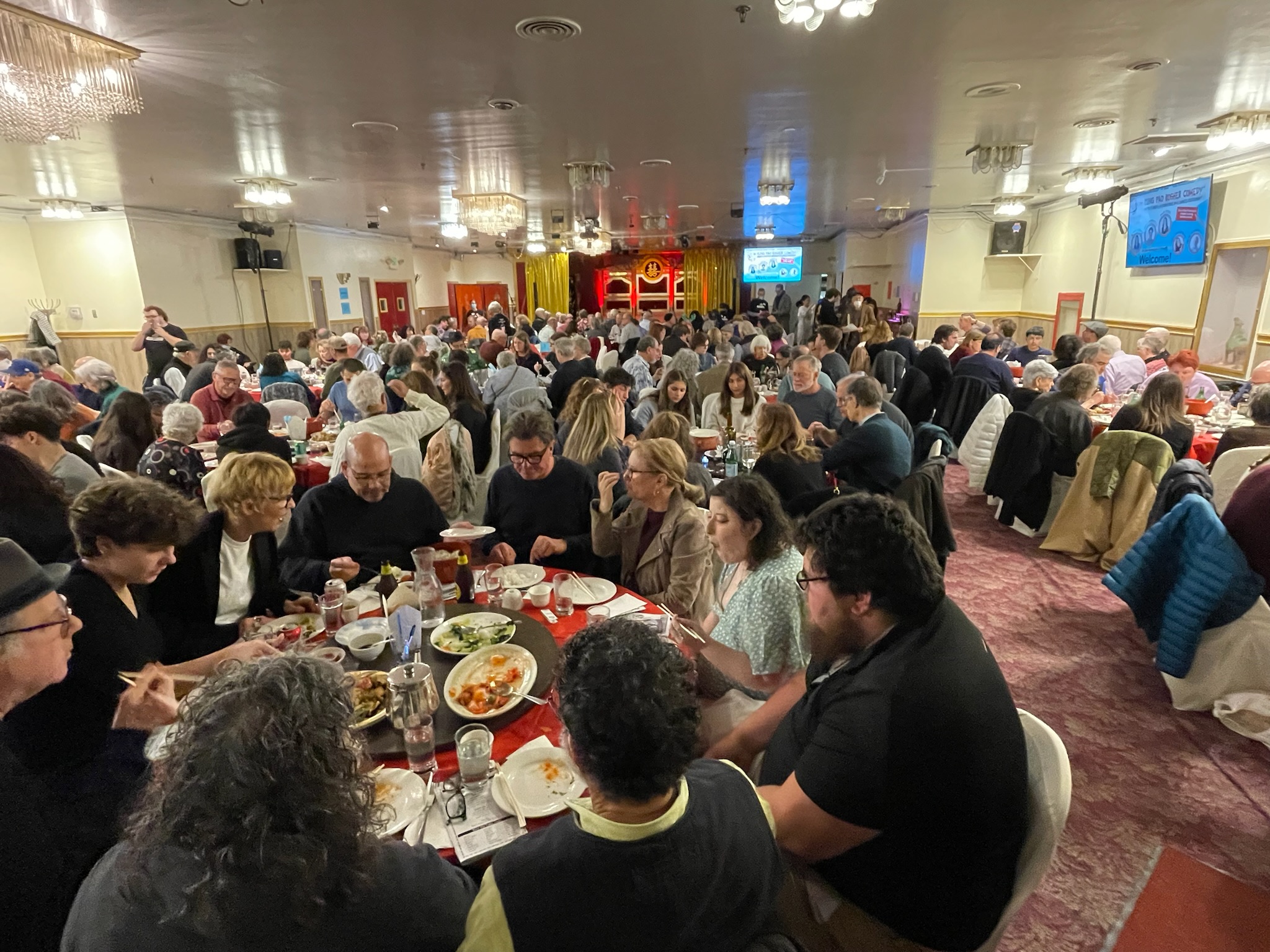
A Kung Pao Kosher Comedy audience, at Imperial Palace Restaurant in December 2023. Credit: Courtesy Lisa Geduldig
“I thought it was going to be a comedy club, and when I got there, it was a Chinese restaurant. So, then I was telling Jewish jokes at a Chinese restaurant,” she says. “Told a friend in New York about it the next morning. And then the idea of Jewish comedy on Christmas at a Chinese restaurant came about.”
Geduldig has personal as well as political reasons for wanting to spearhead “Resistance Comedy.” For 12 years, she hosted a monthly show at El Rio. During the pandemic, she hosted a show called “Lockdown Comedy” over Zoom, which ran from July 2020 through September 2024. She spent a large part of the pandemic in Florida, caring for her mother, Arline, who died in August 2024. Now, back home in the Mission, she is eager to get started again.
“Laughter is necessary, especially when something horrible is going on,” Geduldig adds. “I miss my mom so much … I just thought, how am I going to get on stage again? Am I going to perform while I’m grieving? But I have, and it’s been really healing. So, whether you’re dealing with impending fascism or the recent death of a parent, laughter is so essential.”
Lisa Geduldig, founder of Kung Pao Kosher Comedy, says laughter is ‘necessary’ during tough times. Credit: Courtesy Lisa Geduldig
The other inspiration for “Resistance Comedy” is obvious: her outrage at Trump and company, and the pain they have inflicted one appalling executive order and nonsensical mass firing at a time.
“I’m not trans, but I’m in the LGBTQ+ community,” Geduldig says. “I’m not an immigrant, but I have lived in Mexico, and I know people who are immigrants from Mexico who are my extended family … you need to get involved.”
“I went to a meeting a couple of weeks ago, largely Latino, largely in Spanish, about immigration issues and know[ing] your rights,” she adds. “And I came out of there feeling better, to be doing something, to be getting involved with people.”
For now, Geduldig has booked “Resistance Comedy” into the Eclectic Box for one Sunday a month through November. She hasn’t decided about December, since she will be in Kung Pao mode then. Beyond that, she isn’t sure. She can only use her past as a guide.
“I started the El Rio comedy series, which I thought was going to be a year long, and it was 10 or 12 years,” she says. ”Kung Pao, I thought was a one-off, and now it’s 33 years. So, if the public wants it, and people keep coming, I’ll continue to do it … I mean, we’re definitely going to need to laugh.”
The first ‘Resistance Comedy’ takes place 7 p.m. Sunday, March 23 at Eclectic Box (446 Valencia St.). Tickets (sliding scale, $27.50 and up) and more info here.
Dr Russell Razzaque • Premiered Mar 13, 2025 • Ever wondered why Trump voters support him? In this video, a psychiatrist breaks down the psychology and motivations behind Trump voters’ decisions. Learn about the mindset and influences that shape their political choices and opinions. If you’re curious about political psychology, this video will give you new insights into voter behavior and why people support political figures like Trump.
The National initiative is a proposed process to petition an initiative at the federal level in the United States via a national vote on the national ballot measure. While some U.S. states allow direct or indirect initiatives, there are currently no national initiatives in the United States.
The process and system for a national initiative was proposed in the early 2000s by the late Mike Gravel, a former U.S. Senator, and the Democracy Foundation, a non-profitnon-governmental organization. The set of proposals, referred to by its proponents as the National Initiative for Democracy (and later renamed National Citizens Initiative for Democracy in 2012[1]), gathered endorsements from author, activist and former independent candidate for President of the United States Ralph Nader; linguist, philosopher, political activist and author Noam Chomsky; author of The Tao of Democracy and co-director of the non-profit Co-Intelligence Institute Tom Atlee; and socialist thought-leader and author of A People’s History of the United StatesHoward Zinn.
National Initiative for Democracy (USA)
The National Initiative for Democracy (NI4D) is a proposed constitutional amendment (Democracy Amendment) which recognizes the people’s right to make laws at the local, state and federal level of every jurisdiction in the country and a federal law (Democracy Act) which spells out orderly procedures for the people to develop and vote on laws.[citation needed]
“The National Initiative does not change or eliminate Congress, the President, or the Judicial Branch of government. Laws created by initiative must still stand up in the courts just like laws created by Congress.” The National Initiative adds an additional check—the people—to America’s system of checks and balances, while setting up a working partnership between the People and their elected representatives.[citation needed]
The framers of the National Initiative for Democracy believe the law-making branch of government (Congress) no longer effectively represents the will of the American people. They believe as America continues to grow and diversify, Congress can only become less and less effective in representing the masses; that the gap between the elite decision-making few and the ever diversifying average citizen can only be bridged through direct citizen participation in governing. They contend that while “voting out” representatives from office or enacting term limits is a good idea, those actions do not address the basic, fundamental flaw of governing an enormous, increasingly heterogeneous population by a tiny, elite few. They believe that recent technological advances have made it possible for all Americans to voice their opinions on policies and laws which affect their lives; technology that did not exist in 18th century America, when the Constitution was written.[citation needed]
The National Initiative for Democracy believes direct citizen participation in law-making is the sovereign right of all Americans and should no longer be the exclusive right of Congress (at the federal level). Since it does not seek to abolish Congress, the States’ Constitutional right to a representative form of government stated in Article I, Section 1, remains unaffected. The Supreme Court has recognized the Constitutional right of citizens to make laws at the state level but oddly, not at the federal. The National Initiative believes most of the existing state initiative processes have the right idea but are terribly flawed. NI4D designed their proposal to specifically address those shortcomings. Their proposal encompasses a unique, multi-step, deliberative process, by which citizens can initiate and enact laws. A process they believe has eliminated, to the further extent possible, the feared “mob rule” mentality.[citation needed]
By 2009, 24 US states had an initiative process in place at the state level. The proposed National Initiative would be somewhat similar to those already in place at the state level, but they would differ in the following significant ways:
An independent Electoral Trust would be established consisting of a Board of Trustees and a Director. The Board of Trustees shall consist of 53 members: one member elected by the citizens of each of the 50 states, the District of Columbia, Puerto Rico and the Territories of the United States. The Director, except for the first Director, shall be appointed by majority vote of the Board of Trustees. The Board of Directors of the Democracy Foundation shall appoint the first Director. A variety of safeguards are written into the Democracy Act to prevent abuses by Trustees or the Director which include: Trustees and the Director serve a single term and cannot be re-elected; Trustees can be removed from office in a recall election or if three-fourths of the Trustees vote for removal; Trustees can recall the Director with a supermajority and all Electoral Trust meetings are open to the public.
The Electoral Trust would be responsible for establishing procedures and regulations to register eligible citizens for lifetime voter registration, to assist sponsors in preparing initiatives for qualification (drafting), to process initiatives, to distribute information on proposed initiatives to every registered voter via various media outlets, to administer initiative elections and to administer elections and recall elections of the Board of Trustees and the Director. The Director is acting CEO of the Electoral Trust and is responsible for its day-to-day management and operations, consistent with the policies established by the Board of Trustees.
Only citizens of the United States who are registered to vote may sponsor an initiative. The sponsor shall be identified on the initiative, on any petition, and on any qualifying poll. Any communication, regardless of the medium through which conveyed, that promotes or opposes an initiative shall conspicuously identify the person(s) responsible for that communication, in a manner specified by the Electoral Trust. Only U.S. citizens may contribute funds, services or property in support of or in opposition to an initiative. Financial disclosures and monetary thresholds will be established by the Electoral Trust. Contributions from corporations including, but not limited to, industry groups, labor unions, political parties, PACs, organized religions and associations are prohibited. Such entities are also prohibited from coercing or inducing employees, clients, customers, members, or any other associated person to support or oppose an initiative. Violations of the prohibitions shall constitute a felony. The initiative itself shall address one subject pertaining to public policy only, but may include related or mutually dependent parts. The initiative shall contain no more than five thousand words.
Before being put to a national vote, an initiative would need to qualify in one of 3 ways: a public opinion poll, a petition or legislative resolution. The Electoral Trust in the relevant jurisdictions will determine the number of yeas or signatures needed for qualification by polling and petition. A simple majority in the legislative body of the relevant jurisdiction is all that will be needed for qualification by legislative resolution. The sponsor may withdraw an initiative from further consideration and processing at any time prior to a deadline established by the Electoral Trust.
After an initiative qualifies, before it is voted on publicly, multiple hearings on the initiative will be conducted. A public hearing will be held with representatives of the sponsor and representatives of the legislative body of the relevant jurisdiction. Testimony on the initiative will be given by citizens, proponents, opponents, and experts which can be solicited. Their testimony shall be published as the Hearing Record. After the Public Hearing is completed, the Electoral Trust shall convene a Deliberative Committee (much like Oregon’s Citizens’ Initiative Review) [1] to review the initiative. The Committee shall consist of citizens selected at random from the voter registration rolls of the relevant jurisdiction maintained by the Electoral Trust and balanced as fairly as possible. Committee members are not required to participate (like jurors) and will be compensated for time spent and expenses incurred in performance of their duties should they choose to participate. The Deliberative Committee shall review the Hearing Record, secure expert advice, deliberate the merits of the initiative, and prepare a written report and recommendations. By two-thirds vote, the Committee may alter the initiative, provided that the changes are consistent with its stated purpose.
Each initiative, together with its Hearing Record and report of the Deliberative Committee, shall be transmitted to the legislative body of the relevant jurisdiction (local or state) or Congress (federal) for an advisory vote. Upon completion of the Legislative Advisory Vote, or 90 days after the initiative has been delivered to the legislative body, whichever comes first, the Electoral Trust shall publish a schedule for the election of the initiative.
The Electoral Trust will take advantage of modern technologies in developing procedures for voting and validating those votes. Voters may use multiple modern technologies from anywhere in the world using the most sophisticated encryption and security protections available that day. The Electoral Trust shall establish and maintain a web site for each qualified initiative that will contain, at a minimum, a summary of the Hearing Record, the report of the Deliberative Committee, the result of the Legislative Advisory Vote, statements prepared by the sponsor, other proponents and opponents, and a balanced analysis of the pros and cons of the initiative, its social, environmental, and economic implications, costs and benefits. Voters can use this information to make informed decisions before they cast their votes.
An initiative that modifies the Constitution or a charter would be enacted by affirmative vote of more than half the registered voters of the relevant jurisdiction in each of two successive elections. If such initiative is approved in the first election, the second election shall occur no earlier than six months and no later than a year after the first election. Half of the electorate, not merely half the people who care to vote, must vote yes, twice, in order to change a constitution or a charter.
An initiative that enacts, modifies or repeals statute law assumes the force of law when approved by more than half the voters in the relevant jurisdiction participating in an election. This means that in the case of statutes, the majority of the votes received will be counted as the favorable opinion (as opposed to modifying the Constitution, which will require more than 50% of all registered voters).
Background
The Democracy Foundation and the Philadelphia II Corporation are non-profit organizations established by former United States Senator Mike Gravel (Democratic Party, Alaska, 1969–1981). These organizations were established in conjunction to promote direct democracy through the enactment of a Constitutional amendment and a related Federal statute. If enacted, the amendment would both assert and codify the people’s right to make laws, and outline the structure of the Electoral Trust. The “Democracy Act” or federal statute would outline the details with which the constitutional amendment would be implemented.[citation needed]
The Democracy Foundation is the sponsor of the Democracy Amendment and the Democracy Act. It is also responsible for fundraising and educational efforts. The Philadelphia II Corporation was established separately to administer the national vote the organization hopes to use to enact the proposed legislation through the method of ‘direct decree by the People’.[citation needed]
Direct decree The process of direct decree is the legal basis proposed by The Democracy Foundation with which it hopes to sustain its proposed enactments. Direct decree is premised with the fact that ‘people’s sovereignty‘ implemented the US political system by direct decree in the United States Constitution. It cites that document’s opening clause, “We the people” as evidence of the same premise. By proposed logical extension, having legally created the government of the United States the people may alter it at any time in similar fashion.
The concept of direct decree further posits that although the authority of the United States Congress is limited by the constitution, the authority of the people is inherently sovereign and above the authority of the state. By such a theory any measure voted upon and approved by the popular majority of the people is posited to be legally binding and authoritative over all other law. NI4D does not accept the long-held belief that the two ways spelled out in Article V of the U.S. constitution are the only ways in which the constitution can be amended. The argument for bypassing Article V is that Article V dictates the means which representatives can amend the constitution but does not expressly forbid amendment by the popular vote of the People in its wording. This notion is supported by constitutional scholar Akhil Reed Amar: “…Article V nowhere prevents the People themselves, acting apart from ordinary government, from exercising their legal right to alter or abolish government, via the proper legal procedures. Article V presupposes this background right of the People, and does nothing to interfere with it. It merely specifies how ordinary government can amend the constitution without recurring to the people themselves, the true and sovereign source of all lawful power.”[citation needed]
Summary of the proposal
The National Initiative for Democracy is a proposed Amendment to the US Constitution that recognizes the people’s right to make laws, and an accompanying Federal Law that spells out the procedures for the people to develop and vote on laws. This proposed law making is supplemental to those means existing and established through the institutions of representative government (i.e. Congress and the President).[2]
asserts the legislative powers of the people to make laws
allows the people to amend the constitution by holding two successive elections, more than six months but less than one year apart
legitimizes the national election conducted by Philadelphia II, a non-profit IRS 501 C (4) corporation, to enact the Democracy Amendment and the Democracy Act (see below),
creates The Electoral Trust to administer the procedures established by the Democracy Amendment and the Democracy Act,
outlaws the use of funds not from natural persons in initiative elections under this article, and
outlaws non-natural persons from sponsoring initiatives under this article.
The proposed Federal Statute:
sets out deliberative procedures to be used by citizens to create laws by initiative,
describes the responsibilities of The Electoral Trust to administer these procedures on behalf of the people,
appropriates the funds from The Treasury for The Electoral Trust, and
defines the threshold of affirmative votes needed to enact this legislation (see below).
This legislation considers itself to be enacted when it has received a number of affirmative votes greater than half the total number of votes cast in the presidential election occurring immediately prior to its certification. The United States Constitution (via Article VII) also self-enacted.
This is neither a government held nor a government sanctioned election. As of this writing, there is currently no official method laid out in the United States Constitution for the people to hold such an election. However, the authority for effecting such a constitutional reform is proposed to derive from:
The National Initiative for Democracy, primarily associated with Mike Gravel, seeks broad public support. Gravel founded The Democracy Foundation and the Philadelphia II corporation and played a significant role in drafting the Amendment and Act’s text. This draft was publicly reviewed at the Democracy Symposium in February 2002. The initiative’s aim to establish a national ballot initiative through popular vote is one among several efforts pursued by Gravel, including previous attempts to promote constitutional amendments during his tenure as a Senator. While it’s stated that former presidential candidate Ralph Nader supports the initiative, this assertion requires proper citation.[citation needed]
In popular culture
A proposal for a national initiative is featured as part of the plot in the 1977 film Billy Jack Goes to Washington, the fourth and last of the Billy Jack series. In the film, Billy Jack is appointed a United States Senator. Seeking to keep him out of the Senate on a day when a controversial energy bill is being voted on, another Senator suggests he meet with a grassroots group that day instead. The group is working to pass a national initiative and Billy Jack becomes convinced of their cause. Billy Jack ends up filibustering in the Senate giving a long speech supporting a national initiative.[citation needed]
Imagine, just for a moment, that you run a foreign entity hostile to the United States. And imagine that you had the wherewithal to hire the services of a newly elected president. What might you pay them to do?
Undermining democracy might be useful, as well as taking a bulldozer to the carefully constructed but rather fragile checks and balances built into the Constitution. But that wouldn’t create true chaos. And because it would strengthen your presidential pawn, it could make him a threat. You’d need more.
You’d definitely want to trash the economy, and as quickly as possible—preferably creating as much confusion as you could along the way. Decimating the health system would be useful, too, since epidemics and outbreaks of food poisoning can be effective at furthering economic disruption and undermining social cohesion. Disrupting essential benefits like Social Security would be effective, too. If you also could mess with agriculture and essential services like weather forecasting, you could generate some real turmoil.
Now take a look at the Trump administration agenda, much of it implemented by unelected co-president Elon Musk. Do you sense a pattern?
No, I am not saying that Donald Trump is the paid agent of some foreign power or other nefarious force, although you don’t have to look hard to find people seriously suggesting such things. I have no reliable information on which to evaluate such claims and, frankly, no emotional bandwidth to try, so I won’t go there. But the Trump/Musk agenda has become increasingly hard to understand as anything other than calculated destruction.
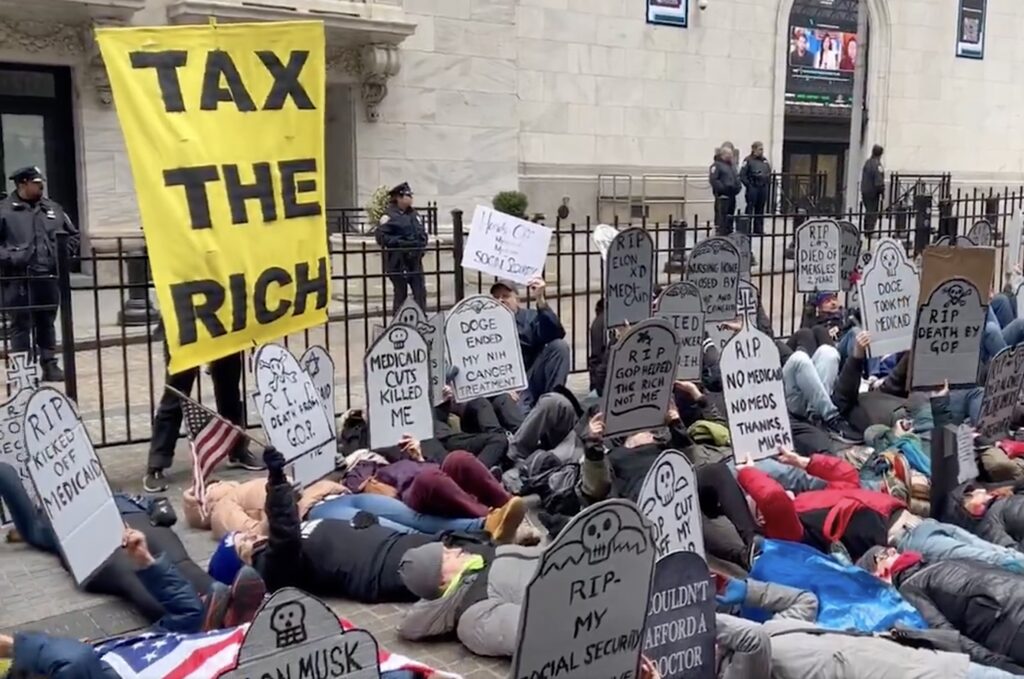
Protesters in NYC staged a die-in against DOGE cuts to social spending this weekend.
TARIFFS AND CLOSURES AND LAYOFFS—OH MY!
I won’t spend much time on the big stories like Trump’s trade wars that you’ve no doubt seen if you follow the news at all. Let’s just acknowledge that while there have been legitimate critiques of the assorted free trade agreements negotiated during the nineties (some lightly modified by Trump during his first term) and there’s a case to be made for considering modifications, there is no sense—none, zero—in Trump’s wild, on-again, off-again zigzags. Companies like automakers have built huge, complex, cross-border manufacturing and supply chains that can’t be changed in a week, a month, or a year. Trump has created instant chaos for industries, their workers, and all the assorted ports, truckers and other services and suppliers who depend on them. This is crazy.
Meanwhile, Musk’s (fake) “Department of Government Efficiency” is laying off tens of thousands of federal workers—effectively shutting down entire agencies, despite having no legal authority to do so—and cancelling without warning many billions of dollars of contracts, causing the businesses and nonprofits who hold those contracts to lay off more workers. You don’t need a Ph.D. in economics (and at the rate Trump has been threatening to defund universities, you may not get one) to know that fired workers stop buying stuff, which means the businesses selling the goods and services those workers used to buy also have to lay off workers. There’s a term for this. It’s called “a recession.” Oh, and staff cuts at the Social Security Administration are apparently so severe that former officials are warning that benefits could start to be interrupted this spring.
Sponsored link
Help us save local journalism!
Every tax-deductible donation helps us grow to cover the issues that mean the most to our community. Become a 48 Hills Hero and support the only daily progressive news source in the Bay Area.
The recent stock market implosion is not random chance.
But you probably knew all that, so enough of the big-picture stuff. Let’s get granular and dig into some details you may not have seen because there are just too many of them happening at the same time. I’ll admit upfront that I’m not an impartial observer here: As I’ve noted here before, I’m doing some communications work for Defend Public Health, a network of healthcare workers, researchers and allies trying to salvage at least some of our public health system from the Trump/Musk onslaught. And like other advocacy organizations, we try to get our messages out through the same channels others use, like news coverage and social media.
And hoo-boy, is this a wild news environment. You’ve heard of a four-alarm fire? This is a 40,000-alarm fire. It’s like being stuck in the middle of the movie “Everything Everywhere All at Once” and trying to send out a press release through every dimension of the multiverse at the same time. There’s so much chaos going on in so many places, with so much new every day and so much of it being hidden, that the media, even the outlets that are sincerely trying, barely know where to look or what to try to cover, and even the most frantic social media doomscrollers struggle to keep up.
Federal shipments of food have been cut off for Hawaiian food banks.
MINDLESS CRUELTY
Let’s start with some particularly mindless acts of cruelty that didn’t get much national coverage. You may have heard of the Fulbright Scholarships, officially described as “the United States government’s flagship program of international educational and cultural exchange.” Each year this program sends hundreds of US students, teachers, artists and scholars abroad to study, teach and do research, and brings hundreds from abroad here.
Trump and Musk suddenly cut off the money that thousands on Fulbright scholarships and other State Department exchange programs were depending on for things like paying rent and buying groceries, leaving them high and dry with no idea when their expected stipends would resume. Seriously. The participants’ stories quoted by WUOB public media in Athens, Ohio are heartbreaking.
And then there are the mass firings underway at the Veterans Administration, which appear to have originally included staff at the Veterans Crisis Line. They apparently were even starting to cut staff at the suicide prevention line for veterans until several enraged members of Congress made noise. Now it was all apparently a “clerical error.” Sure.
And in a twofer, Trump’s Dept. of Agriculture managed to simultaneously screw small farmers and hungry children by abruptly ending two programs that provided schools and food banks over $1 billion a year to buy food from local farmers. And in Hawaii, food banks across the islands reported that food shipments being sent through a separate program were suddenly cut off. Neither the food banks nor Hawaii Public Radio, which reported the story, were able to get clear answers as to why the shipments were cut off or when or whether they might be restored.
Still out in the Pacific, you may remember the devastating fire that wiped out much of the town of Lahaina on the Hawaiian island of Maui in August 2023, killing over 100 and wiping out thousands of homes and businesses. The federal government was funding nonprofits who employed 131 residents whose workplaces were destroyed by the fire, paying them to help other displaced residents find new homes and jobs, as well as to do assorted other cleanup, recovery and humanitarian work. Seems like the sort of thing you’d like your tax dollars to go to, doesn’t it? Gone. The workers were all laid off, the funding cut with no warning.
Let’s stay in Hawaii for a minute—partly because I live here now and have a particular interest in the place, and partly because what’s happening here seems both shrouded in mystery and more than a little ominous.
Local news reports have indicated that multiple federal buildings may be offloaded by DOGE, but it’s not clear which ones. By process of elimination, one can deduce that one listed as potentially surplus may be the temporary headquarters of the Hawaii Volcano Observatory in Hilo, part of the US Geological Survey. That may or may not be alarming. HVO is working on a new permanent headquarters, but there have been no recent updates on progress, so this could be normal or it could be scary. Hawaii Island has two very active volcanoes on its land mass, and the 2018 Kilauea eruption took out 700 homes, so monitoring volcanoes here is no joke. Inquiries to HVO from 48 Hills were forwarded to the main USGS office in Washington, and then… silence.
Protesting cuts outside the NOAA facility in Boulder, CO. Photo by Hart Van Denburg/CPR News
TSUNAMI WARNINGS? WEATHER FORECASTS? DO WE REALLY NEED ‘EM?
DOGE has ordered severe cuts to the National Oceanic and Atmospheric Administration, NOAA, which includes the National Weather Service and serves as a major repository of climate research and data (and thus was a major target highlighted by Project 2025). NOAA covers both weather and oceans and includes the Pacific Tsunami Warning Center, which has lost at least one staff position, among other cuts in the Pacific region.
Like volcanoes, tsunamis are serious business here. A 1946 Tsunami killed 173 in and around Hilo and 14 on Maui, and another in 1960 killed 61 and remade the city of Hilo. The folks who keep tabs on these things are not expendable bureaucrats.
We asked the offices of Hawaii Senator Mazie Hirono and Representative Jill Tokuda, whose district includes Hilo and all of Hawaii Island, for any information they have on these cuts. They had no response, which – given that they’re Democrats not generally shy about criticizing Trump – likely means that they’re as in the dark as everyone else.
Although all the cuts to NOAA aren’t completely clear, they seem to be widespread and brutal. Half a dozen NOAA and NWS employees in Monterey were let go in late February, including three at the Monterey weather station that serves 11 counties. Other reported cuts may include cancellations of leases to multiple key National Weather Service facilities. Meteorologist Daniel Swain, whose Weather West blog and social media posts are required reading for anyone interested in West Coast weather, has posted that such cuts, if they happen, “would spell the end of US numerical weather prediction—the scientific models, run on supercomputers, used to create virtually all weather forecasts.”
And it’s not just the buildings. National Weather Service Employees Organization General Counsel Richard Hirn told ABC News in early March that due to staff cuts, “hundreds of operational personnel who usually staff the 122 NWS forecast offices, 13 River Forecast Centers, and two tsunami warning centers will disappear overnight.” Given the extreme weather events of the last few years in California and across the US, this seems like genuine sabotage. Even if the idea is to privatize all weather forecasting, as some theorize, the chaos during the transition could be disastrous.
If sabotaging weather forecasting isn’t enough to devastate agriculture, the administration is working to compound the damage by deleting vital climate information from federal websites. Apparently in service of the fantasy that climate change is a hoax, Inside Climate News reports, “The Trump administration has deleted thousands of climate-related web pages from the US Department of Agriculture’s (USDA) website, stripping farmers of critical resources as droughts, floods and shifting growing conditions intensify.” As with many of these issues, lawsuits are flying – in this case filed by a group of farmers with the assistance of Earthjustice. In the meantime, private parties are left scrambling to try to save and reassemble as much data as possible.
But hey, never fear. If disaster strikes, DOGE has moved to terminate the lease on the Army Corps of Engineers’ Florida headquarters, in the heart of hurricane country. It’s not like the guys taking the lead on preserving the Everglades and the state’s drinking water as well as leading hurricane response are doing anything important down there. In another corner of the South, a grotesquely symbolic DOGE move: The administration has moved to sell the Freedom Riders Museum and Montgomery Bus Station in Alabama.
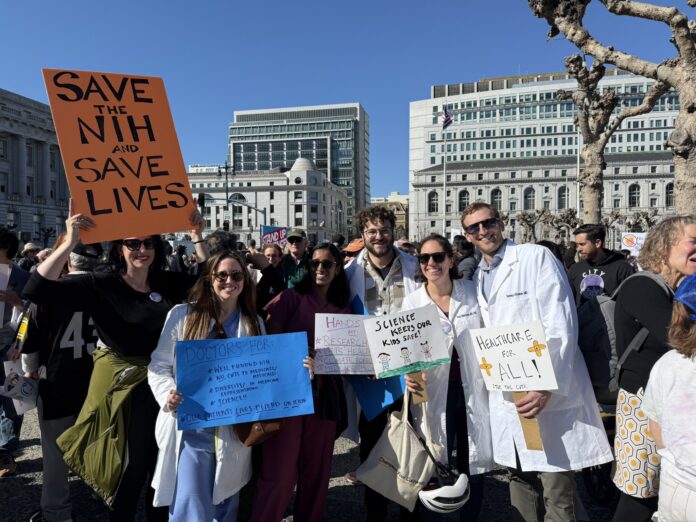
Protesting cuts to the National Institutes of Health. Photo by Laura Marie
MAKE AMERICA SICK AGAIN
Others among the nearly 750 leases that DOGE recently claimed to be terminating included facilities used by the Occupational Safety and Health Administration and the Indian Health Service. While initial severe cuts to the Indian Health Service were rescinded, other services that citizens of Native American tribes depend on remain at risk, and both reporters and local officials have had trouble getting clear answers.
Other issues on the health front look grim. Peter Lurie, former Associate Commissioner for Public Health Strategy and Analysis at the FDA and now leading the Center for Science in the Public Interest, has warned repeatedly about FDA staff cuts. In early March he argued that DOGE has “taken a flamethrower to the staff directory at FDA” and endangered public safety in the process.
Cuts to research at the National Institutes of Health mean not only fewer studies – and thus fewer new treatments and cures—but also, as my Defend Public Health colleagues James Alwine and Elizabeth Jacobs, both epidemiologists, pointed out in a recent commentary for The Hill, fewer researchers: “We are already seeing universities cut back on admission of graduate students for health science programs, even rescinding offers of admission that have already been sent. Postdoctoral training and clinical research training programs will follow.”
And, as HHS Secretary Robert F. Kennedy Jr.’s anti-vaccine agenda takes hold, NIH just cancelled over 40 grants involving studies of vaccine hesitancy – as a measles outbreak spreads among the unvaccinated in the Southwest. Since NIH is currently without a permanent director, this must have been directed from above. An internal NIH email obtained by NPR states, “It is the policy of NIH not to prioritize research activities that focuses gaining scientific knowledge on why individuals are hesitant to be vaccinated.” Ponder that. It is now official policy of the world’s premier medical research institution that there are things about healthcare that it prefers not to learn.
The health cut—and there’s more we haven’t talked about—aren’t limited to the US Almost from the moment Trump took office, Musk and DOGE targeted the US Agency for International Development, the major source of US health assistance overseas, bizarrely calling it a “criminal enterprise.”
US foreign policy, of course, has always been a strange, Jekyll and Hyde phenomenon. With one hand, we fight bloody, stupid wars in places like Vietnam and Iraq and support or foment antidemocratic coups in Iran, Chile, and more other countries than I can name. But with the other, we do some genuinely good, life-saving work, feeding millions of people who would otherwise die of malnutrition and providing healthcare to millions who would suffer or die from preventable or treatable illnesses without the billions of dollars the US spends on such help. That good side of US foreign policy, the side that saves lives and reduces suffering every single day, is the side that Trump and Musk have decided to obliterate.
Something like 10,000 USAID contracts have been terminated, originally reported as 90% of the total, though now the official figure is 83%, and the global toll will be devastating. Food and healthcare programs all over the world will simply stop unless impoverished local governments or private donors can backfill at least some of the funding. Not yet entirely clear is the fate of PEPFAR, the President’s Emergency Plan for AIDS Relief—possibly the only truly good thing to come out of the George W. Bush administration. PEPFAR has provided tens of millions of people with life-saving anti-HIV medication, HIV testing and other services.
PEPFAR funding was cut off during the first DOGE assault, then supposedly restored after howls of outrage, but multiple reports have questioned whether the money spigot has really been turned back on. Stories like this March 11 report from South Africa abound: clinics with thousands of desperate patients, funding cut off and workers with no idea whether they will have jobs again or not. In addition to PEPFAR, other USAID programs addressing AIDS and tuberculosis remain in danger, and while court orders were supposed to stop some of the immediate layoffs, long-term prospects remain highly uncertain.
What did I say before about mindless cruelty?
Anti-Muks/tesla ‘Swasticar’ ads popped up in Europe.
RESISTANCE IS NOT FUTILE
Amazingly, the above barely scratches the surface of the destruction and misery that Trump, Musk and their teams have begun inflicting during less than two months in office—the US is now bombing Yemen and attempting to deport whoever it wants by invoking a 228-year-old law with a terrible legacy, by the way. Although I’m told that the universe has an essentially infinite supply of pixels, a full accounting might well exhaust that supply.
But all is not lost. I mean it.
If one lesson of the last two months is that the Trump reboot is infinitely worse than Trump 1.0, the other lesson is that resistance can work, and we need more of it.
All sorts of injured parties, the list is nearly endless, have filed lawsuits against the administration, and many have won their initial court battles—on birthright citizenship and some of the anti-diversity, equity and inclusion orders, for example. On March 13, US District Judge William Alsup ordered the administration to reinstate thousands of workers fired in February at the Veterans Affairs, Agriculture, Defense, Energy, Interior and Treasury departments. Alsup made clear that he’d lost patience with the government’s lawyers, saying, “Come on, that’s a sham. Go ahead. It upsets me, I want you to know that. I’ve been practicing or serving in this court for over 50 years, and I know how do we get at the truth. And you’re not helping me get at the truth. You’re giving me press releases, sham documents.”
There have been signs of foot-dragging on obeying some of these rulings, and most will surely be appealed, but they gum up the works and slow the damage. That matters.
On the same day as Alsup’s ruling, Trump abruptly yanked the nomination of anti-vaccine and anti-abortion zealot Dave Weldon to lead the Centers for Disease Control and Prevention hours before his scheduled confirmation hearing. Weldon blamed Republican Senators Susan Collins and Bill Cassidy for refusing to support him, which implies that the growing campaign against him in the days leading up to the hearing played a role. The fact that HHS Secretary Robert F. Kennedy Jr. promised both senators he’d moderate his anti-vaccine stances in order to get their votes and then immediately backtracked probably didn’t help.
Economic pressure can play a role as well. The February 28 Economic Blackout Day appears to have taken a bite out of Target’s online traffic and helped Costco, which, in contrast to Target, publicly reaffirmed its commitment to diversity, equity and inclusion.
And then there’s Tesla, the biggest of Elon Musk’s enterprises and the major source of his wealth. Astute 48 Hills readers may recall that back in November 2022 I suggested avoiding buying a Tesla because of Musk’s increasingly sketchy politics—and I got some heat for it. Apologies will be graciously accepted.
Well, Tesla’s in trouble. After a huge post-election run-up, Tesla’s stock price imploded by 41.3% between Jan.1 and March 13, erasing a sizeable chunk of Musk’s wealth, per Marketbeat.
And all over the globe, Tesla sales are down. We won’t have complete figures until the company’s first quarter sales report in early April, but what stats have trickled in from around the world look bleak. Reports of US January vehicle registrations, released in March, were quite good for electric vehicles – up 14% overall, with big gains for Ford, General Motors, and several other manufacturers. But Tesla registrations dropped by 11%, bringing its share of the US EV market down to 42.5%. That may sound good, but as recently as September 2023 it was hovering near 60%. And the January sales drop, of course, was before the full extent of the DOGE rampage had become clear.
Things are looking tough for Tesla all over the world. In China, there are signs of weakening demand for Tesla vehicles (probably more due to strong competition from locally produced EVs than to Musk’s politics). And the company’s sales have absolutely cratered in Europe, where that whole Nazi salute thing didn’t go over well. All of this made the recent Tesla photo-op at the White House, with Trump (who famously doesn’t drive) making a public show of buying one of his hatchet man’s cars—look rather desperate.
Protests keep happening at Tesla showrooms, not just in the US, but worldwide—which would seem to undercut Musk’s claim that it’s all a Democratic Party operation. And in London, activists replaced a bus stop billboard with a mock Tesla ad showing Musk standing in one of his vehicles giving the “Sieg heil!” salute with the caption: “Goes from 0 to 1939 in 3 seconds. Tesla, the Swasticar.” Ouch.
Does this really matter? It might. Musk’s power comes from his money, and as his fortune shrinks and his business falters, he looks smaller, weaker and more desperate by the day. And it’s not just Musk. The stock market has dropped big-time as the layoffs and Trump’s trade wars spook investors.
And if the GOP’s wealthy backers start to seriously fear losing their fortunes and threaten to turn off the money spigot for Trump’s congressional enablers, things could get very interesting indeed.
Help Outreach Working Group lift the fog of corporate media. Donate to help us maintain this website and distribute literature on the street.
This Sunday’s Town Hall: Announcing This Week’s Progressive Town Hall: Every Sunday at 4pm ET/1pm PT RSVP HERE Join PDA activists online from across the country to discuss the importance of progressives reclaiming the American story from the MAGA right, an issue of heightened importance as we’re now within one... Continue reading →
Community Coffee – Outer Sunset Sunday, April 19 | 1–3 PM Location: Java Beach Cafe, 1396 La Playa St Sign-up The San Francisco Democratic Party has been hosting community coffee events to connect with residents of our many different neighborhoods in SF every month. No speeches, just conversations and hearing... Continue reading →
We protest Heritage Foundation EVERY MONDAY (Join us!!!!) By admin | September 2, 2025 | Uncategorized Cliff Cash Comedy Premiered Jul 26, 2025 Every Monday at The Heritage Foundation 214 Massachusetts Ave. Washington D.C. 4pm protest 6pm pizza Every Friday at Fox News D.C. 400 N. Capitol St. Washington D.C. 4pm protest 6pm pizza We are... Continue reading →
Milk Club April General Membership Meeting Date: Tuesday, April 21 Time: 7-9 PM Location: SF LGBT Center, 1800 Market Street, San Francisco Zoom Link: Click here
One Million Rising: Strategic Non-Cooperation to Fight Authoritarianism Virtual Event · Hosted by No Kings Time Wednesdays 8 – 9:30pm EDT Location Virtual event Join from anywhere About this event Across the country, authoritarian forces are getting bolder and more dangerous. Trump and his allies are not hiding their agenda: mass deportations,... Continue reading →
Meeting Agenda April 22, 2026 The San Francisco Democratic County Central Committee will meet on Wednesday, April 22, 2026 at 6:30 pm at Milton Marks Auditorium, 455 Golden Gate Ave, San Francisco, CA 94102. A security screening will be required to enter the building. Members of the public can live... Continue reading →
SF Green Party Showing events after 3/27. Look for earlier events Wednesday, April 20 7:30pm SF Green Party Council Meeting WhenWed, April 20, 7:30pm – 9:00pm WhereEl CafeTazo, 3087 16th St, San Francisco, CA 94103 (map) Description: This elected group is the equivalent to other political parties Central Committee. The San Franciso... Continue reading →
THURSDAY, JUNE 29, 2023 AT 2 AM – 4 AM PDT How to create trust in a group? Details Event by Extinction Rebellion Empathy Circles online EMPATHY CAFE Duration: 2 hr Public · Anyone on or off Facebook How to create trust in a group? This is the question that arose in our... Continue reading →
When you volunteer for Saikat, it’s on us to give you a great experience and a genuine chance to make a difference. We don’t want to waste a second of your time. That’s why we’re always optimizing. And I’m excited to report that this Saturday we talked with 300% more... Continue reading →


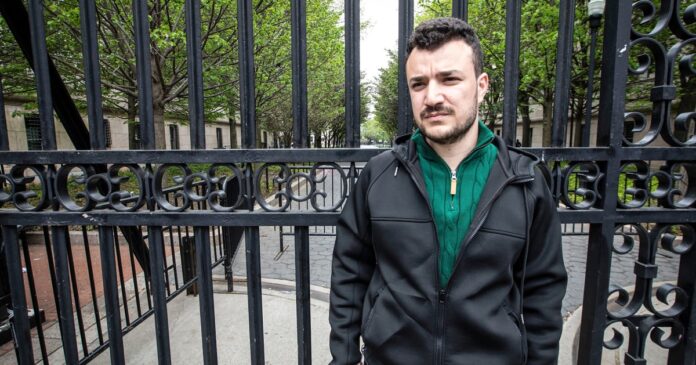
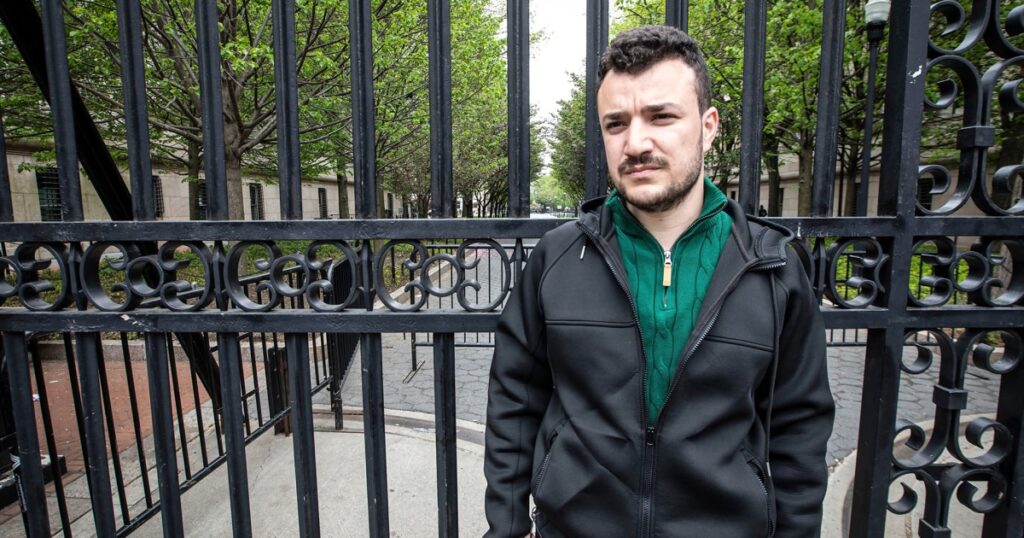
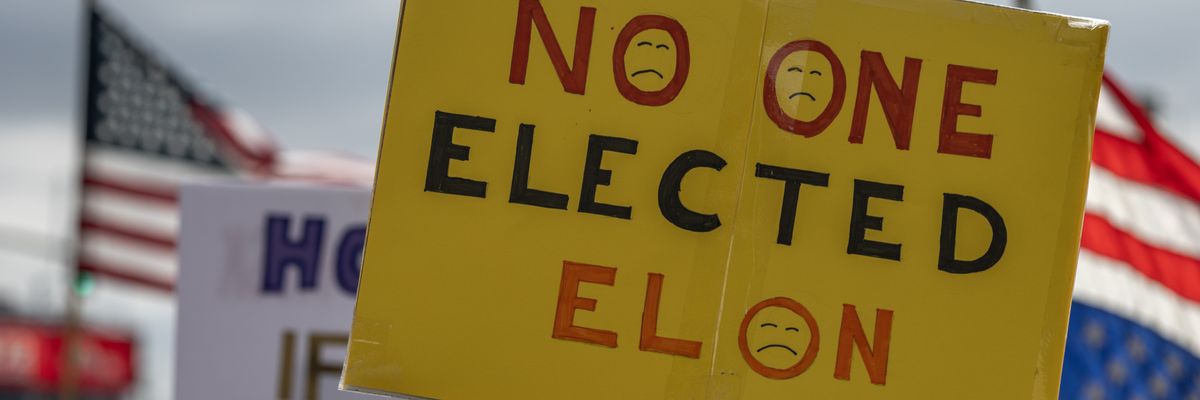
 by
by