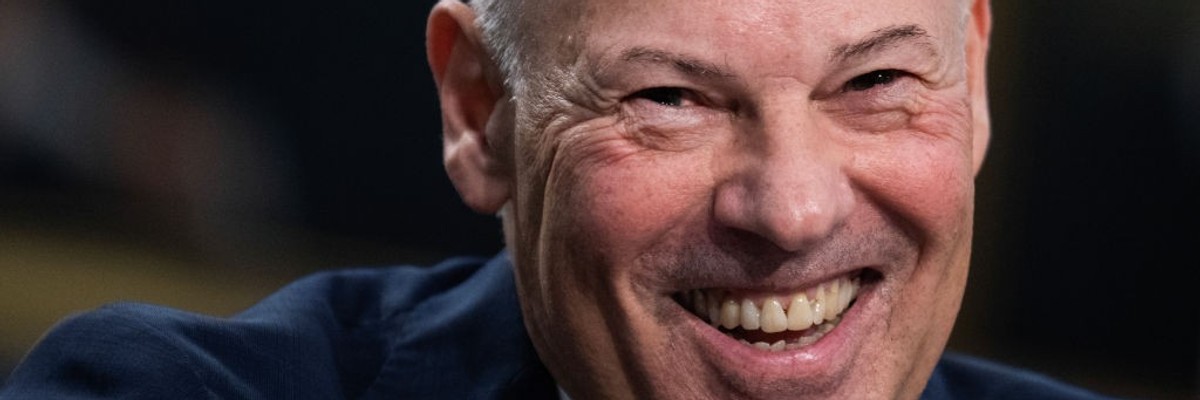
Postmaster General Louis DeJoy testifies during the House Appropriations Committee hearing titled “United States Postal Service’s Role in 2024 Election Mail Readiness,” in Rayburn building on Thursday, September 26, 2024.
(Photo: Tom Williams/CQ-Roll Call, Inc via Getty Images)
Instead of privatization, said one Democratic lawmaker, “Fire his former pick for postmaster, DeJoy, and let a real professional run it like it should be run. The first priority is delivering mail. Cut the Pentagon’s bloat if you want to save money.”
After weekend reporting indicated President-elect Donald Trump is actively thinking about avenues to privatize the U.S. Postal Service, progressives decried any such efforts and once again directed their ire on the much-reviled Postermaster General, appointed to run the USPS during Trump’s first term.
Citing people familiar with recent talks within the incoming team’s camp, the Washington Postreported Saturday that Trump is “keen” for a privatization scheme that would hand the USPS over to for-profit, private interests.
According to the Post:
Trump has discussed his desire to overhaul the Postal Service at his Mar-a-Lago estate with Howard Lutnick, his pick for commerce secretary and the co-chair of his presidential transition, the people said. Earlier this month, Trump also convened a group of transition officials to ask for their views on privatizing the agency, one of the people said.
Told of the mail agency’s annual financial losses, Trump said the government should not subsidize the organization, the people said. The people spoke on the condition of anonymity to reflect private conversations.
Trump’s hostility to government programs that serve the public interest—including Medicare, Social Security, public education, and consumer protection agencies—is well-documented.
“The United States Postal Service is a crucial asset that was built and is owned by all of us, and there is zero mandate from the public to turn it over to an oligarch.”
Trump’s attacks on the Postal Service, including his blessing of the 2020 appointment of Postmaster General Louis DeJoy, a former logistics industry executive, sparked alarm about Republican desires to gut the agency from the inside out.
While calls to fire DeJoy from the USPS top leadership post persisted during the last year of Trump’s first term and remained constant during Biden’s time in office, he remains Postmaster General despite repeated accusations that his ultimate aim is to diminish the agency to such an extend that it will be more possible to justify its dismantling.
While the Post‘s reporting on Saturday stated that Trump’s “specific plans for overhauling the Postal Service” in his upcoming term “were not immediately clear,” it did quote Casey Mulligan, who served as a top economic advisor during the last administration, who touted the private sectors performance compared to a Postal Service he claimed was too slow and costly.
“We didn’t finish the job in the first term, but we should finish it now,” said Mulligan.
Progressive defenders of the Postal Service, in response, denounced any future effort to privatize the agency, one of the most popular among the U.S. public.
“The Post Office is in our constitution,” said Rep. Mark Pocan (D-Wis.) on Saturday. “There is no way we let Donald Trump privatize it. Fire his former pick for postmaster, DeJoy, and let a real professional run it like it should be run. The first priority is delivering mail. Cut the Pentagon’s bloat if you want to save money.”
Former Ohio state senator Nina Turner also defended the USPS, saying that “72% of Americans approve of the U.S. Postal Service, it’s how many seniors receive medication, especially in rural areas.”
Progressive critics of right-wing attacks on the Postal Service have noted for years that the “financial performance” issues are a direct result of the “burdensome and unnecessary” pre-funding of liabilities mandated by the 2006 Postal Accountability and Enhancement Act, which forces the USPS to pay billions each year towards future postal worker retirement benefits.
“No matter what your partisan stripe,” said Micah Rasmussen, director of the The Rebovich Institute for New Jersey Politics at Rider University, “we should be able to agree the United States Postal Service is a crucial asset that was built and is owned by all of us, and there is zero mandate from the public to turn it over to an oligarch.”
Our work is licensed under Creative Commons (CC BY-NC-ND 3.0). Feel free to republish and share widely.
A man carries the body of a child who was rescued from the rubble toward a Health Ministry vehicle following Israeli bombardment on a four-story house in the north of Gaza City on Oct. 26, 2024. Photo: Omar Al-Qattaa/AFP via Getty Images
TUCKED INTO A $895 billion Pentagon bill making its way through Congress is a little-noticed provision to further conceal the death toll in Gaza — the latest effort by U.S. policymakers to cast doubt on casualty figures reported by Palestinian health officials.
The House approved this year’s National Defense Authorization Act, or NDAA, on Wednesday and sent it to the Senate for a vote, despite Democratic objections over a GOP proposal to prohibit transgender children on military health insurance from receiving gender-affirming care.
The death toll provision of the must-pass bill, which passed 281-140 with 81 Democratic votes, has received significantly less attention. It would bar the Pentagon from publicly citing as “authoritative” casualty data from the Gaza Health Ministry, effectively concealing the full extent of the death toll in Gaza in the military’s public communications. The data from Palestinian authorities has been the only consistent and reliable count of the death toll out of Gaza over the last 14 months, with Israel consistently denying human rights workers access to the enclave and preventing foreign media journalists from entering.
“This is an alarming erasure of the suffering of the Palestinian people, ignoring the human toll of ongoing violence,” said Rep. Ilhan Omar, D-Minn., in a statement to The Intercept.
The provision does not explicitly cite the Gaza Health Ministry; instead, it says that the Pentagon cannot “cite as authoritative in public communications, fatality figures that are derived by United States-designated terrorist organizations, governmental entities controlled by United States-designated terrorist organizations or any sources that rely on figures provided by United States-designated terrorist organizations.”
Still, the target is clear. Politicians in the United States have repeatedly cast doubt on the numbers provided by the Gaza Health Ministry because it falls under the jurisdiction of Hamas, a U.S.-designated terrorist organization. Earlier this year, the House of Representatives passed legislation explicitly prohibiting the State Department from citing data from the Gaza Health Ministry. And President Joe Biden previously told reporters that he had “no confidence in the number that the Palestinians are using,” despite his own State Department reliably using those numbers for years.
International human rights bodies, including the United Nations, have long relied on the data from the Gaza Health Ministry and considered it credible and in line with their own findings.
“In the past, the five, six cycles of conflict in the Gaza Strip, these figures were considered as credible, and no one ever really challenged these figures,” the U.N. Relief and Works Agency for Palestine Refugees chief, Philippe Lazzarini, told reporters at a press conference last year.
The NDAA rider extends the prohibition to any sources that rely on Health Ministry data, which includes most leading human rights organizations and the United Nations.
The legislation comes shortly after Amnesty International declared that Israel was committing genocide in Gaza, noting as a factor in their decision the immense death toll in the besieged Strip. In the first year of Israel’s ongoing assault on Gaza, the military had killed 44,835 people in Gaza, according to the Health Ministry.
Now, the legislation will move to the Democratic-controlled Senate, likely for a vote next week. Sen. Bernie Sanders, I-Vt., has already come out in opposition, arguing that at a time when Americans are struggling paycheck to paycheck, Congress should not be giving a $900 billion handout to the military-industrial complex.
“We do not need a defense system that is designed to make huge profits for a handful of giant defense contractors while providing less of what the country needs,” said Sanders on the Senate floor on Wednesday. “We do not need to spend almost a trillion dollars on the military, while half a million Americans are homeless, children go hungry, and elderly people are unable to afford to heat their homes in the winter.”
PDAMERICA • Started streaming 43 minutes ago Since our inception in 2004 we’ve been organizing around removing insurance companies from our healthcare mix and providing actual high quality health care for everyone via a Single Payer, government managed health system, whether at the Federal level via Expanded and Improved Medicare for All, or via a state-based system like Canada saw develop into health care nationwide. Join us as long-time friend and ally of PDA Chuck Pennacchio of Single Payer States lays out not only how such a system can work at the state level, but also why the time is ripe for all of us to organize to help make it happen. We’ll also cover breaking political news, and build our community of hope in these trying times. We hope you’ll join us, and invite a friend.
Katy N. Burdine • Aug 26, 2015 Iraq for Sale: The War Profiteers is a 2006 documentary film made by Robert Greenwald and Brave New Films. Produced while the Iraq War was in full swing, the film deals with the alleged war profiteering and negligence of private contractors and consultants who went to Iraq as part of the US war effort.[1] Specifically, the film claims four major contractors – Blackwater, K.B.R.-Halliburton, CACI and Titan [2] – were over-billing the U.S. government and doing substandard work while endangering the lives of American soldiers, Iraqi civilians, and their own employees.[1] These corporations were tasked with “virtually everything except the actual killing,”[3] including food, laundry, housing, security, intelligence gathering and interrogation.[4]
Three months after publicly accusing his former employer, OpenAI, of infringing on copyrights when training its AI chatbot, 26-year-old Suchir Balaji was found dead in his Lower Haight apartment.
Balaji was found by San Francisco police performing a welfare check at his Buchanan Street apartment two days before Thanksgiving, on November 26, as Bay Area News Group reports.
The medical examiner’s office deemed his death a suicide suicide, and the SFPD said this week that they have no evidence of foul play.
Balaji spoke out t0 the New York Times in October, telling the paper that as a researcher at OpenAI, it had been his job to gather information on the internet to feed into the ChatGPT model, and he soon began to believe that the company was running afoul of the “fair use” doctrine for using copyrighted material — something that has not been tested in the courts, though there are multiple lawsuits now pending against the company.
He also said he had left OpenAI in August because he no longer believed that artificial intelligence will provide more benefit than harm to humanity.
“If you believe what I believe, you have to just leave the company,” Balaji told the Times. He also said of the scouring of copyrighted material to feed such models, “this is not a sustainable model for the internet ecosystem as a whole.”
OpenAI has seen a significant exodus of executives over the last year amid some apparent internal turmoil. In September, OpenAI announced it would be becoming a for-profit enterprise, after being founded as nonprofit.
Balaji was also a key player in the New York Times’ own lawsuit against OpenAI for the use of its copyrighted material. Balaji was reportedly one of 12 individuals, most of them current or former OpenAI employees, who had “unique and relevant documents” in support of the paper’s case.
News of Balaji’s death comes as OpenAI CEO Sam Altman was discovered to be among the Silicon Valley billionaires cozying up to President-elect Trump and ponying up $1 million for his inauguration celebration.
A radically different approach to social and environmental justice work for fans of adrienne maree brown and Bessel van der Kolk
Instead of thinking about social justice as a process that starts with changing people’s minds, Embodied Activism understands our bodies–how we feel in them and relate to others through them–as the sites of transformation
How do ordinary people with busy lives leverage our actions in support of liberation, justice, and authentic connection? How can activists and social change-makers avoid burning out? How does the body factor into what our social movements miss ? Drawing on the somatic arts, trauma-informed psychology, and anti-oppressive movements, Embodied Activism helps us explore and transform the political realities of our everyday lives in a new by harnessing the felt experience of our bodies as the sites of our activism. Rae Johnson teaches us to listen to our body language–and to question body image norms. They show us how to reconnect to our sensual capacities, which we can lose sight of in a non-stop, nervous-system-hijacking world. They give us tools and exercises to nourish ourselves and protect our bodies, minds, and spirits from the toll that activism can take. And they teach us about nonverbal communication styles and how to connect with each other in joyful, authentic community. Embodied Activism is written for embodiment professionals, community organizers, and all readers looking for new tools and perspectives for changing the world, one body at a time.
Here is an explosive account of wrongful acts perpetrated, and the ensuing cover-ups inflicted upon us, by American corporations. Bestselling author David Wayne exposes the ways that the capitalist regime has got us under their thumbs—from the mainstream media and its control over us, to the trillions stolen by big banks and mortgage companies during the mortgage crisis, to the scams perpetrated by Big Oil and Big Pharma. American Corporate Conspiracies takes aim at those who take advantage of us little guys and kick us to the curb when our usefulness has expired.
Probably most disturbing is the book’s examination of politics and capitalism teaming up against us—how politicians and lobbyists all have their hands in each other’s pockets while stabbing us in the back, and how America’s biggest export as of late is perpetual war.
This is a decidedly different side to the stories we’ve all heard and read about in the New York Times and the Wall Street Journal. You may not believe everything you read in American Corporate Conspiracies, but it is guaranteed to make you think twice about being enslaved and cheated by corporate America.
Skyhorse Publishing, as well as our Arcade imprint, are proud to publish a broad range of books for readers interested in history–books about World War II, the Third Reich, Hitler and his henchmen, the JFK assassination, conspiracies, the American Civil War, the American Revolution, gladiators, Vikings, ancient Rome, medieval times, the old West, and much more. While not every title we publish becomes a New York Times bestseller or a national bestseller, we are committed to books on subjects that are sometimes overlooked and to authors whose work might not otherwise find a home.
Richard Jay Belzer was an actor, a stand-up comedian, and author. He is best known for his role as Detective John Munch on Homicide: Life on the Street and Law and Order: SVU.
Belzer authored four books, the last two of which were a crime fiction series co-written with Michael Black that featured Belzer as the mystery-solving protagonist. I’m Not a Cop, the first of the two, was published in 2008, followed by the sequel, I’m Not a Psychic, in 2009. Belzer penned UFOs, JFK and Elvis: Conspiracies You Don’t Have to Be Crazy to Believe in 2000, and co-authored How to Be a Standup Comic in 1988 with “Borat” director and writer, Larry Charles, and Catch a Rising Star owner Rick Newman.
A culture clash is headed for Washington that will pit the risk-embracing, fast-first nature of Silicon Valley against the lumbering bureaucracy of the country’s largest federal agency.
Donald Trump has already tapped billionaire finance executives to be Navy secretary and the Pentagon’s No. 2, and startup world successes are in the running for other Pentagon posts. If they all make it, the long-frustrated kings of the Valley who bristle at the doddering pace of Pentagon decision-making could force real change in the building — and benefit themselves while trying.
They’ll be tasked with building weapons faster, fixing a broken shipbuilding system and matching China’s tech prowess. And while every new administration tries to clean up the Pentagon, this crew of outsiders has animated the tech sector.
“A lot of us are hoping there’s a revolution coming,” Joe Lonsdale, founder of software company Palantir and startup investor said at a recent defense forum, “where we hold the bureaucracy accountable, where we shock the bureaucracy.”
The Trump team has worked to fill the Pentagon with picks such as Stephen Feinberg, a wealthy investor with no experience inside the building, as deputy secretary of Defense. Palantir’s chief technology officer, Shyam Sankar, is being considered for the Pentagon’s top research and engineering job, as POLITICO first reported. Trae Stephens, co-founder and chair of Anduril Industries, is also in the mix for a high-ranking job at the Pentagon.
The executives all have investments and stakes in multiple companies working with the Pentagon and will need to determine how they detangle a web of potential conflicts of interest — such as Anduril’s drone development or Palantir’s software platforms the Pentagon is helping fund.
Donald Trump has already tapped billionaire finance executives to be Navy secretary and the Pentagon’s No. 2, and startup world successes are in the running for other Pentagon posts. | Heather Khalifa/AP
Several other serial investors with deep interests in defense companies — such as SpaceX’s Elon Musk and venture capitalist Marc Andreessen — are close to Trump and playing a role in putting the new administration together.
Many in the Valley cheered Trump’s picks, especially those frustrated that the Pentagon hasn’t more fully adopted their tech despite years of conversations and pledges of more cooperation.
“I’m hoping the new administration realizes that they have a blank slate and that we’re in a crisis,” said Steve Blank, an entrepreneur who was one of the pioneers of the Silicon Valley tech explosion in the 1980s. “If you want to respond to a crisis, you can’t keep appointing the same people you did 10 years ago, you can’t have the same organizations you had 10 years ago, and you can’t have the same processes.”
But any significant changes to how the Pentagon does business won’t come at the commercial tech industry’s breakneck pace. This is especially true of a sprawling bureaucracy built on institutional practice.
“They’re going to have to learn how to speak the same language, and even that will take some time,” said one entrepreneur who has had success in getting small contracts with the Pentagon and, like others, was granted anonymity to avoid blowback from the incoming administration.
The tension between the startups and the institution was on display recently at the Reagan National Defense Forum in Simi Valley, California. The annual event, once a gathering of Republican lawmakers and defense industry executives, has over the past two years been dominated by startup investors looking to elbow their way into defense contracting with drones, lasers, software solutions and other new weapons developed outside of the traditional government-controlled process.
Sen. Deb Fischer, (R-Neb.), a top Republican on the Senate Armed Services Committee, offered a warning to the newcomers.
“When you look at any kind of efficiencies or cuts to any government program or any government spending, each and every one of us, each and every one of you, needs to propose a program that you personally benefit from that you’d be willing to cut.”
Others also questioned whether the “break things” mentality of Silicon Valley can work in an organization with 3 million employees and layers of process.
“When you look at any kind of efficiencies or cuts to any government program or any government spending, each and every one of us, each and every one of you, needs to propose a program that you personally benefit from that you’d be willing to cut,” said Sen. Deb Fischer. | Mariam Zuhaib/AP
“The hardest problem by far will be, can they redirect enough money with enough flexibility into next generation programs to move the needle,” one tech executive said. “That’s like number one.”
Several billionaires with Trump’s ear have already called for the F-35 fighter jet and Abrams tank to face the chopping block in favor of drones. Such a move would upend tens of billions of dollars in contracts not only in the U.S., but with dozens of close allies.
Many generals and other Pentagon leaders aren’t bristling at change. But they’re still cautious about moving too fast to alter weapons that, despite their flaws, are effective on the battlefield.
“Warfare is always a human endeavor,” Air Force Chief of Staff Gen. David Allvin said at the Reagan forum. “My own belief is that the future is really about the most effective human-machine teaming.”
And many legacy weapons systems, while expensive, have proven that they work against the Russian army in Ukraine, or in shooting down ballistic missiles and drones built by Russia, Iran and North Korea.
“There are a number of tech leaders who say, ‘If I parachute inside of these buildings, I can break things loose,’” said Klon Kitchen, managing director at Beacon Global Strategies, a national security advisory firm. “This will be the closest Washington and the Valley have been latched up to this point.”
Even outspoken billionaires already working with the Pentagon such as Musk — at least so far — have had limited success. Musk did not respond to a request for comment.
“The U.S. government wants it all, big programs, little programs,” Kitchen said. “What the Valley wants is a customer who can actually buy stuff.”
I hereby give you my Oscar-nominated Documentary on the Killer Health Insurance companies like United HealthCare —SICKO — for FREE… and let’s end and replace this so-called “health care system” NOW
It’s been three days since Luigi Mangione’s manifesto was discovered in his backpack explaining why he assassinated the CEO of United HealthCare.
In Mangione’s manifesto, he said that he was not the “most qualified person to lay out the full argument” against our for-profit healthcare industry. Apparently, to Mangione, one of those qualified people — is me. In his manifesto, he references how I’ve “illuminated the corruption and greed,” implying folks should go to my work to understand the complexity — and the power-hungry abuse — within our current system.
It’s not often that my work gets a killer five-star review from an actual killer. And thus, my phone has been ringing off the hook which is bad news because my phone doesn’t have a hook. Emails are pouring in. Text messages. Requests from many in the media. The messages all sound something like this:
“Luigi mentioned you in his manifesto. That people should listen to you. Will you come on our show, or talk to our reporter and tell them that you condemn murder!?”
Hmmm. Do I condemn murder? That’s an odd question. In Fahrenheit 9/11, I condemned the murder of hundreds of thousands of innocent Iraqi people and the senseless murder of our own American soldiers at the hands of our American government.
In Bowling for Columbine, I condemned the murder of 50,000 Americans every year at the hands of our gun industry and our politicians who do nothing to stop it.
In my 35 years as a filmmaker, have I said or done anything that has implied I condone murder? As a teenager during the Vietnam War, I was required to register for the draft at the local draft board. There was a box on the form asking me if I had a problem with killing Vietnamese people. Actually, it just asked me to check the box if I was going to file for Conscientious Objector status — meaning, if given the opportunity, would I swear that I would never kill a Vietnamese person. I checked the box. Throughout my adult life, I have repeatedly stated that I’m a pacifist. In fact, I have never struck another human in my life. Not even on the playground. I was taller and bigger than the other boys so they mostly left me alone. Usually I was the one who would try to stop the bullies from picking on the smaller kids. When they’d start swinging at me, I would wrap my arms around them, pinning their arms to their sides in my “human straitjacket” and not letting them go until they stopped.
Here’s a sad statistic for you: In the United States, we have a whopping 1.4 million people employed with the job of DENYING HEALTH CARE, vs only 1 million doctors in the entire country! That’s all you need to know about America. We pay more people to deny care than to give it. 1 million doctors to give care, 1.4 million brutes in cubicles doing their best to stop doctors from giving that care. If the purpose of “health care” is to keep people alive, then what is the purpose of DENYING PEOPLE HEALTH CARE? Other than to kill them? I definitely condemn that kind of murder. And in fact, I already did. In 2007, I made a film – SICKO – about America’s bloodthirsty, profit-driven and murderous health insurance system. It was nominated for an Oscar. It’s the second-largest grossing film of my career (after Fahrenheit 9/11). And over the past 15 years, millions upon millions of people have watched it including, apparently, Luigi Mangione.
After the killing of the CEO of United HealthCare, the largest of these billion dollar insurance companies, there was an immediate OUTPOURING of anger toward the health insurance industry. Some people have stepped forward to condemn this anger.
The anger is 1000% justified. It is long overdue for the media to cover it. It is not new. It has been boiling. And I’m not going to tamp it down or ask people to shut up. I want to pour gasoline on that anger.
Because this anger is not about the killing of a CEO. If everyone who was angry was ready to kill the CEOs, the CEOs would already be dead. That is not what this reaction is about. It is about the mass death and misery — the physical pain, the mental abuse, the medical debt, the bankruptcies in the face of denied claims and denied care and bottomless deductibles on top of ballooning premiums — that this “health care” industry has levied against the American people for decades. With no one standing in their way! Just a government — two broken parties — enabling this INDUSTRY’s theft and, yes, murder.
And now the press is calling me to ask, “Why are people angry, Mike? Do you condemn murder, Mike?”
Yes, I condemn murder, and that’s why I condemn America’s broken, vile, rapacious, bloodthirsty, unethical, immoral health care industry and I condemn every one of the CEOs who are in charge of it and I condemn every politician who takes their money and keeps this system going instead of tearing it up, ripping it apart, and throwing it all away. We need to replace this system with something sane, something caring and loving — something that keeps people alive.
This is a moment where we can create that change.
But instead, what are we doing? What are our “leaders” doing? What is the Democratic Party doing?
This is what they are doing — THIS is why people are angry. Listen to an everyday American on TikTok:
And here is a perfect example of what the young man in that video is talking about — at a press conference this week, Pennsylvania Governor Josh Shapiro repeatedly grabbed the spotlight to say… this:
Shapiro wasn’t alone. After last week’s killing — which was just one more gun death in an unending sea of American gun deaths — our Democratic leaders all chimed in to say, “In America, we don’t solve our problems and our ideological disputes with violence!” and that there’s “no place for political violence” in America.
No place for political violence? America’s entire history is defined by political violence. We slaughtered the Native people who already lived here. We enslaved and slaughtered the African people our Founding Fathers kidnapped and brought here. We — to this day — force Women in our country to give birth against their will. 77 MILLION AMERICANS just voted in November to approve Trump mobilizing the U.S. Military to round up and forcibly remove immigrants, dead or alive, from our country. We spent $8 TRILLION in the last 20 years bombing and slaughtering people in the Middle East. We are spending billions and billions of dollars right now to bomb and kill and starve and exterminate women and children in Gaza… and you, our leaders, are telling us there’s no place for political violence in America?
People across America are not celebrating the brutal murder of a father of two kids from Minnesota. They are screaming for help, they are telling you what’s wrong, they are saying that this system is not just and it is not right and it cannot continue. They want retribution. They want justice. They want health care. And they want to use their money to live — not to throw it away each month into a black hole of health insurance premiums only to discover that when the time finally comes to use their insurance, when the leg breaks or the car crashes or the gun accidentally goes off, their health insurance company is there not to help them but to deny their claim, bankrupt them with deductibles and copays, and give them the runaround until their spirit is broken and they just give up and wait to die.
But the politicians and the pundits and the headlines aren’t telling you that. Just like they aren’t telling you the truth about this crime. They’re so busy telling you not to riot and not to participate in an uprising against their advertisers and campaign funders that they won’t tell you what this really is — a RICH ON RICH crime! Luigi, a young rich man with a couple of Ivy League degrees, scion of a family that owns 2 of the biggest country clubs in Maryland and who is in line to inherit a chain of nursing homes — in other words, scion of a family that’s enriched themselves off a broken healthcare system by bilking retirees and their families in their end-of-days — this young, rich man with an ax to grind against another multi-millionaire, a CEO facing a Justice Department anti-trust investigation, as well as accusations of bilking tax payers in Medicaid/Medicare schemes and of participating in illegal insider trading.
On Monday, the mainstream media was breathlessly reporting about Luigi’s “manifesto.” On Tuesday, though the manifesto was leaked, the mainstream media refused to publish it. By Wednesday, with the whiff of a perfectly choreographed PR move, the mainstream media stopped calling it a “manifesto” — now it was “a letter” or “a confession” or “rantings.” Some of the words were “indecipherable”! It wasn’t a “manifesto,” it was “nonsense”! Clearly the health insurance companies were immediately spending millions of dollars on publicists and lobbyists to convince each of the networks to send out a memo to their anchors and reporters banning the word “manifesto” in the desperate hope that the American public would not be inspired to rise up, not with violence, but with the immense power they already hold in their own hands. Because the numbers don’t lie. There are only 800 billionaires in this country, 6 million millionaires and 160 million of you reading this right now who are living from paycheck to paycheck and literally cannot afford the rent. For God’s sake, don’t call what he wrote a “manifesto” because the one mistake the rich have made is that those 160 million working class people were taught, free of charge, to read.
I don’t know.
When Lyndon Johnson used the manufactured Gulf of Tonkin incident to launch the Vietnam War, his address to the nation was 546 words long. LBJ’s manifesto ended with the pledge that America’s “mission is peace.” That mission ended in the pointless deaths of 58,220 American soldiers and 4 million people in Southeast Asia.
When George W. Bush addressed the nation on the night of his “shock and awe,” his manifesto was 578 words. In it, he promised that “The people [we] liberate will witness the honorable and decent spirit of the American military.” George’s words killed nearly 5,000 American servicemembers and countless thousands of Iraqis.
One hundred and sixty-three years ago, half our country, desperate to keep enslaving people, launched the Civil War, leading to President Abraham Lincoln’s manifesto — the Gettysburg Address… which is just 262 words long.
Luigi Mangione’s manifesto? It’s also 262 words long.
But don’t get me wrong. No one needs to die. In fact, that’s my point. No one needs to die – No one should die because they don’t “have” health insurance. Not one single person should die because their “health insurance” denies their health care in order to make a buck or Thirty Two Billion Bucks.
These insurance corporations and their executives have more blood on their hands than a thousand 9/11 terrorists. And that’s why they are scrubbing their executives’ profiles from their websites and putting up fences around their headquarters. Because they know what they have done. You can’t be the CEO of a company where you knowingly deny care to people — often leading to their deaths — and not have people mad at you, people hate you, people who have no pity for you because you have no pity for them.
But I have a solution. No one has to kill anyone. And it doesn’t cost anything. I have a solution that does not involve any violence. Unless violence to you means us taking money out of your rich effing pockets, unless violence to you means you can’t send your kids to USC or UPenn or buy a third vacation home or a fourth Tesla or a fifth Land Rover or another yacht.
The solution is simple. Throw this entire system in the trash, dismantle this immoral business that profits off the lives of human beings and monetizes our deaths, that murders us or leaves us to die, destroy it all, and instead, in its place, give us all the same health care that every other civilized country on Earth has:
Universal, free, compassionate, and full of life.
Give us Scotland. Give us Uruguay. Give us Taiwan. Give us Canada or give us death! Just go ahead and deny us all now the care that we will someday need. Or give us Canada and let us get busy curling.
And now, what I would like is for everyone reading this to watch my movie, SICKO, and then, when it’s over, join me in condemning this murderous health insurance system. Here it is… YOU can watch it right here, right now, for FREE (and please, please share this with your friends and family):
If the Democrats’ theme of 2017 was Resistance, the theme for Democrats in 2025 needs to instead be Opposition. Outgoing Senate Minority Leader Mitch McConnell (R-Kentucky) and Sen. Tommy Tuberville (R-Alabama) may be the models to emulate.
It may seem unusual that man widely regarded as the sole reason the US Senate is broken should be heralded as an example for Senate Democrats, let alone the senator that put national security at risk by stalling promotions of top military officials for the better part of a year. However, if Democrats have any hope of halting President-elect Donald Trump’s agenda, there’s no better archetype than these two Senate Republicans.
Even though McConnell has since ceded his position to incoming Senate Majority Leader John Thune (R-South Dakota), his tenure has exposed all the faults the US Senate has as an institution and Democrats hoping to frustrate the Trump White House should take notes. Any effective opposition will be one in which Democrats stall the machinery of the Senate to a standstill and prevent any legislation from passing without 60 votes.
And as Tuberville showed, there is also an important procedural trick Democrats have up their sleeve — denying unanimous consent — that can be deployed to prevent Trump’s legislative agenda from coming to fruition if they have the wherewithal to use it. It’s critical for Democrats to understand that even though a term-limited Trump is coming into power with Republican control of the House, Senate, and a 6-3 far-right Supreme Court supermajority, they have the ability to minimize the damage Trump can do in his second term if they unite across factions and act strategically.
HOW DEMOCRATS CAN LEARN FROM MCCONNELL’S EXAMPLE
McConnell’s time as both minority leader and majority leader has proven to be historic. He single handedly stole former President Barack Obama’s third Supreme Court appointment and later bragged about it as the “most consequential” moment of his career. He made it his mission to help Trump confirm hundreds of Article III judges to lifetime appointments during his first administration. And he was a pioneer in exploiting the Senate filibuster to make sure the past two Democratic presidents were severely limited in what they could accomplish.
The Senate is different from the House of Representatives in that rather than bills having a simple up-or-down vote after emerging from their respective committee, a single member of the Senate can invoke a “cloture” motion to prevent the body from moving to a strict up-or-down majority vote on legislation in order to engage in further debate. This requires 60 votes to overcome, meaning almost all bills can be stalled indefinitely without 60 votes.
As Senate.gov’s record shows, the number of cloture motions more than doubled from 68 in the 109th Congress to 139 in the 110th Congress, once outgoing Senate Minority Leader Bill Frist (R-Tennessee) passed the reins to McConnell. Cloture motions only increased with each subsequent meeting of Congress. When Democrats recaptured the Senate majority in 2021, the number of cloture motions filed jumped to 336. Essentially, McConnell made it so almost every bill that arrived in his chamber was doomed to fail unless it cracked the 60 vote threshold.
McConnell’s intransigence was on full display in the 116th Congress, when Democrats recaptured the House majority after the 2018 blue wave midterm elections. Then-House Speaker Nancy Pelosi (D-California) referred to the Kentucky Republican as the “grim reaper” of the Senate. House Democrats had passed nearly 400 bills, yet as majority leader of the Senate, McConnell simply refused to bring any of those bills up for a vote. These bills included legislation funding new infrastructure projects, curbing price hikes for prescription drugs, expanding voting rights, and tackling climate change, among others.
“It’s not that we’re not doing anything. It’s that we’re not doing what the House Democrats and these candidates for president on the Democratic ticket want to do,” McConnell said in February of 2020.
In order to overcome the 60-vote cloture hurdle, Democrats were only able to shepherd through President Joe Biden’s 2021 American Rescue Plan and the 2022 Inflation Reduction Act through a process called “budget reconciliation.” This allows for a bill to pass the Senate with just 50 votes (with Vice President Kamala Harris casting the tie-breaking vote) provided it’s limited to budgetary matters. As the Center on Budget and Policy Priorities reported, reconciliation was used sparingly by previous administrations: Ronald Reagan, Donald Trump and George W. Bush used it to pass tax cut packages that primarily benefited the rich; Barack Obama used it to pass the Affordable Care Act, and Bill Clinton used it to cut welfare.
Trump will likely lean on reconciliation again for a potential new round of tax cuts that could cost up to $4.6 trillion over 10 years. But if he hopes to repeal Biden’s legacy-defining bills or scrap the Affordable Care Act, it’s not likely that Senate rules will allow for those legislative pushes to be done via reconciliation. Notably, after Thune was elected by his fellow Republicans to lead the Senate GOP Conference, he made it clear that the filibuster would remain in place, signaling that the incoming Republican majority will still keep the tools available for Democrats that McConnell used to sink Democratic legislation.
“Senators have a tendency to defend their power, just like everybody else does. I don’t know a lot of wimps in the United States Senate,” Sen. Kevin Cramer (R-North Dakota) told NBC News in November. “I think we’ve all lived through the possibility of losing the filibuster as a tool to defend. And I would be surprised if there were enough Republicans who thought that we should change it now.”
DEMOCRATS SHOULD ENTHUSIASTICALLY EMBRACE TOMMY TUBERVILLE’S TACTICS
In 2023, Tuberville — the former Auburn University football coach who had never once held elected office prior to becoming a US senator — made headlines for single handedly blocking more than 300 critical military promotions. His blockade lasted roughly 10 months, and was ostensibly done out of protest for the Pentagon’s policy of reimbursing the travel costs of service members who have to travel out of state to receive abortion care (specifically traveling from a state that banned abortion in the wake of the Supreme Court overturning Roe v. Wade in 2022).
Tuberville’s blockade was so destructive that it may have been a contributor to General Eric Smith, who is the commandant of the Marine Corps, suffering a heart attack that left him hospitalized for several days. Smith had been taking on the workload of both the commandant and the assistant commandant, given that Senate confirmation of the official who had been tapped to be Smith’s top deputy was being held up by the Alabama senator.
“This is outrageous,” an unnamed senior DOD official told Politico at the time. “I cannot help but think — because at the end of the day, Eric Smith is a human — that Tuberville’s unnecessary stress that he’s put in the situation where you don’t have a backup … has added a level of complexity and danger to an already bad situation.”
As NPR reported, Tuberville was able to grind hundreds of military promotions to a complete halt for 10 months simply by denying unanimous consent. In the Senate, both parties agree on “unanimous consent rules” that dictate how business is conducted in the chamber for that particular meeting of Congress. The late Senator Robert C. Byrd (D-West Virginia), who served in his role for 51 years, once estimated that roughly 98% of the Senate’s actions happen through the unanimous consent process. And McConnell once joked that the Senate requires unanimous consent to “turn the lights on before noon.”
This means that any single member of the Senate can bring the entire chamber to a standstill by denying unanimous consent, saying they prefer “extended debate” on any particular measure. Senator Bernie Sanders (I-Vermont), for example, could frustrate the New GOP majority by denying unanimous consent for even the most basic procedures. Sanders in particular has virtually unlimited political capital to spend on obstructing Trump’s agenda in the Senate, as he was just reelected to another six-year term from one of the safest Democratic states in the country.
As Adam Jentleson — a former aide to now-retired Senate Majority Leader Harry Reid (D-Nevada) — wrote in the Washington Post in 2017, Democrats could deny unanimous consent on any Trump appointee for up to four days apiece. And because there are roughly 1,000 positions that require Senate confirmation, Senate Democrats have no limit on opportunities to slow everything down to a snail’s pace.
But denying unanimous consent isn’t a strategy unique to Tuberville: In 2010, at the height of the Great Recession that followed the 2008 financial crisis, then-Senator Jim Bunning (R-Kentucky) repeatedly denied unanimous consent for a 30-day extension of unemployment benefits for the long-term jobless that were set to expire. Senator Jeff Merkley (D-Oregon) asked Bunning to relent after his continued denials, with the Kentucky Republican simply responding with: “Tough shit.” If Democrats choose to embrace this tactic in 2025, they should have the exact same response when Republicans complain that they aren’t able to ram through Trump’s Cabinet picks.
THE HOUSE WILL ALSO BE A CRITICAL VENUE FOR DEMOCRATIC OPPOSITION
The rules of the House of Representatives are far less arcane and convoluted than the Senate, and Republicans are coming into 2025 with a majority. However, their razor-thin majority will almost certainly be put to the test for contentious legislation, and Democrats can exploit that to their advantage.
As of right now, Republicans have just a 219-215 majority, as former Rep. Matt Gaetz (R-Florida) resigned from Congress after Trump nominated him to be attorney general (Gaetz withdrew from consideration just eight days after he was nominated). But that majority will soon shrink to just one seat after the new Congress is sworn in on January 3, depending on when two Republicans tender their resignations to join the Trump administration.
If Reps. Elise Stefanik (R-New York) and Mike Waltz (R-Florida) both end up serving as United Nations ambassador and National Security Advisor, respectively, that will peg the Republican majority at just 217-215. If even one Republican joins a united Democratic opposition, that would kill any legislation, as a bill cannot pass on a 216-216 tie. Their vacancies will be filled via special election, and because they are both from safe Republican districts, it’s likely the slim majority will hold. But it will be incredibly difficult for the House Republican Conference to pass any legislation with such a slim majority.
Moreover, individual representatives are very sensitive to constituent calls, and individual residents calling their representatives can have a very pronounced impact on whether certain legislation passes or fails. As Rep. Alexandria Ocasio-Cortez (D- New York) posted to Bluesky, HR 9495 (which allows for the IRS to strip any nonprofit of its tax-exempt status if the Treasury secretary deems it a terrorist organization) initially had 52 Democratic supporters. But after a wave of phone calls from engaged constituents, that number dropped to just 15.
We should all be clear-eyed about the very dangerous implications Trump’s second term has for marginalized communities, immigrants, and the working class. He will undoubtedly do profound damage to those groups and to our institutions as a whole that will take years to undo, and as president, he will make numerous foreign policy decisions that Congress and the courts will be unable to stop. But one major takeaway from this election should be that Democrats still have the numbers to put up a big fight in Congress, and that they can stymie a significant chunk of his legislative agenda if they’re willing to commit to four years of steadfast opposition. And if Democrats start to relent in their opposition, constituents should know they have the power to take a few minutes every day to call their office and remind them of their duty.
Carl Gibson is a journalist whose work has been published in CNN, USA TODAY, the Guardian, the Washington Post, the Houston Chronicle, the Louisville Courier-Journal, Barron’s, Business Insider, the Independent, and NPR, among others. Follow him on Bluesky @crgibs.bsky.social.
Help Outreach Working Group lift the fog of corporate media. Donate to help us maintain this website and distribute literature on the street.
https://us06web.zoom.us/j/82277824260?pwd=fl9pABrChumF21XONZfFDtPSCk8RVe.1 Cost of Rome wishes… Now depends on who you are. (1) (Still free on a star.) A black hole departs. Speeding from its galaxy. New stars in its wake. (2) We say “Epstein files.” Trump says “N* F****** W**, *******S” Blacked out text matters. Trump executes grass. (Schedule 1... Continue reading →
We protest Heritage Foundation EVERY MONDAY (Join us!!!!) By admin | September 2, 2025 | Uncategorized Cliff Cash Comedy Premiered Jul 26, 2025 Every Monday at The Heritage Foundation 214 Massachusetts Ave. Washington D.C. 4pm protest 6pm pizza Every Friday at Fox News D.C. 400 N. Capitol St. Washington D.C. 4pm protest 6pm pizza We are... Continue reading →
One Million Rising: Strategic Non-Cooperation to Fight Authoritarianism Virtual Event · Hosted by No Kings Time Wednesdays 8 – 9:30pm EDT Location Virtual event Join from anywhere About this event Across the country, authoritarian forces are getting bolder and more dangerous. Trump and his allies are not hiding their agenda: mass deportations,... Continue reading →
SF Green Party Showing events after 3/27. Look for earlier events Wednesday, April 20 7:30pm SF Green Party Council Meeting WhenWed, April 20, 7:30pm – 9:00pm WhereEl CafeTazo, 3087 16th St, San Francisco, CA 94103 (map) Description: This elected group is the equivalent to other political parties Central Committee. The San Franciso... Continue reading →
THURSDAY, JUNE 29, 2023 AT 2 AM – 4 AM PDT How to create trust in a group? Details Event by Extinction Rebellion Empathy Circles online EMPATHY CAFE Duration: 2 hr Public · Anyone on or off Facebook How to create trust in a group? This is the question that arose in our... Continue reading →
When you volunteer for Saikat, it’s on us to give you a great experience and a genuine chance to make a difference. We don’t want to waste a second of your time. That’s why we’re always optimizing. And I’m excited to report that this Saturday we talked with 300% more... Continue reading →
This Sunday’s Town Hall: Announcing This Week’s Progressive Town Hall: Every Sunday at 4pm ET/1pm PT RSVP HERE Join PDA activists online from across the country to discuss the importance of progressives reclaiming the American story from the MAGA right, an issue of heightened importance as we’re now within one... Continue reading →
We protest Heritage Foundation EVERY MONDAY (Join us!!!!) By admin | September 2, 2025 | Uncategorized Cliff Cash Comedy Premiered Jul 26, 2025 Every Monday at The Heritage Foundation 214 Massachusetts Ave. Washington D.C. 4pm protest 6pm pizza Every Friday at Fox News D.C. 400 N. Capitol St. Washington D.C. 4pm protest 6pm pizza We are... Continue reading →