Chuck Schumer exemplifies a conflict-averse spirit in the Democratic Party.
After Kamala Harris’s loss last year, professional Democrats with moderate politics prepared for their favorite quadrennial sport: recrimination. They wanted to “take back” the party from the self-imagined villains they oppose. They wrote manifestos and donor memos and positioned themselves against “the groups.” Just a couple of weeks ago, they organized a retreat where they condemned “ideological purity tests” as their path to a brighter future.
I’m struck by how irrelevant that all sounds, less than two months into Donald Trump’s second term. It feels like these people are arguing about proper salad fork etiquette while their house is on fire. There’s a much more elemental question animating Democratic politics at the moment, if you bother to listen to people who still call themselves Democrats (or even independents): Is the party in opposition to Donald Trump going to oppose anything?
We saw this week what in retrospect was a predictable answer to that question. House Democrats, who face voters every two years, who must pay attention to the public mood, saw the government funding deadline as an early and important moment of defiance against the ransacking of America. They didn’t come to it on the basis of being progressive or moderate, in a safe seat or a swing district. They listened to their voters, who were looking for some sign of life among Democrats, or a plan to stanch the bleeding of an economic and moral collapse.
But Trump is also a great uniter of his own side, and he was able to pull the Freedom Caucus in on a spending bill for the first time in ages by promising he would continue to impound and delete programs regardless of what the bill said. Happy to outsource the carnage and the responsibility, all Republicans went with it. So it fell to the Senate, where Democratic votes would be needed on the bill for it to pass.
Senate Democrats don’t face voters every two years. They have the luxury of overthinking themselves into oblivion, inventing scenarios to avoid confrontation that they can reverse engineer into seeming wise. That’s what Chuck Schumer did, retreating from the fight and advancing a bill he called abhorrent to avoid a government shutdown, as if we’re not experiencing that already.
Progressive Caucus chair Greg Casar (D-TX) may have summed it up best: “Today the biggest split among Democrats is between those who want to stand and fight and those who want to play dead.” There’s a Fearless Caucus and a Fear Caucus, a caucus who understands the risk of failure and wants to try to win anyway, and a caucus consumed by failure, straitjacketed by risk, who cowers and bows and shrinks from conflict.
That’s a split inside Washington. It’s not a close question in the rest of the country. There, the stand-and-fight faction is dominant, seen in the boiling anger at town hall meetings that caused Republicans to stop holding them. Gov. Tim Walz, who stood in for one of those Republicans at a swing district in Eau Claire, Wisconsin, yesterday, went viral for some red meat mocking an “unelected South African nepo baby.” But what he said right before that made the critical point: “There’s a responsibility in this time of chaos where elected officials need to hear what people are irritated about. And I would argue that Democratic officials should hear the primal scream that’s coming from America, [which] is, ‘Do something, dammit! This is wrong!’”
Walz was part of the losing ticket last November, and has the perspective of meeting people from across the country and gauging the national mood. His main takeaway was that the campaign was too cautious, too buttoned-down, too unwilling to take risks. That’s the correct lesson, because it has migrated from a tactical failing to a defining feature of the Democratic Party.
I certainly have views about what policies would bring about shared prosperity in America, and I believe that most of them would prove out as good politics. But I also agree that the Democrats’ major problem, before the election and certainly today, is that they are perceived as weak. Anything that perpetuates that image is poisonous for the party.
There is white-hot anger across the country right now, and responding to that with cowardice will end your political career. Maybe not today; a theoretical primary challenge for Schumer is three years away, when he would be 77. But his lack of leadership has been exposed. Democrats want a different party, one with a pulse, and eventually they will get it.
The politicians who understand this are not neatly grouped ideologically or generationally. Bernie Sanders, still out there giving speeches to thousands at age 83, is in the Fearless Caucus; on this issue, so was Nancy Pelosi. AOC has led the charge, but this was among the most eloquent statements I’ve seen this week:
Last night, House Democrats stood united against a bill that would let President Trump and Elon Musk shut down whatever part of the government they want, whenever they want. Now all eyes are on the Senate, the only institution in government where Democrats have true leverage thanks to the filibuster. Leader Schumer and Senate Democrats must use that leverage to fight for Americans facing higher costs, bigger deficits, and an intentional recession. They must use their leverage to bring Republicans to the negotiating table on President Trump’s unconstitutional funding cuts that violate the separation of powers.
Congress is a coequal branch of government, and we should take this opportunity to remind President Trump that he is not all-powerful. It’s time to stand up for our country and for Congress’s role as a check and balance on an overzealous president. If not now, when? If not us, then who?
That’s from Rep. Scott Peters (D-CA), former vice chair of the New Democrat Coalition and a member of the Problem Solvers Caucus.
Federal employees, who would be at risk of furlough or even termination in a shutdown, are in the Fearless Caucus. The lawyers and state attorneys general taking the Trump administration to court are in the Fearless Caucus. The ordinary people taking time out of their day to picket in front of a Tesla showroom or yell at their representative in Congress are in the Fearless Caucus. Even those who are pissed off by a weakening economy are in the Fearless Caucus, suggesting that the caucus is a majority of the country.
When there’s this big a disconnect between a party’s leadership and the voters, it cannot last.
David Dayen is the Prospect’s executive editor. His work has appeared in The Intercept, The New Republic, HuffPost, The Washington Post, the Los Angeles Times, and more. His most recent book is ‘Monopolized: Life in the Age of Corporate Power.’
Smoke emitting from burning crates in factory. Photo via Getty Images
As the climate crisis escalates, a just and rapid transition to renewable energy might seem like the obvious solution. Yet somehow, fossil fuel expansion always remains on the agenda. Environmental activist and author Bill McKibben joins Inequality Watch to expose the network of carbon guzzling billionaires manipulating our media to keep our planet warming and their pockets flush with oil and gas profits.
Produced by: Taya Graham, Stephen Janis Studio Production: David Hebden, Cameron Granadino Post-Production: Adam Coley Written by: Stephen Janis
TRANSCRIPT
The following is a rushed transcript and may contain errors. A proofread version will be made available as soon as possible.
Taya Graham:
Hello, my name is Taya Graham, and welcome to our show, The Inequality Watch. You may know me and my reporting partner, Stephen Janis, for our police accountability reporting. Well, this show is similar except, in this case, our job is to hold billionaires and extremely wealthy individuals accountable. And to do so, we don’t just focus on the bad behavior of a single billionaire. Instead, we examine the system that makes the extreme hoarding of wealth possible.
And today we’re going to unpack a topic that is extremely unpopular with most billionaires. It also might not seem like the most likely topic for a story about inequality, but I think when we explain it and talk to our guests, you might find there’s more to it than meets the eye.
I’m talking about the future of renewable energy and how it could impact your life. And now wait, before you say, Taya, you’re crazy, I mean, Elon Musk builds electric cars. How do you know billionaires don’t like green energy? Well, just give me a second. I think the way we approach this topic will not be what you expect. That’s because there’s a huge invisible media ecosystem that has been constructed around the idea that green energy is somehow too expensive or useless — Or, even worse yet, a conspiracy to fill liberal elite politico coffers.
But what if that’s not true? What if it’s not just fault, but patently, vehemently untrue? If you believe the right-wing media ecosystem, we’re apparently destined to spend tens of thousands of dollars to purchase and then tens of thousands to maintain gas-guzzling cars for the rest of our lives. We’ll inevitably be forced to pay higher and higher utility bills to pay for gas, oil, and coal that will enrich the wealthiest who continue to extract it.
But I just want you to consider an alternative. What if, in fact, the opposite is true? What if renewables could finally and for once, and I really mean for once, actually benefit the working people of this country? What if solar, for example, keeps getting cheaper and batteries more efficient so that using this energy could be as cheap and as simple as pointing a mirror at the sun? And what about the so-called carbon billionaires who are enriched by burning planet-heating gases while they jet set in private planes burning even more carbon while I’m busy using recycled grocery bags? What if they’ve constructed an elaborate plan to make you believe that electricity from the sun is somehow more costly and less healthy?
And what if that’s all wrong? What if someday your utility bill could be halved? What if you could buy an electric car for one-fifth the price of a gas powered and leave gas stations and high gas prices behind forever? And what if your life could actually be made easier by a new technology?
Well, there is a massive media ecosystem that wants you to think you are destined to be immersed in carbon. They want you to believe that progress is impossible, and ultimately, that innovation is simply something to be feared, not embraced.
But today we are here to discuss an alternative way of looking at renewable energy, and we’ll be talking to someone who knows more about its potential than anyone. His name is Bill McKibben, and he’s one of the foremost advocates for renewable energy and a leader in the fight against global climate change. Bill McKibben is the founder of Third Act, which organizes people over the age of 60 for action on climate injustice. His 1989 book, The End of Nature, is regarded as the first book for a general audience about climate change, and it’s appeared in over 24 languages. He helped found 350.org, the first global grassroots climate campaign, which has organized protests on every continent — Including Antarctica — For climate change. And he even played a leading role in launching the opposition to big oil pipeline projects like the Keystone XL and the fossil fuel divestment campaign, which has become the biggest anticorporate campaign in history. He’s even won the Gandhi Peace Prize. I cannot wait to speak to this amazing champion.
But before we turn to him, I want to turn to my reporting partner, Stephen Janis, and discuss how issues like renewables fit into the idea of inequality and why it’s important to view it through that lens.
Stephen Janis:
Well, Taya, one of the reasons we wanted to do this show was because I feel like we are living in the reality of the extractive economy that we’ve talked about. And that reality is psychological. Because we have to be extracted from. They’re not going to give us good products or good ways or improve our lives, they’re going to find ways to extract wealth from us.
And this issue, to me, is a perfect example because we’ve been living in this big carbon ecosystem of information, and the dividend has been cynicism. The main priority of the people who fill our minds with the impossibility are the people who really live off the idea of cynicism: nothing works, everything’s broken, technology can’t fix anything, and everything is dystopian.
But I thought when I was thinking about our own lives and how much money we spend to gas up a car, this actually has a possibility to transform the lives of the working class. And that’s why we have to take it seriously and look at it from a different perspective than the way the carbon billionaires want us to. Because the carbon billionaires are spending tons of money to make us think this is impossible.
And I think what we need really, truly is a revolution of competency here. A revolution of idea, a revolution that there are ways to improve our lives despite what the carbon billionaires want us to believe, that nothing works and we all hate each other. And so this, I think, is a perfect topic and a perfect example of that.
Taya Graham:
Stephen, that’s an excellent point.
Stephen Janis:
Thank you.
Taya Graham:
It really is. I feel like the entire idea of renewable energy has been sold as a cost rather than a benefit, and that seems intentional to me. It seems like there is an arc to this technology that could literally wipe carbon billionaires off the face of the earth in the sense that the carbon economy is simply less efficient, more costly, and, ultimately, less plentiful.
But before we get to our guest, let me just give one example. And to do so, I’m going to turn to politics in the UK. There, the leader of a reform party, a right-wing populous group that has been gaining power called renewable energy a massive con and pledged to enact laws that would tax solar power and ban — Yes, you heard it right — Ban industrial-scale battery power. But there was an issue: a fellow member of the party in Parliament had just installed solar panels on his farm and had touted it on a website as, you guessed it, a great business decision. The MP Robert Lowe, as The Guardian UK reported, was ecstatic about his investment, touting it as the best way to get low-cost energy. I mean, I don’t know if the word hypocrisy is strong enough to describe this.
Stephen Janis:
Seems inadequate.
Taya Graham:
Yeah, it really does.
But I do think it’s a great place to introduce and bring in our guest, Bill McKibbon. Mr. McKibbon, thank you so much for joining us.
Bill McKibben:
What a pleasure to be with you.
Taya Graham:
So first, please just help me understand how a party could, on one hand, advocate against renewable energy and, on the other, use it profitably? What is motivating what I think could be called hypocrisy?
Bill McKibben:
Sign up for The Real News Network Newsletter and stay ahead with news and analysis designed to inform—and inspire action.SIGN UP
Well, we’re in a very paradoxical moment here. For a long time, what we would call renewable energy, energy from the sun and the wind, was more expensive. That’s why we talked about it as alternative energy. And we have talked about carbon taxes to make it a more viable alternative and things. Within the last decade, the price of energy from the sun and the wind and the batteries to store that when the sun goes down or the wind drops, the price of that’s been cut about 90%. The engineers have really done their job.
Sometime three or four years ago, we passed some invisible line where it became the cheapest power on the planet. We live on an earth where the cheapest way to make energy is to point a sheet of glass at the sun. So that’s great news. That’s one of the few pieces of good news that’s happening in a world where there’s a lot of bad news happening.
Great news, unless you own a oil well or a coal mine or something else that we wouldn’t need anymore. Or if your political party has been tied up with that industry in the deepest ways. Those companies, those people are panicked. That’s why, for instance, in America, the fossil fuel industry spent $455 million on the last election cycle. They know that they have no choice but to try and slow down the transition to renewable energy.
Stephen Janis:
So I mean, how do they always seem to be able to set the debate, though? It always seems like carbon billionaires and carbon interests seem to be able to cast aside renewable energy ideas, and they always seem to be in control of the dialogue. Is that true? And how do they do that, do you think?
Bill McKibben:
Well, I mean, they’re in control of the dialogue the way they are in control of many dialogues in our political life by virtue of having a lot of money and owning TV networks and on and on and on. But in this case, they have to work very hard because renewable energy, especially solar energy, is so cheap and so many people have begun to use it and understand its appeal, that it’s getting harder and harder to stuff this genie back into the bottle.
Look at a place like Germany where last year, 2024, a million and a half Germans put solar panels on the balconies of their apartments. This balcony solar is suddenly a huge movement there. You can just go to IKEA and buy one and stick it up. You can’t do that in this country because our building codes and things make it hard, and the fossil fuel industry will do everything they can to make sure that continues to be the case.
Well, I have to ask, given what you’ve told us, what do you think are the biggest obstacles to taking advantage of these technological advances? What is getting in our way and what can we do about it?
Bill McKibben:
Well, look, there are two issues here. One is vested interest and the other is inertia. And these are always factors in human affairs, and they’re factors here. Vested interest now works by creating more inertia. So the fossil fuel industry won the election in 2024. They elected Donald Trump. And Donald Trump in his first day in office declared an energy emergency, saying that we needed to produce more energy, and then he defined energy to exclude wind and solar power; only fossil fuels and nuclear need apply. He’s banned new offshore wind and may, in fact, be trying to interfere with the construction of things that had already been approved and are underway.
So this is hard work to build out a new energy system, but by no means impossible. And for the last two years around the world, it’s been happening in remarkable fashion. Beginning in about the middle of 2023, human beings were putting up a gigawatt’s worth of solar panels every day. A gigawatt’s the rough equivalent of a nuclear or a coal-fired power plant. So every day on their roofs, in solar farms, whatever, people were building another nuclear reactor, it’s just that they were doing it by pointing a sheet of black glass at the great nuclear reactor 93 million miles up in the sky.
Stephen Janis:
Speaking of around the world, I was just thinking, because I’ve been reading a lot, it seems like we’re conceding this renewable future to China a bit. Do you feel like there’s a threat that, if we don’t reverse course, that China could just completely overwhelm us with their advantages in this technology?
Bill McKibben:
I don’t think there’s a threat, I think there’s a guarantee. And in fact, I think in the course of doing this, we’re ceding global leadership overall to the Chinese. This is the most important economic transition that will happen this century. And China’s been in the lead, they’ve been much more proactive here, but the US was starting to catch up with the IRA that Biden passed, and we were beginning to build our own battery factories and so on. And that’s now all called into question by the Trump ascension. I think it will probably rank as one of the stupidest economic decisions in American history.
Taya Graham:
Well, I have to follow that up with this question: Do you think that the current administration can effectively shut down this kind of progress in solar and renewables? And how much do you think the recent freeze in spending can just derail the progress, basically?
Bill McKibben:
So they can’t shut it down, but they can slow it down, and they will. And in this case, time is everything. And that’s because one of, well, the biggest reason that we want to be making this shift is because the climate future of the planet is on the line. And, as you are aware, that climate future is playing out very quickly. Look, the world’s climate scientists have told us we need to cut emissions in half by 2030 to have some chance of staying on that Paris pathway. 2030, by my watch, is four years and 10 months away now. That doesn’t give us a huge amount of time. So the fact that Trump is slowing down this transition is really important.
Now, I think the deepest problem may be that he’s attempting to slow it down, not only in the US, but around the world. He’s been telling other countries that if they don’t buy a lot of us liquified natural gas, then he’ll hit them with tariffs and things like that. So he’s doing his best to impose his own weird views about climate and energy onto the entire planet.
Again, he can’t stop it. The economics of this are so powerful that eventually we’ll run the world on sun and wind — But eventually doesn’t help much with the climate, not when we’re watching the North and the South Poles melt in real time.
Taya Graham:
I just want to follow up with a clip from Russell Vought who was just confirmed the lead to the Office of Management and Budget. And he was giving a speech at the Center for Renewing America. And I just wanted Mr. McKibbon to hear this really quick first and then to have him respond. So let’s just play that clip for him.
[CLIP BEGINS]
Russell Vought:
We want the bureaucrats to be tramatically affected. When they wake up in the morning, we want them to not want to go to work because they’re increasingly viewed as the villains. We want their funding to be shut down so that the EPA can’t do all of the rules against our energy industry because they have no bandwidth financially to do so. We want to put them in trauma.
[VIDEO CLIP ENDS]
Taya Graham:
So the reason why I played this for you is because I wanted to know what your concerns would be with the EPA being kneecapped, if not utterly defunded. And just so people understand what the actions are that the EPA takes and the areas that the EPA regulates that protect the public that people just might not be aware of.
Bill McKibben:
I’m old enough to have been in this country before the EPA, and before the Clean Water Act and the Clean Air Act. They all came together in the early 1970s right on the heels of the first Earth Day and the huge outpouring of Americans into the street. And in those days, you could not breathe the air in many of the cities in this nation without doing yourself damage. And when I was a boy, you couldn’t swim in an awful lot of the rivers, streams, lakes of America. We’ve made extraordinary environmental progress on those things, and we’d begun, finally, to make some halting progress around this even deeper environmental issue of climate change.
But what Mr. Vought is talking about is that that comes at some cost to the people who are his backers: the people in the fossil fuel industry. He doesn’t want rules about clean air, clean water, or a working climate. He wants to… Well, he wants short-term profit for his friends at the long-term expense of everybody in this country and in this world.
Stephen Janis:
It’s interesting because you bring up a point that I think I hear a lot on right-wing ecosystem, media ecosystems that, somehow, clean energy is unfairly subsidized by the government. But isn’t it true that carbon interests are subsidized to a great extent, if not more than green energy?
Bill McKibben:
Yes. The fossil fuel subsidy is, of course, enormous and has been for a century or more. That’s why we have things like the oil depletion allowance and on and on and on. But of course, the biggest subsidy to the fossil fuel industry by far is that we just allow them to use our atmosphere as an open sewer for free. There’s no cost to them to pour carbon into the air and heat up the planet. And when we try to impose some cost — New York state just passed a law that’s going to send a bill to big oil for the climate damages — They’re immediately opposed by the industry, and in this case, with the Trump administration on their side, they’ll do everything they can to make it impossible to ever recover any of those costs. So the subsidy to fossil energy dwarfs that to renewable energy by a factor of orders of magnitude.
Stephen Janis:
That’s really interesting because sometimes people try to, like there was a change in the calculation of the cost of each ton of carbon. That’s really a really important kind of way to measure the true impact. You make a really good point, and that is quite expensive when you take a ton of carbon and figure out what the real cost is to society and to our lives. It’s very high.
Bill McKibben:
Well, that cost gets higher, too, all the time. And sometimes people, it’s paid in very concentrated ways — Your neighborhood in Los Angeles burns down and every house goes with it. And sometimes the cost is more spread out. At the moment, anybody who has an insurance policy, a homeowner’s insurance policy in this country, is watching it skyrocket in price far faster than inflation. And that’s because the insurance companies have this huge climate risk to deal with, and they really can’t. That’s why, in many places, governments are becoming insurers of last resort for millions and millions of Americans.
Taya Graham:
I was curious about, since I asked you to rate something within the current Trump administration, I thought it would be fair to ask you to rate the Inflation Reduction Act. I know the current administration is trying to dismantle it, but I wanted your thoughts on this. Do you think it’s been effective?
Bill McKibben:
Yeah, it’s by no means a perfect piece of legislation. It had to pass the Senate by a single vote, Joe Manchin’s vote, and he took more money from the fossil fuel industry than anybody else, so he made sure that it was larded with presence for that industry. So there’s a lot of stupid money in it, but that was the price for getting the wise money, the money that was backing sun and wind and battery development in this country, the money that was helping us begin to close that gap that you described with China. And it’s a grave mistake to derail it now, literally an attempt to send us backwards in our energy policy at a moment when the rest of the world is trying to go in the other direction.
Stephen Janis:
Speaking of that, I wanted to ask you a question from a personal… Our car was stolen and we were trying to get an electric car, but we couldn’t afford it. Why are there electric cars in China that supposedly run about 10,000 bucks, and you want to buy an electric car in this country and it’s like 50, 60, 70, whatever. I know it’s getting cheaper, but why are they cheaper elsewhere and not here?
Bill McKibben:
Well, I mean, first of all, they should not, unless you want a big luxury vehicle, shouldn’t be anything like that expensive even here. I drive a Kia Niro EV, and I’ve done it for years, and you can get it for less than the cost of the average new car in America. [Crosstalk] Chinese are developing beautiful, beautiful EVs, and we’ll never get them because of tariffs. We’re going to try and protect our auto industry — Which would be a reasonable thing to do if in the few years that we were protecting that auto industry, it was being transformed to compete with the Chinese. But Trump has decided he’s going to get rid of the EV mandate. I mean, in his view, in his world, I guess will be the last little island of the internal combustion engines, while everybody else around the world gets to use EVs.
And the thing about EVs is not just that they’re cleaner, it’s that they’re better in every way. They’re much cheaper to operate. They have no moving parts, hardly. I’ve had mine seven years and I haven’t been to the mechanic for anything on it yet. It’s the ultimate travesty of protectionism closing ourselves off from the future.
Taya Graham:
That’s such a shame. And because I feel like people are worried that in the auto industry, that bringing in renewables would somehow harm the autoworkers, it’s just asking them to build a different car. It’s not trying to take away jobs, which I think is really important for people to understand.
Stephen Janis:
Absolutely.
Taya Graham:
But I was curious, there’s a bunch of different types of renewables, I was wondering maybe you could help us understand what advantages solar might have versus what the advantages of wind [are]. Just maybe help us understand the different type of renewables we have.
Bill McKibben:
Solar and wind are beautifully complimentary, and in many ways. The higher in latitude you go, the less sun you get, but the more wind you tend to get. Sun is there during the midday and afternoon, and then when the sun begins to go down, it’s when the wind usually comes up. If you have a period without sun for a few days, it’s usually because a storm system of some kind that’s going through, and that makes wind all the more useful. So these two things work in complement powerfully with each other. And the third element that you need to really make it all work is a good system of batteries store that power.
And when you get these things going simultaneously, you get enormous change. California last year passed some kind of tipping point. They’d put up enough solar panels and things that, for most of the year, most days, California was able to supply a hundred percent of its electricity renewably for long stretches of the day. And at night when the sun went down, batteries were the biggest source of supply to the grid. That’s a pretty remarkable thing because those batteries didn’t even exist on that grid two or three years ago. This change is happening fast. It’s happening fastest, as we’ve said in China, which has really turned itself into an electro state, if you will, as opposed to a petro state, in very short order. But as I say, California is a pretty good example. And now Texas is putting up more clean energy faster than any other place in the country.
Stephen Janis:
That’s ironic.
Taya Graham:
Yeah. Well, I was wondering, there’s a technology that makes the news pretty often, but I don’t know if it’s feasible, I think it’s called carbon capture or carbon sequestration. I know that Biden administration had set aside money to bolster it, but does this technology make sense?
Bill McKibben:
These were the gifts to the fossil fuel industry that I was talking about in the IRA. It comes in several forms, but the one I think you’re referring to is that you put a filter on top, essentially, of a coal-fired power plant or a gas-fired power plant and catch the carbon as it comes out of the exhaust stream and then pump it underground someplace and lock it away. You can do it, you just can’t do it economically. Look, it’s already cheaper just to build a solar farm than to have a coal-fired power plant. And once you’ve doubled the price of that coal-fired power plant by putting an elaborate chemistry set on top of it, the only way to do this is with endless ongoing gifts from the taxpayer, which is what the fossil fuel industry would like, but doesn’t make any kind of economic sense.
Stephen Janis:
You just said something very profound there. You said that it’s cheaper to build a solar field than it is to build a coal plant, but why is this not getting through? I feel like the American public doesn’t really know this. Why is this being hidden from us, in many ways?
Bill McKibben:
In one way, it is getting through. Something like 80% of all the new electric generation that went up last year in this country was sun and wind. So utilities and things sort of understand it. But yes, you’re right. And I think the reason is that we still think of this stuff as alternative energy. I think in our minds, it lives like we think of it as the whole foods of energy; it’s nice, but it’s pricey. In fact, it’s the Costco of energy; It’s cheap, it’s available in bulk on the shelf, and it’s what we should be turning to. And the fact that utilities and things are increasingly trying to build solar power and whatever is precisely the reason that the fossil fuel industry is fighting so hard to elect people like Trump.
When I told you what California was doing last year, what change it had seen, as a result, California, in 2024, used 25% less natural gas to produce electricity than they had in 2023. That’s a huge change in the fifth largest economy on earth in one year. It shows you what can happen when you deploy this technology. And that’s the reason that the fossil fuel industry is completely freaked out.
Stephen Janis:
By the way, as a person who has tried to shop at Whole Foods, I immediately understood your comparison.
Taya Graham:
I thought that was great. It’s not the Whole Foods of energy, It’s actually the Costco, that’s so great.
Stephen Janis:
There is that perception though, it’s a bunch of latte-drinking liberals who think that this is what we’re trying to get across —
Taya Graham:
Chai latte, matcha latte.
Stephen Janis:
That’s why it’s so important. It’s cheaper! It’s cheaper. Sorry, go ahead —
Taya Graham:
That’s such a great point. We actually, we try to look for good policy everywhere we go. And we attended a discussion at the Cato Institute, and this is where their energy fellow described how Trump would use a so-called energy emergency to turn over more federal lands to drilling. So I’m just going to play a little bit of sound for you, and let’s take a listen.
[CLIP BEGINS]
Speaker 1:
What does work in your mix?
Speaker 2:
So I call it the Joe Dirt approach. Have you seen that scene in the movie where he’s talking to the guy selling fireworks, and the guy has preferences over very specific fireworks, it’s like snakes and sparklers. The quote from Joe Dirt is, “It’s not about you, it’s about the consumer.” So I think, fundamentally, I’m resource neutral. I will support whatever consumers want and are willing to pay for. I think where that comes out in policy is you would remove artificial constraints. So right now we have a lot of artificial constraints from the Environmental Protection Agency on certain power plants, phasing out coal-fire power, for example. So I would hope, and I would encourage a resource-neutral approach, just we will take energy from anybody that wants to supply it and anybody that wants to buy it.
[CLIP ENDS]
Stephen Janis:
Mr. McKibben, I still feel like he’s not really resource neutral. Do you trust the Cato Institute on this issue, or what do you think he’s trying to say there?
Bill McKibben:
Well, I mean, I think he’s… The problem, of course, is that we have one set of energy sources [which] causes this extraordinary crisis, the climate crisis. And so it really doesn’t make sense to be trying to increase the amount of oil or coal or whatever that we’re using. That’s why the world has been engaged for a couple of decades now in an effort, a theoretical effort, with some success in some places, to stop using these things. And the right wing in this country that has always been triggered by this and has always done what they can to try and bolster the fossil fuel industry. That was always stupid economically just because the costs of climate change were so hot. But now it’s stupid economically because the cost of renewable energy is so low.
Stephen Janis:
Yeah, I mean, the right always purports to be more cost effective, cost conscious or whatever. I just don’t understand it. I would think they’d be greedy or something, or they’d want to make more money. Is it just that renewables ultimately won’t be profitable for them? Or what’s the…
Bill McKibben:
If you think about it, you’re catching an important point there. For all of us who have to use them, renewable energy is cheap, but it’s very hard to make a fortune in renewable energy precisely because it’s cheap. So the CEO of Exxon last year said his company would never be investing in renewable energy because, as he put it, it can’t return above average profits for investors. What he means is you can’t hoard it. You can’t hold it in reserve. The sun delivers energy for free every morning when it rises above the horizon. And for people, that’s great news, and for big oil, that’s terrible news because they’ve made their fortune for a century by, well, by selling you a little bit at a time. You have to write ’em a check every month.
Taya Graham:
Stephen and I came up with this theory about billionaires, that there’s conflict billionaires, for example, the ones who make money from social media; there’s capture billionaires with private equity; and then there’s carbon billionaires. So I was just wondering, we have this massive misinformation ecosystem that seems very much aligned against renewables. Do you have any idea who is funding this antirenewable coalition? Is our theory about the carbon class correct, I guess?
Bill McKibben:
Yes. The biggest oil and gas barons in America are the Koch brothers, they control more refining and pipeline capacity than anybody else. And they’ve also, of course, been the biggest bankrollers of the Republican right for 30 years. They built that series of institutions that, in the end, were the thing that elected Donald Trump and brought the Supreme Court to where it is and so on and so forth. So the linkages like that could not be tighter.
Stephen Janis:
So last question, ending on a positive note. Do you foresee a future where we could run our entire economy on renewables? I’m just going to put it out there and see if you think it’s actually feasible or possible.
Taya Graham:
And if so, how much money could it save us?
Bill McKibben:
People have done this work, a big study at Oxford two years ago, looking at just this question. It concluded that yes, it’s entirely possible to run the whole world on sun, wind, and batteries, and hydropower, and that if you did it, you’d save the world tens of trillions of dollars. You save more the faster you do it simply because you don’t have to keep paying for more fuel. Yes, you have to pay the upfront cost of putting up the solar panel, but after that, there’s no fuel cost. And that changes the equation in huge ways.
We want to get this across. That’s why later this year in September on the fall equinox, we’ll be having this big day of action. We’re going to call it Sun Day, and we’re going to make the effort to really drive home to people what a remarkable place we’re in right now, what a remarkable chance we have to reorient human societies. And in a world where everything seems to be going wrong, this is the thing that’s going right.
Stephen Janis:
Well, just [so you] know, we did buy a used hybrid, which I really love, but I love electric cars. I do want to get an electric car —
Bill McKibben:
Well, make sure you get an e-bike. That’s an even cooler piece of [crosstalk] technology. Oh, really?
Stephen Janis:
Oh, really? OK. Got it. Got it. But thank you so much.
Bill McKibben:
All right, thank you, guys.
Taya Graham:
Thank you so much for your time. We really appreciate you, and we got you out in exactly 40 minutes, so —
Bill McKibben:
[Crosstalk].
Taya Graham:
OK. Thank you so much. It was such a wonderful opportunity to meet you. Thank you so much.
Bill McKibben:
Take care.
Stephen Janis:
Take care.
Taya Graham:
OK, bye.
Wow. I have to thank our incredible guest, Bill McKibben, for his insights and thoughtful analysis. I think this type of discussion is so important to providing you, our viewers, with the facts regarding critical issues that will affect not only your future, but also your loved ones, your children, and your grandchildren. And I know the internet is replete with conspiracy theories about climate change and the technologies that we just discussed, but let’s remember, the real conspiracy might be to convince you that all of this possible progress is somehow bad. That the possibility of cheap, clean energy is what? It’s a plot. It’s a myth.
Stephen, what are your thoughts before I try to grab the wheel?
Stephen Janis:
I want to say emphatically that you’re being fooled in the worst possible way, all of us. And we’re literally being pushed towards our own demise by this. You want to talk about a real conspiracy, not QAnon or something, let’s talk about the reason that we don’t think that we could embrace this renewable future. And it’s for the working class. It’s for people like us that can barely afford to pay our bills. We’ll suddenly be saving thousands of dollars a year. It’s just an amazing construct that they’ve done on the psychology of it to make it think that we’re antiprogress, in America of all things. We’re antiprogress. We’re anti-the future.
Taya Graham:
We’re supposed to be the innovators. We’re the ones who have had the best science. Didn’t we get to the moon first?
Stephen Janis:
[Crosstalk]
Taya Graham:
We have scientists, innovation. I mean, in some ways we’ve been the envy of the world and we’ve attracted some of the most powerful scientists and intellectuals from around the globe to our country because we’re known for our innovation. This is really —
Stephen Janis:
We embrace stuff like AI, which, God knows where that’s going to go, and other things. But this is pretty simple. This is pretty simple. Something that could actually affect people’s lives directly. We spend $2,500 a year on gas, $3,000 to $4,000 a year on utilities. And here’s one of the leading, most respected people in this field saying, you know what? You’re not going to pay almost anything by the time it’s all installed. And yet we believe it’s impossible. And it’s really strange for me. But I’m glad we had him on to actually clarify that and maybe push through the noise a little bit.
Taya Graham:
Yeah, me too. Me too. I just wanted to add just a few closing thoughts about our discussion and why it’s important. And I think this conversation literally could not be more important, if only because the implications of being wrong are literally an existential crisis, and the consequences of being right could be liberating.
So to start this rant off, I want to begin with something that seems perhaps unrelated, but is a big part of the consequences for our environment and the people like us that will have to live with it. And hopefully in doing so, I’ll be able to unpack some of the consequences of how these carbon billionaires don’t just hurt our wallets, but actually put our lives in harm’s way. I want to talk about firetrucks.
Stephen Janis:
Firetrucks?
Taya Graham:
Yes. OK. I know that sounds crazy, but these massive red engines, they scream towards a fire to save lives. Isn’t this image iconic? Who hasn’t watched in awe as a ladder truck careens down a city street to subdue the flames of a possibly deadly blaze? But now, thanks to our ever increasingly extractive economy, they’re also symbol of how extreme economic inequality affects our lives in unseen ways. And let me try to explain how.
Now, we all remember the horrific fires in Los Angeles several weeks ago. The historic blazes took out thousands of homes, leaving people’s lives in ruin and billions of dollars in damage. But the catastrophe was not immune from politics. President Trump accused California of holding back water from other parts of the state, which was untrue. And Los Angeles officials were also blasted for not being prepared, which is a more complicated conversation.
However, one aspect of fire that got less attention was the firetrucks. That is, until The New York Times wrote this article that is not only shocking, but actually shows how deep extractive capitalism has wreaked havoc on our lives.
So this story recounts how additional firefighters who were called in to help with the blaze were sidelined because of lack of firetrucks. So the story notes that the inability to mobilize was due to the sorry state of the fleet, which was aging, in disrepair, and new replacements had not been ordered, and the ones that had been ordered had yet to be delivered.
So this, of course, all begs the question why? Why is the mighty US economy not able to deliver lifesaving equipment in a timely manner? Well, the failure is, in part, thanks to private equity, the Wall Street firms who buy out healthy companies and then raid their coffers to enrich themselves. Well, during the aughts, a private equity firm named American Industrial Partners started buying up small firetruck manufacturers. They argued that the consolidation would lead to more efficiency — And, of course, higher profits. But those efficiencies never materialized. And as a result, deliveries of firetrucks slowed down significantly, from 18 months, to now to several years.
And this slow down left fire departments across the country without vital lifesaving equipment, a deficit that Edward Kelly, who’s the general president of the International Association of Firefighters, he said it was all due to extractive capitalism run amuck. Here’s how he capitalized it.
How can anyone place profits over first responders and their lifesaving equipment? To me, this is a failure of market capitalism, and it’s indicative of what we’re seeing with our renewable energy and our country’s failure to take advantage of it. They have literally captured the market and set the terms of the debate. Set the most widely beneficial and efficient solution is buried underneath an avalanche of self-serving narratives. Greedy, private equity firms, hedge fund managers, and Wall Street investment banks have not just warped how our economy works, but also how we even perceive the challenges we face. They have flooded the zone, to borrow a phrase, with nihilistic and antagonistic and divisive sentiments that the future is bleak, hope is naive, and the only worthy and just outcome is their rapid accumulation of wealth.
And so with an alternative system of clean, affordable energy that’s achievable, that promises to save us money and our environment, consider the firetruck — Or as author David Foster Wallace said, consider the lobster. Consider that we are being slowly boiled by the uber rich. They distract us with immersive social media and misinformation so they can profit from it. They distort the present to make serious problems appear unsolvable to ensure the future so their profits will grow exponentially. They persuade us not to trust each other or even ourselves. And they literally convinced us to lack empathy for our fellow workers and then profit from our communal doomerism.
And like with the example with the firetrucks, they value, above all else, profits, not people, not the world in which we all live, not the safety of firefighters or the safety of the communities and the future that we’re all responsible for. None of it matters to them and none of it ever will. It’s up to us, we the people, to determine our future. Let’s fight for it together because it really does belong to us.
Well, I have to thank my reporting partner, Stephen Janis, for joining me on this new venture of The Inequality Watch. I really appreciate it.
Stephen Janis:
I’m very happy to be here, Taya. Thank you for having me.
Taya Graham:
Well, it’s a pleasure. It. I’m hoping that in the future we’ll be able to bring on more guests and we are going to bring on people that might surprise you. So please keep watching, because we are looking for good policy and sane policy wherever we can find it. My name is Taya Graham, and thank you so much for watching The Inequality Watch.
Host & Producer Taya Graham is an award-winning investigative reporter who has covered U.S. politics, local government, and the criminal justice system. She is the host of TRNN’s “Police Accountability Report,” and producer and co-creator of the award-winning podcast “Truth and Reconciliation” on Baltimore’s NPR affiliate WYPR. She has written extensively for a variety of publications including the Afro American Newspaper, the oldest black-owned publication in the country, and was a frequent contributor to Morgan State Radio at a historic HBCU. She has also produced two documentaries, including the feature-length film “The Friendliest Town.” Although her reporting focuses on the criminal justice system and government accountability, she has provided on the ground coverage of presidential primaries and elections as well as local and state campaigns. Follow her on Twitter.More by Taya Graham
Host & Producer Stephen Janis is an award winning investigative reporter turned documentary filmmaker. His first feature film, The Friendliest Town was distributed by Gravitas Ventures and won an award of distinction from The Impact Doc Film Festival, and a humanitarian award from The Indie Film Fest. He is the co-host and creator of The Police Accountability Report on The Real News Network, which has received more than 10,000,000 views on YouTube. His work as a reporter has been featured on a variety of national shows including the Netflix reboot of Unsolved Mysteries, Dead of Night on Investigation Discovery Channel, Relentless on NBC, and Sins of the City on TV One.More by Stephen Janis
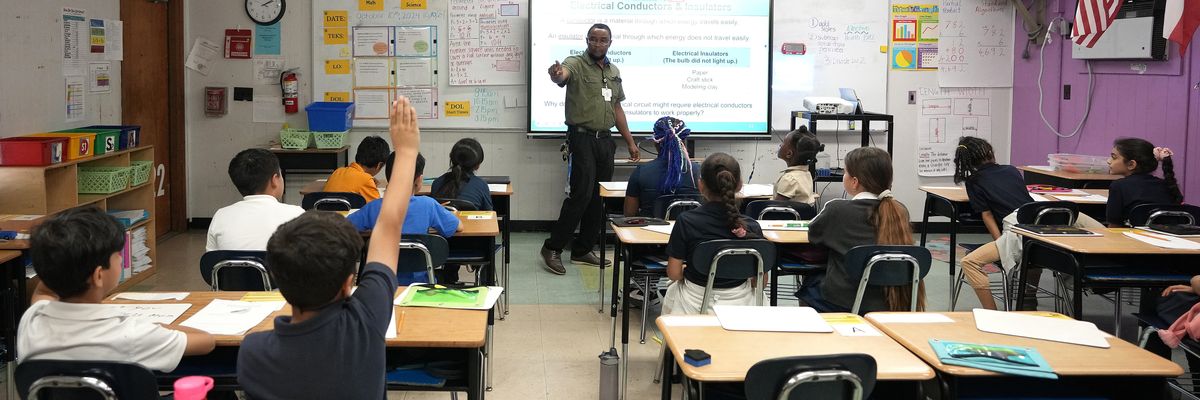
Fourth grade science teacher Paul Obakpolo teaches at Benavidez Elementary School on October 10, 2024, in Houston.
(Photo: Karen Warren/Houston Chronicle via Getty Images)
“Our nation’s public schools, colleges, and universities are preparing the next generation of America’s leaders—we must take steps to strengthen education in this country, not take a wrecking ball to the agency that exists to do so.”
In a letter to U.S. Education Secretary Linda McMahon on Monday, Sen. Bernie Sanders led more than three dozen of his Democratic colleagues in dismissing the Trump administration’s “false claims of financial savings” from slashing more than 1,000 jobs at the Education Department, emphasizing that the wealthy people leading federal policy “will not be harmed by these egregious attacks” on public schools.
“Wealthy families sending their children to elite, private schools will still be able to get a quality education even if every public school disappears in this country,” reads the letter spearheaded by Sanders (I-Vt.), the ranking member of the Senate Health, Education, Labor, and Pensions Committee. “But for working-class families, high-quality public education is an opportunity they rely on for their children to have a path to do well in life.”
The decision by President Donald Trump and his unelected billionaire ally, Elon Musk of the so-called Department of Government Efficiency( DOGE), to slash the Department of Education (DOE) workforce by 50%—or 1,300 people—and take steps to illegally close the agency has already had an impact on students, noted the senators, pointing to a glitch in the Free Application for Federal Financial Aid (FAFSA) that preventing families from accessing the applications “not even 24 hours after the staff reductions were announced.”
“The staff normally responsible for fixing those errors had reportedly been cut,” reads the letter, which was also signed by lawmakers including Sens. Elizabeth Warren (D-Mass.), Peter Welch (D-Vt.), and Ron Wyden (D-Ore.).
“Without the Department of Education, there is no guarantee that states would uphold students’ civil and educational rights.”
The letter was sent as The Associated Pressreported that cuts within the DOE’s Office of Civil Rights have placed new barriers in front of families with children who have disabilities. Families who can’t afford to take legal action against schools or districts that are not providing accommodations or services for students with disabilities have long been able to rely on on the office to open an investigation into their cases, but the AP reported that “more than 20,000 pending cases—including those related to kids with disabilities, historically the largest share of the office’s work—largely sat idle for weeks after Trump took office.”
“A freeze on processing the cases was lifted early this month, but advocates question whether the department can make progress on them with a smaller staff,” reported the outlet.
The reduction in force has been compounded by the fact that the remaining staff has been directed to prioritize antisemitism cases, as the Trump administration places significant attention on allegations that pro-Palestinian organizers, particularly on college campuses, have endangered Jewish students by speaking out in favor of Palestinian rights and against Israel’s U.S.-backed assault on Gaza and the West Bank.
An analysis of more than 550 campus protests found that 97% of the demonstrations last year remained non-violent, contrary to repeated claims by both Republican and Democratic lawmakers that they placed Jewish students in danger. Meanwhile, the Trump administration, pro-Israel advocates, and Republicans have dismissed outcry over Musk’s display of a Nazi salute at an inaugural event in January.
“Special needs kids [are] now suffering because of a manufactured hysteria aimed [at] silencing dissent against genocide,” said writer and political analyst Yousef Munayyer. “Utter depravity.”
In their letter, Sanders and his Democratic colleagues noted that “several regional offices responsible for investigating potential violations of students’ civil rights in local schools” have also been shuttered, expressing alarm that many cases will likely “go uninvestigated and that students will be left in unsafe learning environments as a result.”
They noted that at a time of “massive income and wealth inequality, when 60% of people live paycheck to paycheck,” the federal government’s defunding of public education “would result in either higher property taxes or decreased funding for public schools, including in rural areas.”
“It is a national disgrace that the Trump administration is attempting to illegally abolish the Department of Education and thus, undermine a high-quality education for our students,” wrote the lawmakers. “These reductions will have devastating impacts on our nation’s students and we are deeply concerned that without staff, the department will be unable to fulfill critical functions, such as ensuring students can access federal financial aid, upholding students’ civil rights, and guaranteeing that federal funding reaches communities promptly and is well-spent.”
Trump, they noted, has expressed a desire “to return education back to the states” despite the fact that state governments and local school boards already make education policy, with just 11% of public education funding coming from the DOE.
However, “the Department of Education has a necessary and irreplaceable responsibility to implement federal laws that ensure equal opportunity for all children in this country,” they wrote. “These laws guarantee fundamental protections, such as ensuring that children with disabilities receive a free appropriate public education in the least restrictive environment, that students from low-income backgrounds and students of color will not be disproportionately taught by less experienced and qualified teachers, and that parents will receive information about their child’s academic achievement.”
“Without the Department of Education, there is no guarantee that states would uphold students’ civil and educational rights,” said the lawmakers. “We will not stand by as you attempt to turn back the clock on education in this country through gutting the Department of Education. Our nation’s public schools, colleges, and universities are preparing the next generation of America’s leaders—we must take steps to strengthen education in this country, not take a wrecking ball to the agency that exists to do so.”
Our work is licensed under Creative Commons (CC BY-NC-ND 3.0). Feel free to republish and share widely.
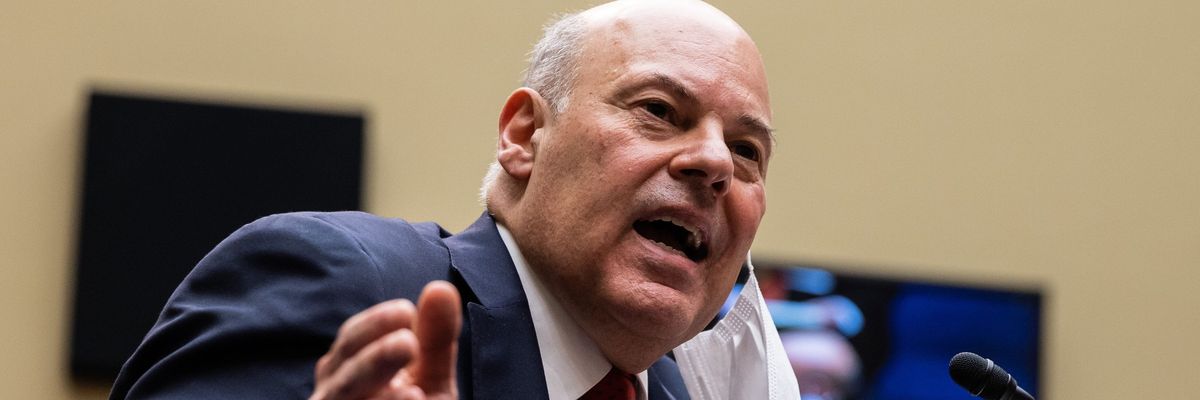
U.S. Postal Service Postmaster General Louis DeJoy speaks during a House Oversight and Reform Committee hearing in Washington, D.C., on February 24, 2021.
(Photo: Graeme Jennings/POOL/AFP)
“Any potential deal that would give Elon Musk and his DOGE associates unilateral authority to manipulate the most critical, expansive national mail network on the planet is deeply troubling,” wrote a group of House Democrats.
A group of House Democrats is demanding that the Committee on Oversight and Government Reform conduct a public hearing on the Trump administration and the so-called Department of Government Efficiency’s plans for the U.S. Postal Service, in light of recent reporting that U.S. Postmaster General Louis DeJoy says he signed an agreement with DOGE to assist the nation’s mail service “in identifying and achieving further efficiencies.”
The news follows Washington Post coverage from February, when the outlet reported that U.S. President Donald Trump is considering putting the Postal Service under the control of the Commerce Department. In December, the Post also reported that Trump was eyeing privatizing the Postal Service. Elon Musk, a GOP megadonor who is playing a core role in Trump’s efforts to slash federal spending and personnel, has also said the Postal Service should be privatized.
Postal workers unions are fiercely opposed to any effort to privatize the Postal Service.
“The Trump administration… is now subjecting the USPS, America’s most trusted federal institution, to the chainsaw approach of Elon Musk and DOGE. This broad assault on the independence of the USPS demands congressional oversight, especially from the committee with jurisdiction over the USPS,” according to the letter, which was signed by 20 House Democrats.
In a March 13 letter to congressional leaders, U.S. Postmaster General Louis DeJoy told Congress he signed an agreement with representatives from Elon Musk’s DOGE and the U.S. General Services Administration (GSA) so that DOGE could help the U.S. Postal Service, which has experienced billions in financial losses in recent years, work to address “big problems.”
The Postal Service plans to cut 10,000 employees in the next 30 days through a voluntary early retirement program, according to DeJoy’s letter.
DeJoy cited challenges facing the Postal Service, such as “mismanagement of our self-funded retirement assets,” “burdensome regulatory requirements restricting normal business practice,” and “unfunded mandates imposed on us by legislation.”
The letter demanding a public hearing, which was addressed to House Oversight Committee Chair Rep. James Comer (R-Ky.), was spearheaded by Oversight Committee Ranking Member Rep. Gerry Connolly (D-Va.), Rep. Raja Krishnamoorthi (D-Ill.), and Rep. Kweisi Mfume (D-Md.)
“This backroom agreement between the billionaire-led DOGE and Postmaster DeJoy sets off alarm bells about this administration’s plans for the Postal Service’s role as a cornerstone public institution,” according to the letter. “The Postal Service facilitates the delivery of more than 115 billion pieces of mail each year, a significant portion of which is delivered to rural, low-income, and hard-to-reach areas that would not otherwise receive service if not for the universal service obligation, which has received bipartisan support in Congress and is integral to the mission of Postal Service.”
“We agree that there are steps Congress could take to strengthen the financial sustainability of the Postal Service, but any potential deal that would give Elon Musk and his DOGE associates unilateral authority to manipulate the most critical, expansive national mail network on the planet is deeply troubling,” they continued.
The group is urging that the committee hold a hearing and wrote that they have prepared a letter to send to DeJoy asking that he furnish any signed agreements he made with the GSA and DOGE. The group is urging that Comer also sign on to that letter.
Our work is licensed under Creative Commons (CC BY-NC-ND 3.0). Feel free to republish and share widely.
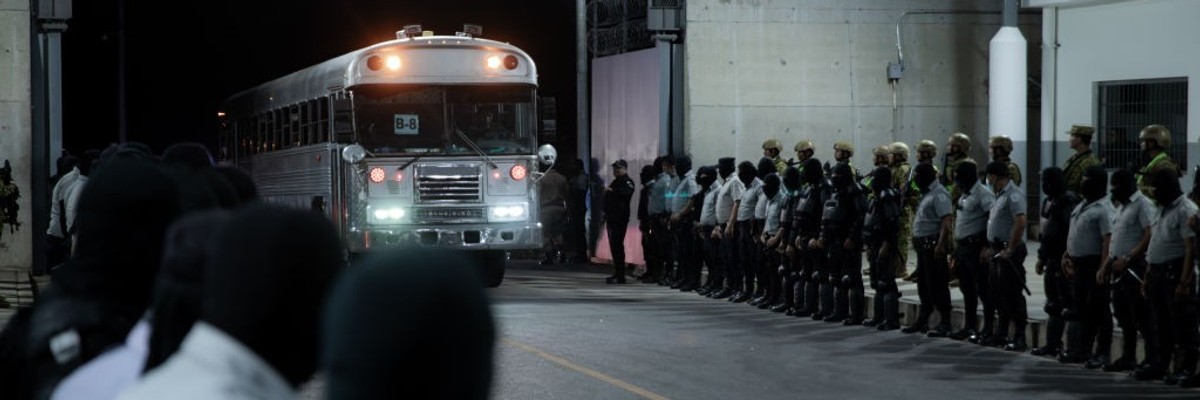
Hundreds of Venezuelans deported by the Trump administration in defiance of a court order arrive in El Salvador on March 16, 2025.
(Photo: El Salvador Presidency/Handout/Anadolu via Getty Images)
“Not a single president in the history of the United States has ever asserted the authority to unilaterally deport someone outside of the procedures set by Congress until now.”
Top Trump administration officials—including the president, vice president, attorney general, and secretary of state—openly celebrated the deportation of hundreds of Venezuelan immigrants over the weekend in defiance of a federal judge’s order to halt the removals, which were carried out under a 1798 law that plainly states it is only operative in the context of a declared war.
U.S. Vice President JD Vance wrote late Sunday that “there were violent criminals and rapists in our country” and “President [Donald] Trump deported them.” There was no due process for the more than 200 Venezuelans whom the Trump administration claims are gang members.
Vance’s social media post, which came in response to reporting about the White House’s acknowledgment that it ignored the court order blocking the deportations, was met with disgust and alarm.
“You are beyond vile,” political scientist Norman Ornstein wrote. “You have no idea if the ones that were picked up and sent illegally to an El Salvador prison are all violent criminals. You abused the plain language of the law, gave them no due process, and defied a legitimate court order. This is American Gestapo.”
On Truth Social, Trump claimed without a shred of evidence that former President Joe Biden “sent” the deported Venezuelans “into our country.” Trump went on to thank El Salvador’s far-right president, Nayib Bukele, for agreeing to imprison the immigrants. El Salvador’s prisons are notorious for abuses, including torture.
Bukele on Sunday mocked the U.S. federal judge’s temporary restraining order against the deportations, writing on X that the decision came “too late”—a claim that the White House echoed in defense of its actions, even though the timeline of events shows it was not, in fact, too late to halt the deportations.
“Oopsie,” Bukele wrote in a post that U.S. Secretary of State Marco Rubio shared.
The American Civil Liberties Union, Democracy Forward, and the ACLU of the District of Columbia demanded in a court filing late Sunday that the Trump administration “submit one or more sworn declarations from individuals with direct knowledge of the facts” on whether deportation flights took off after the federal judge issued his order on Saturday.
The episode underscored the Trump administration’s contempt for legal restraints on the president’s authority to deport people it claims are members of foreign gangs—power which Trump administration officials and supporters suggested is somewhere near absolute. The U.S. Department of Justice declared in a court filing that the Trump administration’s actions under the Alien Enemies Act of 1798 “are not subject to judicial review.”
“This is an absurd claim,” wrote Aaron Reichlin-Melnick, a senior fellow with the American Immigration Council. “Not a single president in the history of the United States has ever asserted the authority to unilaterally deport someone outside of the procedures set by Congress until now, and the Supreme Court has emphasized that Congress is supreme on immigration.”
Overshadowed by the administration’s deportation of Venezuelan immigrants over the weekend was the removal of a kidney transplant specialist and professor at Brown University’s medical school, also in defiance of a court order.
Dr. Rasha Alawieh, 34, is a Lebanese citizen who had traveled to her home country last month to visit relatives. She was detained on Thursday when she returned from that trip to the United States, according to a court complaint filed by her cousin Yara Chehab.
Judge Leo T. Sorokin of the Federal District Court in Massachusetts ordered the government on Friday evening to provide the court with 48 hours’ notice before deporting Dr. Alawieh. But she was put on a flight to Paris, presumably on her way to Lebanon.
In a second order filed Sunday morning, the judge said there was reason to believe U.S. Customs and Border Protection had willfully disobeyed his previous order to give the court notice before expelling the doctor.
The Council on American-Islamic Relations demanded Sunday that the U.S. “immediately readmit” Alawieh.
“As a U.S. resident for six years and a doctor working for the Division of Kidney Disease and Hypertension at Brown Medicine, Dr. Alawieh played a critical role in treating countless patients who needed treatment by a specialist,” the group said in a statement. “Deporting lawful immigrants like Dr. Alawieh without any basis undermines the rule of law and reinforces suspicion that our immigration system is turning into an anti-Muslim, white supremacist institution that seeks to expel and turn away as many Muslims and people of color as possible.”
Our work is licensed under Creative Commons (CC BY-NC-ND 3.0). Feel free to republish and share widely.
Congressional recess is an enormous opportunity for all of us to use the power we’ve been building to pressure Republicans in red areas to break from Musk and Trump, to cheer on Democrats who are leading, and to help others find their spines.
Why this week is a big opportunity. Below you’ll find a lot of content about what we’re doing over recess. But I want to take a step back and talk about the strategic logic here, because I think it’s important.
Trump has spent the months since November claiming that his narrow plurality win gives him a mandate to remake our country, take a chainsaw to the government services we rely on, and govern as a king. He’s wrong. We don’t have kings in America.
Many elected Republicans won’t admit it, but they know that he’s wrong too. That’s why they’ve stopped showing up in public and started hiding from their constituents. If your policies are popular, you’re not scared to go talk to your voters. If you have overwhelming popular support for your plans, you go out and tell people about them.
Republicans know that cuts to cancer research, special education, national parks, and more are deeply unpopular. They know the public is horrified by Elon Musk firing air traffic controllers while he picks up big fat contracts from the FAA for himself. They know that most Americans hate the GOP’s plans to gut Medicaid to pay for another round of giveaways to the rich.
What about Democrats? Well. Where Democrats are ready to fight back, they need to be visible! Out and about, talking to everyone, shouting their heads off about the damage Trump, Musk, and congressional Republicans are doing to our government, our communities, and our democracy. When Democrats do that, we in the grassroots should cheer them on. When they fail to do it, we stiffen their spines.
I’d be remiss if I didn’t notice that we’ve had a pretty big wrench thrown in the plan last week, when Senate Minority Leader Chuck Schumer abandoned House Democrats and rejected the advice of good government wonks, rule of law litigators, the federal government employee union, and the grassroots. He led the Senate Democrats to surrender and accept the GOP funding bill, giving up congressional Democrats’ biggest source of leverage this year. Trump, Musk, congressional Republicans, and the Wall Street Journal editorial board are thrilled.
How Indivisible is leading in this moment. Over the weekend, Indivisible officially called for Chuck Schumer to step down from Senate leadership. With Trump and Musk ramping up their assault on the constitution and rule of law, we cannot afford to quietly accept failed leadership — it is because the stakes are so high that we need to make this call right now.
This is not a step we took lightly, and it’s not a decision that I made or Leah made alone — 91% of the nearly 1,300 local Indivisible leaders on our emergency call on Saturday voted for this move. If you want to dig in more on the human and political cost of Schumer’s leadership failure, hit me or Leah up on Bluesky, or join our What’s The Plan discussion this Thursday.
But because it’s recess week, I want to spend less space in this newsletter on analysis and more on action. It’s time for the grassroots, and those who are willing to fight, to step forward and lead. That’s what we do this week.
How we move forward: locate your leverage; organize with conviction; lead with integrity. Indivisible groups in red districts this week are hosting empty chair town halls to demonstrate their Republican Member of Congress is not just backing Musk and Trump, but also hiding from constituents. Indivisible in blue districts are cheering on House Democrats who held the line and did their part — and holding those who did not accountable, starting with Minority Leader Schumer.
So with that, here’s what you can do during this special congressional recess week.
– Ezra Levin Co-Executive Director, Indivisible
Your weekly to-dos
Musk or Recess: Join a town hall or event. The congressional recess is officially underway and will run through March 23. This is an opportunity to hold Republicans accountable for the lawless chaos we’re enduring, and to demand Democrats fight back. Click the link above to find town halls and other events near you or read through our toolkit to plan your own event.
Call your Democratic senator(s) and tell them Schumer must step down. Last Friday, Democrats had a rare opportunity to exercise real leverage in the government funding fight and demand an end to the Trump-Musk coup. Instead, Chuck Schumer caved and allowed Republicans’ extreme funding bill to pass through without a fight. We need leaders who are willing to fight as hard as we are to save our democracy. If you have a Democratic senator, call them and tell them Schumer must step down as minority leader.
P.S. — With social media companies bending the knee to Trump, Project 2025 purging the government of dissenters, and corporate media companies caving in the face of speech-chilling lawsuits, it’s never been more important to invest in organizations you believe in that are willing to speak out and defy autocracy. Please consider chipping in with a monthly or one-time donation to help us keep up the fight.
The congressional recess is already underway, but there’s still time to demand your Members of Congress host a town hall. Whether you’re represented by Republicans or Democrats, your MoCs work for you and they should be spending this recess meeting with their constituents.
If you have Republican MoCs, demand they host a town hall and explain why they’re gutting Medicaid and Social Security and looting the government for billionaires.
Are you attending or hosting a Hands Off! event on April 5? Want to use the Empower app, proven relational organizing skills, and Indivisible’s messaging to make your event even more impactful?
Join us Thursday, March 20 at 8pm ET/5pm PT to learn about our latest call to action, then use Empower to invite your friends, and grow this movement nationwide. We’ll cover the mass mobilization, the call to action, and how to use Empower to reach your network as a trusted messenger. Register for the call here!
Red state and rural Indivisibles: Join our March 26 caucus call
One of the most common questions we get is, “I’m in a deep red district/I’m in a rural area with little party infrastructure — what can I do?” Our Rural and Red Caucus calls are a great place to find the answers!
Each month, grassroots leaders from rural areas and Republican-dominated districts/states come together to strategize about messaging and tactics that we employ to change hearts and minds in our communities and build grassroots political power.
Don’t let Musk buy a Wisconsin Supreme Court majority
On April 1, control of the Wisconsin Supreme Court is up for grabs. This is one of the most important elections of 2025 — and not just for Wisconsinites. If conservatives win a majority, they will entrench the state’s gerrymander and get the final say in voting rights cases in the crucial swing state. That’s why Elon Musk is pouring millions of dollars into the race.
We’re working with Wisconsin Indivisibles to get out every last vote for our endorsed candidate, Judge Susan Crawford. But if you’re outside Wisconsin, we need your help, too.
On Saturday, New York Indivisibles joined labor unions and other progressive orgs to host a 10,000 person-strong march. The protest featured a “die-in” outside the Stock Exchange coordinated by Indivisible Brooklyn.
Follow us on Bluesky, Mastodon, and Threads to keep up on the latest information, and text “INDIVISIBLE” to 59798 to opt-in to our text messaging program, where we send rapid response actions a few times a month.
Come rally with us on March 18th at 11:00 a.m. before the SFMTA board makes their final decision on Muni’s summer service cuts.
Muni is facing an budget deficit. Rally to oppose any and all of the proposed Muni summer cuts and cover the deficit with a general fund transfer, the city’s reserve, the SFMTA reserve funds, or a combination of all of the above.
If you are not able to attend the rally, please se an email or call to oppose Muni service cuts. The rally website has contact information and a sample script.
2. Tuesday, 3:00pm, BAY AREA: JOIN THE PEOPLE’S TRIBUNAL ON MARCH 18! Maersk General Meeting
1266 66th Street, Emeryville, CA
On Tuesday, Maersk is holding their Annual General Meeting and will vote on 2 resolutions to end the transportation of military cargo to Israel—and people of conscience across the globe are rising up to make sure Maersk makes the right call.
On this day, the Bay Area community will be holding a People’s Tribunal, or a forum to symbolically charge Maersk and other complicit parties with crimes against humanity. We know that Maersk can hear our calls—so we’re ramping up our efforts to put pressure on them to stop doing business with a genocidal pariah state.
They have a choice: continue enabling war crimes, or finally take a stand against genocide. Maersk, the world is watching!
The Women in Conflict Zones webinar, sponsored by World BEYOND War, Southern Anti-Racism Network, International Peace Bureau, Convention for Pan-Africanism and Progress (CPP), and CODEPINK, aims to shed light on the profound impacts of war on women and children and to discuss measures being taken to mitigate these effects.
The webinar will feature speakers from a diverse array of countries, including Belarus, Cameroon, the Democratic Republic of the Congo, Gaza, Lebanon, Mozambique, Nigeria, South Korea, Sudan, and Syria. Each speaker will have five minutes to share their experiences and insights regarding the unique challenges faced by women and children in their respective regions due to ongoing conflict. This platform not only serves as a means to share stories but also as a call to action for global solidarity and support in ending violence and fostering peace.
Women from various conflict zones will provide firsthand accounts of the struggles and resilience of those living amidst war. Their testimonies will highlight the physical, emotional, and social tolls that armed conflicts impose on women and children, who are often among the most vulnerable populations during such crises. The speakers will also discuss initiatives and efforts being undertaken within their communities to promote safety, healing, and long-term peace.
Host: World Beyond War
Info:
4. Wednesday, 10:00am – 12Noon, Bayview Hunters Point Environmental Justice Task Force Meeting
Meeting ID: 284 006 4706 +1 408 638 0968 US (San Jose)
Meeting ID: 284 006 4706
Find your local number: https://us02web.zoom.us/u/kiDc2DVJD
How to join the Zoom meeting online:
1. Go to www.zoom.com 2. Click “Join a Meeting” 3. Enter Meeting ID:
284 006 4706
How to join the Zoom meeting on the phone: 1. Call +1 408 638 0968 2. Enter Meeting ID: 284 006 4706
Thursday, March 20
5. Thursday, 11:00am, San Francisco: US Mail Not For Sale! Protest Against Illegal & Hostile Takeover of USPS
Fox Plaza Post Office 1390 Market St San Francisco, CA 94102
March 20 National Day of Action
The Postal Service is facing one of the most serious threats in our history.
Reports indicate that the new presidential administration is preparing an illegal and hostile takeover of the USPS, threatening the stability of our jobs, our workplaces, and the public service we proudly provide. The American people deserve a Postal Service that remains true to its public mission and continues to serve communities across the country, no matter where you live.
Now postal workers and the communities we serve are standing together to ensure our postal service stays in the hands of the people, not the billionaires.
Let’s make it clear to the country that the U.S Mail is Not For Sale!
During our March 20 National Day of Action, the following activities are permitted in front of Post Offices so long as we remain on public property (sidewalks are considered public property) and we not blocking entrances or interfering with employees or customers:
Leafleting Informational Picketing Talking to the press Holding Signs Chanting Speaking with customers
For more information: https://apwu.org/day-of-action Check site to see if a post office near you will be having an action
As continued U.S. investment in genocide, war, and occupation drain public resources, our cities and communities must take a stand for justice and human rights. Join us for an in-depth training on developing an effective divestment campaign—one that builds power locally and pressures city councils to take action.
With Tax Day approaching on April 15, this is a crucial time to demand that our tax dollars stop funding genocide and militarism abroad. And if Congress won’t stop arming Israel, then we’ll raise hell from the bottom up. We call on local communities across the country to ramp up their city divestment actions around April 15 to shake up the status quo and build toward long-term wins.
This webinar will equip you with the tools to launch or advance a divestment campaign, highlighting real-world examples from organizers (including USCPR youth fellows), best practices, and concrete steps for organizing city council-level action. Whether you’re just starting out or looking to scale up an existing campaign, this session will provide strategic insights and tangible organizing tools you can use to organize in your city.
8. Today is the 11th Angelversary of Alex Nieto, killed by SFPD.
Bernal Hill SF
All are welcomed to join Alex’s parents Refugio and Elvira Nieto on the 21st of each month as they remember Alex. It will be 11 years since Alex was killed.
Please hold the family and friends of Alex in your thoughts.
On March 21, 2014, Alex was murdered by SFPD officers Jason Sawyer, Richard Schiff, Nathan Chew, and Roger Morse, with 59 bullets.
DA Gacon (at the time) declined to file criminal charges against the officers. DA Jenkins let the attorney go who was working pm the case under Chesa Boudin.
There is still no justice for SFPD’s execution of Alex nor of any other victims of SFPD’s execution
9. Friday, 6:00pm – 8:00pm, Workers in Mexico Rising
2973 16th Street Ste. 300, San Francisco, CA
There is a growing wave of union organizing in factories in Mexico. Workers are organizing unions of their own choosing, independent of corporate influence. They are throwing out phony unions and their contracts that only protect factory owners and do not benefit workers. They are demanding wage raises, an end to sexual harassment and respect for their workplace rights.
Presentations by
Julia Quiñonez, director, Comité Fronterizo de Obreras (Border Workers Committee)
Mira Rubio, coordinator, California Trade Justice Coalition
Poetry by Rafael Jesús González
Music by Elizabeth Esteva
This is a benefit to help worker centers and independent unions in Mexico
and the campaign for stronger worker protections in trade agreements.
Immigrants are a primary target of the Trump administration and right-wing movements worldwide. Join a discussion of the reasons behind the scapegoating and what can be done to defend these intrepid workers here in the Bay Area.
Speaker: Norma Gallegos Queer Xicanx reproductive justice and anti-fascist activist
This was just posted. Sorry for an additional email.
SAN FRANCISCO: EMERGENCY PROTEST! STOP THE GENOCIDE!!
Zionist Consulate | 456 Montgomery St
Tues, March 18
6 PM
Dates & water provided
HANDS OFF GAZA! HANDS OFF PALESTINE! HANDS OFF YEMEN! HANDS OFF LEBANON!
The entity has resumed its genocide and all out war on the steadfast Palestinian people in Gaza with full backing of the US Government. The firebelts, targeting of hospitals, and bombings of homes across Gaza come with the zionists’ rejection of the ceasefire and refusal to abide by it, as it was supposed to enter its second phase in the beginning of March. Already, over 100 Palestinians have been murdered by an onslaught of US and Israeli weapons.
The White House is directly responsible for this escalation against Gaza and its noble people. In the heart of empire, we must rise to refuse to accept genocide as normal or business-as-usual, to take to the streets, and to stop the wheels of this mass killing machine in its tracks. War criminals must hear our voices and respond to our demands. Together, we will achieve a total arms embargo against Israel the true path to a permanent ceasefire. We can, we must, and we will confront this moment and what it requires of us. We will never abandon Palestine, for doing so would be to abandon ourselves.
This Sunday’s Town Hall: Announcing This Week’s Progressive Town Hall: Every Sunday at 4pm ET/1pm PT RSVP HERE Join PDA activists online from across the country to discuss the importance of progressives reclaiming the American story from the MAGA right, an issue of heightened importance as we’re now within one... Continue reading →
Community Coffee – Outer Sunset Sunday, April 19 | 1–3 PM Location: Java Beach Cafe, 1396 La Playa St Sign-up The San Francisco Democratic Party has been hosting community coffee events to connect with residents of our many different neighborhoods in SF every month. No speeches, just conversations and hearing... Continue reading →
We protest Heritage Foundation EVERY MONDAY (Join us!!!!) By admin | September 2, 2025 | Uncategorized Cliff Cash Comedy Premiered Jul 26, 2025 Every Monday at The Heritage Foundation 214 Massachusetts Ave. Washington D.C. 4pm protest 6pm pizza Every Friday at Fox News D.C. 400 N. Capitol St. Washington D.C. 4pm protest 6pm pizza We are... Continue reading →
Milk Club April General Membership Meeting Date: Tuesday, April 21 Time: 7-9 PM Location: SF LGBT Center, 1800 Market Street, San Francisco Zoom Link: Click here
One Million Rising: Strategic Non-Cooperation to Fight Authoritarianism Virtual Event · Hosted by No Kings Time Wednesdays 8 – 9:30pm EDT Location Virtual event Join from anywhere About this event Across the country, authoritarian forces are getting bolder and more dangerous. Trump and his allies are not hiding their agenda: mass deportations,... Continue reading →
Meeting Agenda April 22, 2026 The San Francisco Democratic County Central Committee will meet on Wednesday, April 22, 2026 at 6:30 pm at Milton Marks Auditorium, 455 Golden Gate Ave, San Francisco, CA 94102. A security screening will be required to enter the building. Members of the public can live... Continue reading →
SF Green Party Showing events after 3/27. Look for earlier events Wednesday, April 20 7:30pm SF Green Party Council Meeting WhenWed, April 20, 7:30pm – 9:00pm WhereEl CafeTazo, 3087 16th St, San Francisco, CA 94103 (map) Description: This elected group is the equivalent to other political parties Central Committee. The San Franciso... Continue reading →
THURSDAY, JUNE 29, 2023 AT 2 AM – 4 AM PDT How to create trust in a group? Details Event by Extinction Rebellion Empathy Circles online EMPATHY CAFE Duration: 2 hr Public · Anyone on or off Facebook How to create trust in a group? This is the question that arose in our... Continue reading →
When you volunteer for Saikat, it’s on us to give you a great experience and a genuine chance to make a difference. We don’t want to waste a second of your time. That’s why we’re always optimizing. And I’m excited to report that this Saturday we talked with 300% more... Continue reading →