Democracy Now! Sep 4, 2026 Latest Shows Support our work: https://democracynow.org/donate/sm-de… A federal judge has ruled that the Trump administration violated the constitutional rights of international students in seeking to deport them for their pro-Palestinian activism and criticism of Israel. The ruling is the result of a lawsuit filed by The Stanford Daily, the student newspaper at Stanford University, which claimed that some of its writers on student visas declined to report on topics related to Israel and Palestine, or requested their published articles be removed from the paper’s website, for fear of deportation. “What we were hearing from the noncitizens in our newsroom and from noncitizens across campus — current students, former students, alumni — was that they were genuinely frightened because of what they saw in the headlines, what they saw happen to Rümeysa Öztürk,” says George Porteous, editor-in-chief of The Stanford Daily. Rümeysa Öztürk is the former Tufts University graduate student arrested and detained by ICE after co-authoring an op-ed encouraging Tufts to divest from Israel in her university’s student newspaper. “The chill is the point,” adds Will Creeley, legal director at the Foundation for Individual Rights and Expression, or FIRE, the organization that represented The Stanford Daily in court. “That’s a First Amendment violation every day of the week. It’s flatly un-American.” Subscribe to our Daily Email Digest: https://democracynow.org/subscribe
After years of efforts to unionize, more than 200 local and remote US workers from the San Francisco-based Wikimedia Foundation voted to join the Communication Workers of America labor union Thursday.
Thursday’s vote follows months of organizing at Wikimedia Foundation, where employees have discussed unionizing for about a decade. As Wired reports, the effort gained momentum after the foundation, which is headquartered in San Francisco, expanded by hundreds of employees during the pandemic, with workers saying the growth brought more bureaucracy and left some staff feeling powerless in workplace decisions.
More than 200 employees across departments including software engineering, finance, and communications reportedly voted in the election. Workers say frustration with how management handled hiring, firing, and other organizational changes were the main issues driving the union effort, as opposed to pay and benefits.
One major turning point in the group’s efforts was the foundation’s decision in May to disband its six-person Community Tech team, which developed tools requested by Wikipedia’s volunteer editors and served as a link between the foundation and its contributor community. The foundation said the work would instead be distributed among multiple teams because the centralized system had created bottlenecks and delays.
According to The Verge, the decision drew immediate backlash from longtime Wikipedia contributors, who called for the team to be reinstated. Some also questioned whether the restructuring was connected to the employee’s push for unionization. Nadee Gunasena, chief of staff at the Wikimedia Foundation, denied that any staff had been terminated for union activity and said the foundation would try to place the six employees in other roles.
Lauren de Lench, a lead technical program manager, told Wired she supported unionization after seeing colleagues hesitate to raise concerns or propose unconventional ideas because they feared retaliation.
“I want us to be loud and debate freely up and down the organizational chart because that’s how we move quickly, address challenges, and come up with the best collective solutions,” de Lench said.
As Wired reports, the organizing effort also stems from the growing pressure Wikimedia faces from AI companies that scrape Wikipedia for training data, while human traffic to the site has been declining as more people turn to chatbots to answer questions. Workers say the organization needs to rethink how it responds to those challenges, and they believe staff and volunteers should have a greater role in shaping that strategy.
After 70% of eligible US staff signed union cards, the workers reportedly partnered with Communication Workers of America Local 9415. The foundation declined to voluntarily recognize the union, saying a formal election was more democratic, but workers said management remained neutral during the vote.
The workers will now negotiate a collective bargaining agreement with the foundation, with expected issues including protections against termination without just cause, per Wired. The foundation has hired Littler Mendelson, a law firm known for representing employers in labor disputes, for the negotiations. Wikimedia workers in the UK are also organizing and hope to eventually coordinate with the US group.
New details from a whistleblower provide new cause for alarm. Will the courts intervene in time?
Until the release of a whistleblower dossier on Monday, one could be relatively hopeful that a string of court decisions would prevent the U.S. Postal Service from carrying out Trump’s orders to slow-walk mail-in voting. As I wrote in this piece last Friday, U.S. District Court Judge Indira Talwani has enjoined the Postal Service from implementing its plans, pending a full hearing scheduled for tomorrow. Now, however, a whistleblower lays out new alarming details. In a letter to Sen. Richard Blumenthal (D-CT), the whistleblower, described as a government official, explains how the Postal Service is rushing to build an online portal that will be used to screen ballots submitted by state election officials prior to USPS agreeing to mail them to voters. According to the whistleblower complaint, building the information technology infrastructure necessary to complete the portal would normally take a year or more. Yet, USPS leadership ordered that the portal be completed for a launch date of September 1, 2026. That was yesterday.
As a result of this rushed process, USPS has been unable to conduct tests of the portal to ensure its proper functioning, troubleshoot problems, or distribute instructions on use to state election officials. According to the whistleblower, the portal “violates standard principles of testing and debugging new software before launch.” Normal procedures at USPS for such systems include internal testing, customer acceptance testing, and a final development stage before release to end users. The portal has gone through none of these basic checks.
As Blumenthal points out, under the portal, “When ballots are submitted to USPS in large-volume batches, if any one ballot in the batch cannot be verified against the portal, all ballots in that batch will be rejected. For example, if a state election official brings a batch of 10,000 ballots to USPS and USPS is unable to match just one of those ballots against the portal—because, for example, someone has recently changed their name after marriage or they’ve moved—then USPS would refuse to mail the remaining 9,999 ballots as well.”
What’s clear is that if the system goes forward, it gives the Trump administration three possible ways to undermine the 2026 election. Either state officials are forced to comply with a buggy system that will lose millions of mail-in ballots. Or officials in some states will refuse to comply and the Postal Service will refuse to deliver their ballots. Or the sheer confusion and publicity will deter large numbers of citizens from voting. And complaints will be tied up in court until long after the election. In 2024, roughly 48 million people voted by mail. They were disproportionately Democrats.
I have been skeptical of concerns that Trump will try to pull off some kind of Election Day coup by sending in ICE or the military to block voting. But the USPS slow-rolling coup, unless blocked by the courts, could do almost as much damage. It’s already the case that the Postal Service failed to deliver about 10,000 mail-in ballots in the Michigan Democratic primary in time for them to be counted, due to underfunding and incompetence.
According to the whistleblower, the USPS has continued work on the portal despite several court orders directing it to suspend its plans. In a letter to Postmaster General David Steiner on Monday, Blumenthal wrote, “Please state whether USPS has halted work to implement the Executive Order, in compliance with the August 27, 2026 temporary restraining order.” So far, he has received no reply.
But in a statement released Tuesday, the Postal Service seemed to be thumbing its nose at both Blumenthal and the courts: “The Postal Service is now finalizing the portal and will soon make it available to election officials who voluntarily wish to familiarize themselves with the platform,” the statement said. “USPS will also provide tools, presentations, and other resources to help election officials understand the platform and make informed decisions about whether and how they wish to use it.” The Postal Service has only one duty: to deliver the mail. It has no legitimate role in elections.
The lower courts have been doing their jobs in blocking Trump’s postal scheme, but the Supreme Court’s coy pattern has been to allow illegal conduct to proceed, pending some final judgement that is often effectively moot by the time it is rendered. The most recent instance of this gambit is the Court’s 5-4 ruling to allow construction of Trump’s grotesque ballroom to proceed.
Enabling the desecration of the White House is bad enough. It would be far more serious if the high court enabled the postal desecration of our democracy.
The first postmaster general, you may recall, was Benjamin Franklin. When Franklin, emerging from the Constitutional Convention in 1797, famously told a bystander that the Founders had created “a democracy, if you can keep it,” he had no way of knowing that his beloved Post Office might be the instrument of democracy’s destruction.
Members of National Nurses United rally with lawmakers to show their support for the Medicare for All Act on April 29, 2025 in Washington, DC.
(Photo by Chip Somodevilla/Getty Images)
As Trump-GOP healthcare cuts devastate millions, Yale experts have found that Medicare for All would save the US over $1 trillion and more than 114,000 lives per year.
US President Donald Trump railed against Medicare for All during an Oval Office event on Tuesday, falsely claiming the proposal would be prohibitively expensive and ineffective despite new research confirming it would save lives and cost significantly less than the corporate-dominated status quo.
The president’s remarks came during an event touting his limited, voluntary, and secretive agreements with leading pharmaceutical companies, deals purportedly aimed at lowering drug prices. Trump again lied by claiming that his efforts are “much bigger” than Medicare for All, which would provide comprehensive health coverage to every person in the US for free at the point of service, eliminating premiums, copays, and deductibles.
Trump said that Medicare for All, which has not been tried at a national level in the US, “doesn’t work,” falsely claiming a single-payer system would cost “the entire budget of the whole country” and send taxes into the stratosphere.
Total federal outlays were $7.04 trillion in 2025. According to a study published last month by Yale University researchers, a single-payer system like the one set out in Sen. Bernie Sanders’ (I-Vt.) Medicare for All Act would save the US roughly $1 trillion per year in national healthcare expenditures, which totaled around $5.7 trillion last year. The finding was consistent with past research showing major savings under Medicare for All compared with the current privatized system.
“A universal healthcare system in the US would not require the country to spend more on healthcare,” the Yale researchers wrote. “It would require it to spend less. Our results indicate that the existing budget is more than sufficient to cover everyone at lower total cost.”
The study also found that Medicare for All would save more than 114,000 lives across the US each year by providing the tens of millions of uninsured and underinsured Americans with comprehensive coverage.
The researchers contrasted the life-saving impacts of a Medicare for All system with the deadly consequences of the unprecedented Medicaid cuts that Trump signed into law last summer. Experts at Yale and the University of Pennsylvania estimated that the sweeping Republican assault on Medicaid could cause more than 51,000 deaths annually as millions are kicked off the program.
“Numerous highly respected analyses show that improving Medicare and expanding it to everyone, with no premiums, copays, deductibles or coinsurance costs trillions of dollars less than what the nation now spends, while covering the entire population and saving lives,” Altman of Social Security Works told Common Dreams. “The question isn’t how will we pay for universal coverage, but how will we divvy up the savings.”
The House version of the Medicare for All Act, led by Reps. Pramila Jayapal (D-Wash.) and Debbie Dingell (D-Mich.), is cosponsored by a majority of the chamber’s Democratic caucus—though it’s opposed by the House Democratic leader, Rep. Hakeem Jeffries of New York. The Senate version of the bill, led by Sanders, has 17 cosponsors.
“We already introduced the legislation. Now we need the political will to pass it,” Jayapal said on Tuesday. “Healthcare is a human right. No one should go broke, or die, because they got sick.”
Our work is licensed under Creative Commons (CC BY-NC-ND 3.0). Feel free to republish and share widely.
Four victims of the Trump administration’s boat bombings, Eduard Hidalgo, Dushak Milovcic, Ricky Joseph, and Chad Joseph, are seen in a composite image.
(Photo courtesy of CLIP)
“This is a make-believe armed conflict, but these are very real killings,” said one legal expert.
Wednesday marked one year since President Donald Trump began bombing boats allegedly smuggling drugs in the Caribbean Sea and Pacific Ocean—a grim anniversary that sparked a fresh wave of condemnation from rights advocates across the United States and beyond.
“For a year now, the Trump administration has engaged in a terrifying, lawless killing campaign at sea and has yet to provide the public with anything beyond the most threadbare justifications,” said Jeff Stein, staff attorney with ACLU’s National Security Project, in a statement late Tuesday.
The ACLU and the Center for Constitutional Rights are suing over the administration’s refusal to comply with a Freedom of Information Act request for a legal opinion authored by the US Department of Justice’s Office of Legal Counsel (OLC) attempting to justify the strikes.
“These strikes have devastated countless families, terrified communities, and, by the administration’s own admission, failed to achieve their purported goal of stopping drugs from entering into the United States,” Stein said. “We urge leaders in both Congress and the executive branch to put an immediate end to these strikes before anyone else is killed.”
Despite mounting outrage over the bombings, which have killed at least 227 people and, as Amnesty International USA’s national director for government relations, Amanda Klasing, highlighted Monday, “are illegal under both international and US law,” the Republican-controlled Congress has failed to pass any war powers resolutions intended to stop the campaign.
“The Trump administration has summarily killed more than 200 people over the course of the past year, bragging about these killings online and facing no accountability,” Ida Sawyer, crisis, conflict, and arms director at Human Rights Watch, said Wednesday. “The victims and their loved ones deserve a full accounting of these operations, and justice for the grave harm they have suffered.”
After a two-month pause in the bombings, the administration revived them last week, launching a pair of attacks that killed at least six people, according to social media posts and aerial footage from US Southern Command. The strikes followed SOUTHCOM’s early August announcement of an expanded operation across Latin America called Joint Task Force Western Hemisphere.
In September and October 2025, when the strikes began, US Southern Command, known as SOUTHCOM, linked three of the strikes to the Tren de Aragua and Ejército de Liberación Nacional criminal organizations. Most later strikes were described as targeting “a vessel operated by designated terrorist organizations.”
But the military’s most recent two announcements of strikes simply stated that “confirmed intelligence revealed the vessel’s active involvement in narco-trafficking.”
Brian Finucane, a former State Department legal adviser who now advises the US Program at the International Crisis Group, told the outlet that “they are engaging in conduct that is widely regarded to be flagrantly illegal, criminal even, and have not offered anything approaching plausible legal rationale.”
The OLC memo may be the administration’s “permission slip,” Finucane said, but it hasn’t actually substantiated claims that the United States is engaged in an armed conflict with cartels that traffic drugs.
“This war framing on the part of the administration is really bogus,” he added. “This is a make-believe armed conflict, but these are very real killings.”
Several Democrats in Congress, from House Minority Leader Hakeem Jeffries (NY) to Senate Minority Whip and Judiciary Committee Ranking Member Dick Durbin (Ill.), renewed their criticism of the boat bombings on Wednesday.
Sen. Ruben Gallego (D-Ariz.) said that “the most recent strike was four days ago. A year of killing, and this administration has never once come to Congress to justify any of it. This cannot become the way our country goes to war.”
“The American people are already paying for one war they didn’t want in the first place,” he continued, nodding to the illegal six-month assault on Iran. “I fought in Iraq. I know what these wars cost, and I know who pays them. I will use every tool I have as a United States senator to stop this and to defend the Constitution.”
House Armed Services Committee Ranking Member Adam Smith (D-Wash.) noted that “it remains unclear whether these operations have made any real difference in stopping illegal drugs from reaching the United States.”
“This is especially true for fentanyl,” he noted, which Trump and Defense Secretary Pete Hegseth “have repeatedly claimed is the reason for these extrajudicial killings even though we know that it is cocaine—not fentanyl—that is typically shipped via small boats from South America.”
Smith also called out the Department of Defense for failing “to publicly provide the costs of these operations, both in terms of dollars and readiness,” and declared that “never before in my over 20 years on this committee have I seen such a staggering lack of transparency on behalf of an administration and DOD to meaningfully inform Congress of the use of lethal military force.”
However, with Republicans holding narrow majorities in Congress and mostly still refusing to truly challenge the administration on the boat strikes—and various other violent actions around the world—some campaigners are also stepping up pressure on other governments.
“The Trump administration has had complete impunity for this campaign of unlawful killings for a year, and has stated openly that it has no intention of stopping,” said Sawyer. “Other countries should refrain from any cooperation on these strikes, and Congress should urgently work to rein in the deadly actions of an administration bent on violating international law.”
Jamil Dakwar, director of ACLU’s Human Rights Program, said that “the international community must do everything in its power to hold the Trump administration responsible for these extrajudicial killings that are blatant violations of international law.”
“No other country should provide any assistance that could contribute to these unlawful US government killings,” Dakwar added, calling for an “independent international investigation into this lawless campaign.”
Our work is licensed under Creative Commons (CC BY-NC-ND 3.0). Feel free to republish and share widely.
Status Coup News Sep 2, 2026 Status Coup News tagged products below. Status Coup reporter JT Cestkowski breaks down the latest tragedy caused by ICE agents: this time, Pierre Damas Bel, a Haitian student who was forced to wear an ankle monitor like a criminal, took his own life in traffic in response to ICE treatment. JT tells you what you need to know and the incredible hypocrisy of this case compared to an actual murderer in the form of an ICE agent. Status Coup is the leading INDEPENDENT ON-THE-GROUND reporting outlet in America that covers what the corporate media COVERS UP. We are FUNDED BY THE PEOPLE FOR THE PEOPLE—and need your support to help us stay ON-THE-GROUND. Join us as a paying member for as low as $5 bucks a month: https://www.statuscoup.com/join
Americans need to prepare for these midterms as though someone is trying to deny them their right to vote. Here’s how.
With exactly two months to go until the election, a lot of news outlets will try to tell their audiences who to vote for. Not us. If you don’t know who to support at this point, then we honestly can’t help you.
What we can assist you with, however, is something that, depending on where you live, will be much more important than advice on whether to cast your ballot for a member of a weird cult headed by a mentally ill felon or for people trying to exert some kind of oversight over this person and his goon squad: Specifically, we can tell you what to do to ensure that your vote counts.
In a stable democracy, that would not be necessary.
However, the United States in the year of 2026 is not that.
For one thing, Donald Trump’s rhetoric has undermined confidence in US democracy. A mere 60 percent of Americans believe that votes cast in the midterms will be counted accurately.
More importantly (and troublingly), the administration’s actions justify these concerns.
For all of the president’s talk of any election he loses being “stolen,” he and his party are the ones who are continuously trying to manipulate the process to their advantage (as we have pointed out, there’s an important distinction to be made between administratively “rigging” an election, which is unfortunately legal in most cases, and “stealing” it through criminal actions).
Now, to be fair, both Democrats and Republicans are trying to write the rules in a way that benefits them. The difference is that Democrats try to gain an advantage by making it as easy as possible for eligible Americans to vote while the GOP has a long history of trying to suppress the votes of people they believe will not support them.
And that brings us to the point of this column.
If you are a member of one of the Democrats’ core constituencies — e.g., if you are part of a racial or ethnic minority group, a student, a holder of a college degree, or a woman — then there is a Republican out there somewhere who would love to disenfranchise you, make you jump through some extra hoops to cast your ballot, or ensure that your vote is as meaningless as possible.
We, on the other hand, want you to be aware of these strategies and to arm you with the knowledge you need to make as sure as possible that you get to vote if you want to (and you should really want to) and that your vote is counted.
Unfortunately, before the first ballots are cast in a couple weeks’ time, some outcomes have already been predetermined.
For example, by giving each state two senators, the Constitution ensures that Republicans are currently being overrepresented in the Senate. This isn’t part of the rigging of the process; it’s just the way the historical cookie crumbles, as they say.
And what it means is that, while Democratic senators represent many millions more Americans than Republicans, they find themselves in the minority because those GOP senators dominate in the elections of the more sparsely populated states.
Specifically, while eight of the 13* most populous states have two Democratic senators, only four have two Republican senators, and Pennsylvania has one of each. However, it is quite possible that, after the midterms, three more of these states (Texas, Ohio, and North Carolina) will have split representation, and Florida would then be the only state left on that list with two GOP senators — and Republicans could (theoretically) still maintain their Senate majority because they have two senators in eight of the 13 least populated states.
Over in the House, the election manipulation is in full effect because of actions taken by red state Republicans (with an assist from the Supreme Court’s right-wing majority, which gutted what was left of the Voting Rights Act). Officials in red states eagerly answered Trump’s call to engage in an unprecedented mid-decade redistricting spree that could net them about 10 seats while disenfranchising millions of Black voters.
While Black voters were the proximal targets for disenfranchisement in the Southern states we’re talking about here, of course the desired political outcome of all that hasty redistricting is the disenfranchisement of all Democrats, virtually eliminating any Democratic representation of states with millions of Democratic voters — the real prize being a far better prospect for GOP control of the House.
As a result of this redistricting campaign, Democrats are only favored to secure a House majority if they win the popular vote by at least 3 points, and there are some scenarios in which the GOP could maintain its control of the chamber even if Democrats win the popular vote by 6 points. Right now, looking at the nonpartisan Cook Political Report ratings, the GOP can maintain control of the House by winning fewer than half of the contests rated as tossups.
That’s what we mean by “rigging,” by the way. Thanks to the Supreme Court, all of this is technically legal (although we believe it constitutes a crime against democracy).
Now — and this is extremely important and we cannot stress it enough — none of the above should deter you from voting.
First of all, casting a ballot is not only your most important right as a citizen but, we believe, also your obligation.
But there are also many practical reasons to show up. If you live in one of those gerrymandered states, for example, you can teach those who drew the new maps a valuable lesson. In some cases, they may have overdone it and could actually lose seats; and in others, you can at least help make it a close election, forcing the lawmakers there (and elsewhere) to reconsider what they’ve wrought.
In addition, there are always down-ballot races for state offices, local representatives, school boards, etc., that often have a more immediate impact on your life than who represents you in Congress. Plus, you often get to vote on ballot initiatives that give citizens a direct say on issues ranging from reproductive rights and Medicaid expansions to minimum wage increases.
These measures have especially been a thorn in the side of Republicans running those smaller Midwestern states because, as it turns out, voters want all of the above.
Therefore, we urge you to inform yourself and others about the candidates and issues that will be on the ballot where you live. To do so, you can go here or here to view a sample ballot for your district.
Of course, all of this is contingent on whether you will actually be allowed to vote, which is not a given for anybody.
The administration is trying to restrict mail-in voting and also hopes to get its hands on voter rolls to check the eligibility of the names on the list using a database that usually results in the purging of American citizens.
What will come of these anti-democratic efforts is largely in the hands of a Supreme Court that has frequently ruled in favor of Trump and not the Constitution — the authors of which intentionally did not give the executive branch a role in administering elections.
You can find a list of the laws passed in 2025 here and those passed this year here.
So, what does all of this mean for you?
Well, first and foremost, while you may be able to show up at your polling place on November 3 and cast your vote without any problem, you should not assume that you will be able to do so.
That is why, with two months to go before Election Day, you need to start preparing now.
First of all, you should make sure that you are registered to vote in the state where you reside.
In light of all the voter roll purges, that’s not a given.
You can check your voter registration status by going here or here.
On one or both of those sites, you can also find information on registering to vote if you haven’t, locating your polling place, learning which form of ID you may need, getting details on early voting opportunities, tracking a mail-in ballot, and much more.
Speaking of voting by mail, while this is such a convenient way to vote that President Trump routinely avails himself of it, he does not want you to be able to use this method to cast your ballot.
Therefore, if you can use a drop box or vote in person, try to do it (we will share the pros and cons of the different ways to cast your ballot in a future column and keep permanent links to both on our website through the midterms).
We also advise you not to wait until the last minute to do either. If you can vote early, then do so to ensure that you won’t be disenfranchised by some 11th-hour stunt.
You can find out here or here when and how you can vote in your state ahead of Election Day. The vast majority of states provide this option, with some of them allowing you to cast your ballot as early as two weeks from now.
And once you have checked that you are (still) registered and made a plan for when and how you will vote, share this information with everyone you know and urge them to act as though someone is trying to take this most fundamental right away from them.
Because that’s exactly what is happening, and these midterms may be the last best chance to make your voice heard.
*Yes, we realize that 13 is an arbitrary number but we’re trying to make a point here. The same thing would still be true if we had chosen the top 20 states.
Klaus MarreKlaus Marre, a former congressional reporter, is a senior editor for US politics at WhoWhatWhy. He writes regularly here, and you can also follow him on Bluesky and Substack.
Posted on September 3, 2026 by Ellen Brown (ellenbrown.com)
Lincoln Breaks the Interest Trap – image by ScheerPost
In August 2026, the U.S. debt reached a gravity-defying $40 trillion, with an estimated fiscal year 2026 deficit of $2.1 trillion. Interest on the debt hit a record $1.4 trillion over the last 12 months and now consumes more than any federal program except Social Security and Medicare, eclipsing defense spending for the first time in U.S. history. Paid with borrowed money, interest compounds exponentially, making it the fastest-growing part of the budget, far outpacing economic growth. By 2036, the Congressional Budget Office projects that interest costs will double to $2.1 trillion, with debt held by the public reaching 120 percent of GDP. The CBO director has declared the trajectory to be “not sustainable.”
Increasingly, prominent analysts are saying the United States will have to “print” its way out. But using whose printing press, printing what?
Today, “printing” normally means Federal Reserve monetization (Quantitative Easing or QE). The Treasury first issues debt – bills, bonds and notes – which are sold by primary dealers on the open market. If there are insufficient buyers, the Fed as “lender of last resort” may buy the securities with “reserves” created with accounting entries in bank reserve accounts. But Fed Chair Kevin Warsh is trying to reduce the Fed’s balance sheet by selling federal securities, not buy them. And even if the Fed did engage in QE, it would not work today to reduce the debt or the interest. The Fed is required to return its profits to the Treasury after deducting its costs, but ever since 2008 it has paid the banks interest on their reserve balances (IORB) as a policy tool to control inflation; and since 2022, the total sum the Fed has paid in IORB has been higher than the interest it received from the Treasury on its securities. The net result is that instead of the Fed remitting profits to the Treasury, the Treasury now owes the Fed money to cover the gap in IORB, increasing the federal debt and the interest bill. The Fed printing press is running, but it is running in the wrong direction.
Meanwhile, $4.1 trillion USD in marketable federal securities are maturing this year; and many are long-dated bonds yielding low interest, for which there are insufficient buyers. So the Treasury under Scott Bessent has had to take over the business of buying them, using funds raised by selling short-dated Treasuries for which there is a ready market. Some commentators are calling this “Treasury QE,” but the policy is not pumping new Treasury dollars into the market. Other commentators say the buyback expansion is more like the Fed’s earlier “Operation Twist” — just an asset swap, old debt for new.
Under quantitative easing, the Fed buys Treasury securities and pays for them by crediting the reserve accounts of banks.… Base money, the sum of currency and those reserve balances, expands one for one with the purchase.
Treasury has no such keystroke ability. It spends out of the Treasury General Account, its checking account at the Fed, and every dollar in that account got there through taxes or borrowing.
The Treasury’s Keystroke Power
So says conventional analysis, but the Treasury at the direction of Congress actually does have keystroke ability. It is a sovereign power that our forebears used to finance the American Revolution, the Civil War, and some of the most explosive periods of economic growth in U.S. history. From the “colonial scrip” that Benjamin Franklin credited with the prosperity of the colonies, to the Continentals that funded the Revolution, the power to create money was viewed as a public utility. The U.S. Constitution formalized that power in Article I, Section 8, granting Congress the power “to coin Money [and] regulate the Value thereof.”
After Lincoln’s Treasury printed enough U.S. Notes or “Greenbacks” to win the Civil War, the Supreme Court twice affirmed its authority to do so. But that power was captured and handed to a banking cartel that met in secret on Jekyll Island in 1910, where they designed a system in which every new dollar must be borrowed into existence from bankers who simply write deposits into their borrowers’ accounts. And thus was the government’s sovereign power to create its own currency captured by private profiteers.
The Lincoln Precedent
The greatest proof of concept for debt-free sovereign currency remains Abraham Lincoln’s Greenbacks. Facing a fractured nation and usurious interest rates from international bankers, Lincoln bypassed the private credit market. Through the Legal Tender Acts of the 1860s, the Treasury issued $450 million in United States Notes (Greenbacks), which funded the North’s victory in the Civil War and extensive national infrastructure development.
In 1871, the Supreme Court upheld the Legal Tender Acts in Knox v. Lee, ruling that the government’s power to issue currency that was not redeemable in specie (coins) was an inherent attribute of sovereignty. But in 1878, the Greenback supply was capped at less than half a million dollars, ensuring that as the economy grew, the sovereign dollar would be dwarfed by private bank credit backed by gold reserves. In Juilliard v. Greenman (1884), however, the Supreme Court confirmed that the power “of making the notes of the United States a legal tender in payment of private debts” was “included in the power to borrow money and to provide a national currency”.
The Populist Allegory: The Yellow Brick Road
By the late 19th century, the scarcity of credit caused by the bankers’ “Cross of Gold” led to a major depression and a grassroots uprising. In 1894, the march of “Coxey’s Army” on Washington—the first of its kind—would become the inspiration for The Wonderful Wizard of Oz (1889). In that classic American allegory, the “Yellow Brick Road” (the gold standard) leads to a deceptive Emerald City (Washington D.C.), where the Wizard (the President) pulls levers of illusion. William Jennings Bryan, the “Cowardly Lion” of the Greenback movement, had the roar of a great orator but ultimately lacked the courage to stick to the Greenback solution, instead pivoting to bimetallism (silver). [For more on that see E. Brown, Web of Debt.]
In 1912, Bryan was appointed Secretary of State by Pres. Woodrow Wilson. Bryan vigorously opposed the Aldrich Act, which would have handed the “money power” to the bankers; but the bankers won, and the Federal Reserve Act passed. Since that time, the United States has financed itself not with sovereign money but with interest-bearing debt, rolling it over year after year until the interest bill itself has become the fastest-growing federal expense.
That is how we got caught in a debt cyclone in which interest is compounding at a voracious rate. Congress will be coming up against the debt ceiling soon and will need to vote either to raise the ceiling, cut social services and the military, raise taxes, or authorize the Treasury to print its way out. Granted, Congress is unlikely to resort to the sovereign money alternative until it has no other option but to default, but that alternative is approved by both the Constitution and by statute, and it need not raise consumer prices – in fact it can lower them — if the new money is used to create new goods and services, keeping supply and demand in balance. (More on that shortly.)
The Statutory Keys
A statutory mechanism proposed to deal with earlier debt ceiling crises involves 31 U.S.C. § 5112(k), under which the Treasury Secretary is granted the discretion to mint platinum coins in any denomination. The proposal was to mint trillion dollar coins, which would represent a profit to the Mint (seigniorage) rather than loans, so their value does not count toward the statutory debt limit defined in 31 U.S.C. § 3101. See e.g. Paul Krugman’s whimsical endorsement here.
The “Treasury General Account” (TGA) is essentially the government’s only checking account and is held by the Federal Reserve. Fo the sovereign dollar to work, the Fed would need to credit the TGA with the face value of the coins on deposit, but that mandate is also statutory. Under 12 U.S.C. § 391, the Federal Reserve Banks must act as “fiscal agents” for the United States; and under 31 U.S.C. § 5103, all coins minted by the U.S. Treasury are “legal tender for all debts, public charges, taxes, and dues.”
Despite those mandates, when the trillion dollar coin was raised as a solution to an earlier debt ceiling deadline in 2013, then-Fed Chair Ben Bernanke called it “unworkable”; and in 2021, facing another debt ceiling, Janet Yellen called it a “gimmick.”
Perhaps, but the coin is no more a gimmick than the Fed’s own “Quantitative Easing,” which extends the use of a section of the Federal Reserve Act far beyond its intended purpose. Section 14 of the Act (12 USC Sec. 355), authorizing Open Market Operations, was intended only for small-scale adjustments to keep interest rates stead; but after the 2008-10 banking crisis, the Fed used that authority to create trillions of dollars in reserves to bail out bankrupt mega-banks.
If the Fed can create trillions in currency to save the banks, why can’t the Treasury do it to save the taxpayers? If trillion dollar coins seem too much like a gimmick, Congress can just lift the 1878 cap on Greenback issues and issue U.S. Notes directly. The GENIUS Act authorizes new forms of digital coins. Why not a digital Greenback coin backed by the full faith and credit of the United States?
Quelling Inflation Concerns
Combining the Legal Tender power (confirmed in Juilliard), the Minting discretion (31 U.S.C. §5112), and the Fiscal Agency mandate (12 U.S.C. §391), the tools are already in place for Congress to issue currency directly. So what is holding it back?
The standard objection is that Treasury‑issued money is more inflationary than borrowing, because borrowed money will eventually be paid back, extinguishing the newly created deposits. But the federal debt has not been paid off since Andrew Jackson did it nearly two centuries ago. The debt is just rolled over from year to year, and so is the interest. In fact the interest burden grows faster than the debt, because it is largely deficit‑financed. Interest paid on interest compounds exponentially.
Contrary to conventional theory, borrowing money into existence has been shown to be more inflationary than printing it directly. Both add new dollars to the money supply, since the debt-created dollars spent by the government are never paid back. But the interest burden on those dollars drives up taxes, and the Fed attempts to dampen inflation by raising interest rates, which raises the interest that producers must pay on their own debts. Producers then raise their prices to cover these additional costs, inflating consumer prices.
Supporting Data
The additional inflation risk from government-borrowed money is not just theory. In an excellent 2018 academic paper titled “Bringing the Helicopter to Ground,” monetary economists Josh Ryan‑Collins of University College London and Frank van Lerven of the New Economic Foundation examined government finance across 13 advanced economies from 1900 to 2011. For roughly 40 years, from the 1930s to the 1970s, 40 to 50 percent of government debt in the countries studied was funded by the creation of new money rather than by borrowing existing wealth from private savings or foreign investors. The new money was created as credit on the books of both central and commercial banks. The authors highlight that this period also had the lowest incidence of banking crises in modern history, and it coincided with the century’s longest sustained period of low government debt-to-GDP and highest GDP growth. Inflation remained manageable until the shocks of the early 1970s.
After the 1970s oil shock, Milton Friedman’s dictum that “inflation is always and everywhere a monetary phenomenon” became official dogma. But the historical record showed the opposite: price inflation rose in the 1970s, while new money creation fell. Prices were driven up by a shortage of supply rather than an excess of monetary demand.
Money Creation Needs to Be Productive
One particularly compelling experiment in publicly-issued money discussed by Ryan-Collins and van Lerven involved New Zealand. Today, nearly all U.S. states are dealing with housing crises. After the Reserve Bank of New Zealand was nationalized in the 1930s, the government solved its housing crisis by using central bank-issued funds to finance housing, infrastructure, public works and support for farmers. Over a four-year period, The Bank created NZ£30 million for the government, real GDP rose 30 percent, and price inflation remained stable.
Why? Because the new money was not bidding for a fixed stock of goods. It was putting unemployed people and idle resources to work to increase the supply of housing, food and other goods.
That is actually the key to avoiding the inflation trap (“too much money chasing too few goods”). If the money is spent on infrastructure and investments that produce new goods and services, supply and demand will rise together, keeping prices in balance.
In fact we may soon be facing the opposite problem – too little money chasing too many goods. Artificial intelligence and robotics promise large increases in productive capacity while threatening the wage income on which consumer demand depends. The solution in that case will be to add new debt-free money to the economy. See my earlier article series here.
The Hamiltonian Option: Grow Our Way Out
An alternative for dealing with the federal debt that is being advocated by the current Administration is the Hamiltonian approach: increase GDP and grow our way out of the debt, as the U.S. did after World War II. It’s a good idea, but financial commentators say it is not enough. Conditions are far different now than in the post-war period, and the numbers won’t work.
Before GDP can grow, funds must be available for labor and supplies; and the Treasury simply does not have them. Treasury-issued dollars could fill the breach and be sustainable, if the money were directed into infrastructure and development, increasing supply along with demand.
Contrary to the Friedman dictum, inflation is not “always and everywhere a monetary phenomenon.” The relevant question is not just how much money is circulating in the economy but where it is circulating and whether it is connecting productive capacity with human needs.
Today, U.S. factories are operating at only 76% capacity, and the American Society of Civil Engineers projects a shortage in infrastructure funding of $3.7 trillion, while trillions in liquid M2 capital are sitting idle in the stock market or circulating strictly within its walls. In fact corporations are now draining hundreds of billions of dollars out of their productive operations to buy back their own stock, further removing financial wealth from the real economy. If newly created dollars were invested in the economy’s industrial slack or the infrastructure gap, goods and services would be produced for the consumer market, raising supply to balance demand and keeping prices from rising.
The most dramatic modern illustration of this principle is China. In the last three decades, China’s M2 money supply has increased by a dramatic 5500%, yet prices have remained stable. Why? Because the money has been invested in infrastructure and development, increasing supply along with demand. For a detailed explanation and references, see my earlier article here.
What If Greenbacks Retired the Debt?
What if new Treasury money were used to gradually redeem some existing federal securities as they mature? This too would be unlikely to drive up consumer prices. Treasury securities are largely held by funds, banks, insurers, foreign institutions and wealthy investors, who are not likely to spend the money on consumer goods but will seek other investments paying interest. An institutional holder of a $1 million Treasury bond which receives $1 million in sovereign dollars has not suddenly gained $1 million in net wealth. One federal liability has just been exchanged for another: an interest-bearing security for non-interest-bearing money. What has changed is just that the government has been relieved of the obligation to keep paying interest on the retired debt.
Conclusion: The Government Has the Power to Bypass the Interest Trap
If our nation can issue a dollar bond, it can issue a dollar bill. The element that makes the bond good, makes the bill good, also. The difference between the bond and the bill is that the bond lets money brokers collect twice the amount of the bond and an additional 20%, whereas the currency pays nobody but those who contribute directly in some useful way.
It is absurd to say that our country can issue $30 million in bonds and not $30 million in currency. Both are promises to pay, but one promise fattens the usurers and the other helps the people.
Congress has the constitutional power to issue sovereign money directly – interest-free and debt-free – and viable precedents are available for implementing that policy without driving up consumer prices. The question is whether Congress will reclaim this hereditary power before the interest trap snaps shut completely.
Postscript: In October of this year, the Public Banking Institute will be holding a conference on these and related issues in Philadelphia, the city in which Pennsylvania’s “land bank” first proved the power of publicly-issued credit and Benjamin Franklin’s printing press supplied its currency. For more information, see http://PublicBankingInstitute.org.
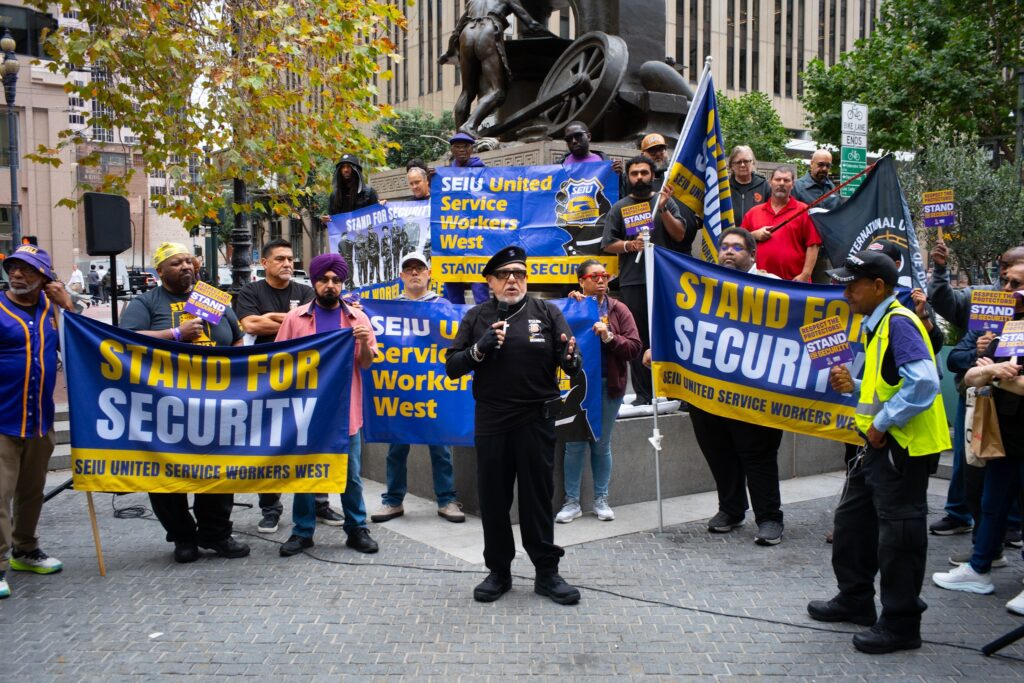
More than 100 people, unionized security guards and allies, gathered at Mechanics Monument Plaza Wednesday to rally against the unfair wages offered by billion-dollar companies.
Security guards from San Francisco to Silicon Valley, with the support of the Service Employees International Union United Service Workers West and allies, announced a strike authorization against companies like Allied Universal and Securitas, both huge national operations that contract with some of the richest companies in the world.
People at the rally chanted “protect the rich while we stay poor” and “hell no we won’t take it no more,” highlighting how employers treat the ones who protect and support their companies. Security officers say they are risking their lives to protect wealthy companies like Salesforce, OpenAI, Anthropic, Google, and Meta—which can easily afford to pay their contractors enough to provide a living wage for guards.
A vocal rally raised the issue of how little people get paid to protect exceptionally wealthy companies
According to UC Berkeley, security officers are mostly workers of color with 41 percent Latino and 23 percent Black. Security officers are paid a median of $20.09; California’s median wage is $28.16.
The 14,000 security guards represented by SEIU-USWW and have been negotiating with some of the nation’s security giants for a new contract since April. Security companies, the unions says, initially proposed a 25-cent hourly raise over the next four years. The latest offer is still not enough to make ends meet, the union says.
One of the security officers affected by the low wages is Jerry Longoria, a security guard of 25 years for Allied Universal. “We put our lives on the line. We guard and protect billion-dollar corporations,” said Longoria, who lives in an SRO. “I can barely afford my rent and for me to barely afford my rent and get this contract, how am I going to survive?”
Since 2003, Longoria has noted how he has only received a few 25-cent raises since he has been a security guard. “I can’t move forward,” said Longoria.
Speakers at the rally emphasized that the workers can’t afford to live where they work. “Security officers risk their lives every single day. This job is becoming more and more dangerous,” said Anton Farmby, secretary treasurer of SEIU-USWW.
“We cannot continue to live in such great wealth and live in poverty,” said David Huerta, president of SEIU-USWW.
Politicians came in support, including Board of Supervisors President Raphael Mandelman, Sup. (and Congressional candidate) Connie Chan, and state Assembly member Matt Haney. “Rain or shine, we will be with you,” said Chan.
Security officers are not only affected by bad wages. Only about half the security guards in California have access to health insurance, and have no access to health family care. They have no secure retirement.
Security officers have demanded as $30/hour, family healthcare, and to be able to have a secure retirement. “What we’re asking for is dignity, respect, and justice,” said Huerta.
A pair of Senate Democrats on Thursday launched an investigation into reports that the Trump administration is planning to weaponize the Internal Revenue Service against left-leaning nonprofits, targeting the tax-exempt status of groups seen as political enemies of the White House and potentially burying the organizations with huge penalties without adequate due process.
Sens. Ron Wyden (D-Ore.) and Raphael Warnock (D-Ga.) announced their inquiry in response to recent reporting by the right-wing New York Post, which reported late last month that US Treasury Secretary Scott Bessent and the IRS “could revoke the tax-free status of left-wing nonprofits such as George Soros’ Open Society Foundations, the Southern Poverty Law Center, and the Council on American-Islamic Relations.”
Wyden, the top Democrat on the Senate Finance Committee, and Warnock called the story “disturbing” and argued it suggests “political considerations—including the timing of the 2026 midterm elections—are influencing” the administration’s targeting of left-leaning nonprofits. The NY Post, which cited three unnamed sources familiar with the matter, reported that “Bessent’s inner circle is drafting a blueprint that could ultimately strip non-compliant organizations of their 501(c)(3) status.”
“The reviews could result in massive back payments and civil penalties,” the outlet added.
The Democratic senators noted in a letter to Bessent and Frank Bisignano, the chief executive of the IRS, that Section 7217 of the Internal Revenue Code prohibits senior executive branch officials from “directly or indirectly” requesting that the IRS conduct or terminate an investigation into any particular taxpayer.
“The New York Post’s reporting fits a wider pattern of the Trump administration actively using national security directives to weaponize the IRS against protected First Amendment speech,” Wyden and Warnock wrote, citing the presidential memorandum known as NSPM-7. “Rather than targeting actual violence, these directives explicitly conflate terrorism with subjective political viewpoints—such as ‘anti-capitalism,’ ‘anti-Christianity,’ and views on race, migration, and gender.”
Wyden and Warnock demanded that the Treasury Department and IRS turn over the reported “blueprint” crafted by Bessent’s inner circle as well as “all policies, directives, guidance, criteria, and other documents concerning Treasury and IRS implementation of NSPM-7 as it relates to tax-exempt organizations, including criteria for selecting organizations for examination or possible revocation.”
The senators also demanded to know whether any executive branch officials in the Trump administration have “identified or recommended” particular organizations—including any of those named in the Post report—for IRS investigation.
“Americans of every political persuasion must be able to trust that the IRS applies the tax code objectively under one set of rules,” Wyden and Warnock wrote. “Organizations that violate section 501(c)(3) should face appropriate enforcement regardless of their politics—and organizations should never face IRS scrutiny because political officials disapprove of their views.”
The senators launched their probe as two Democrats in the House of Representatives introduced legislation aimed at guaranteeing that the IRS can’t strip nonprofit organizations of their tax-exempt status “without evidence and without a fair process.”
Reps. Lloyd Doggett (D-Texas) and Terri Sewell (D-Ala.), the lead sponsors of the Protecting the Rights of Organizations Fairly (PROOF) Act, note that “under current law, many due process protections that are supposed to apply when the IRS examines most nonprofits exist only in the agency’s own internal manual—guidance the IRS can rewrite or suspend on its own authority through an internal memo with no public comment, no rulemaking, and no vote, and that carries no force of law.”
“The IRS should never be a weapon to punish a president’s political enemies,” Doggett said in a statement on Thursday. “No organization—left, right, or center—should lose its tax-exempt status on an accusation, without evidence, and without a fair chance to be heard.”
“The PROOF Act is simple,” he added. “If the government wants to take away a nonprofit’s status, it has to show its proof and follow the law. Today, it may be an organization to which the Trump regime objects. Tomorrow, it could be any of us.”
Our work is licensed under Creative Commons (CC BY-NC-ND 3.0). Feel free to republish and share widely.


 Robert Kuttner